Sand Calculator: Bedding Sand, Play Sand, and Fill — by the Bag or the Ton
One inch. That's all the bedding sand a paver patio gets — not two, not "a little extra to be safe." This is the single biggest thing a sand calculator has to get right, because the instinct people carry over from ordering gravel or topsoil — round the depth up — is exactly what ruins a patio. A 200-square-foot patio at a true 1 inch needs about 0.62 cubic yards, roughly 0.85 tons, or 33 fifty-pound bags. Pour it 2 inches deep instead and you've doubled the order, spent the money, and built a surface that ruts within a season.
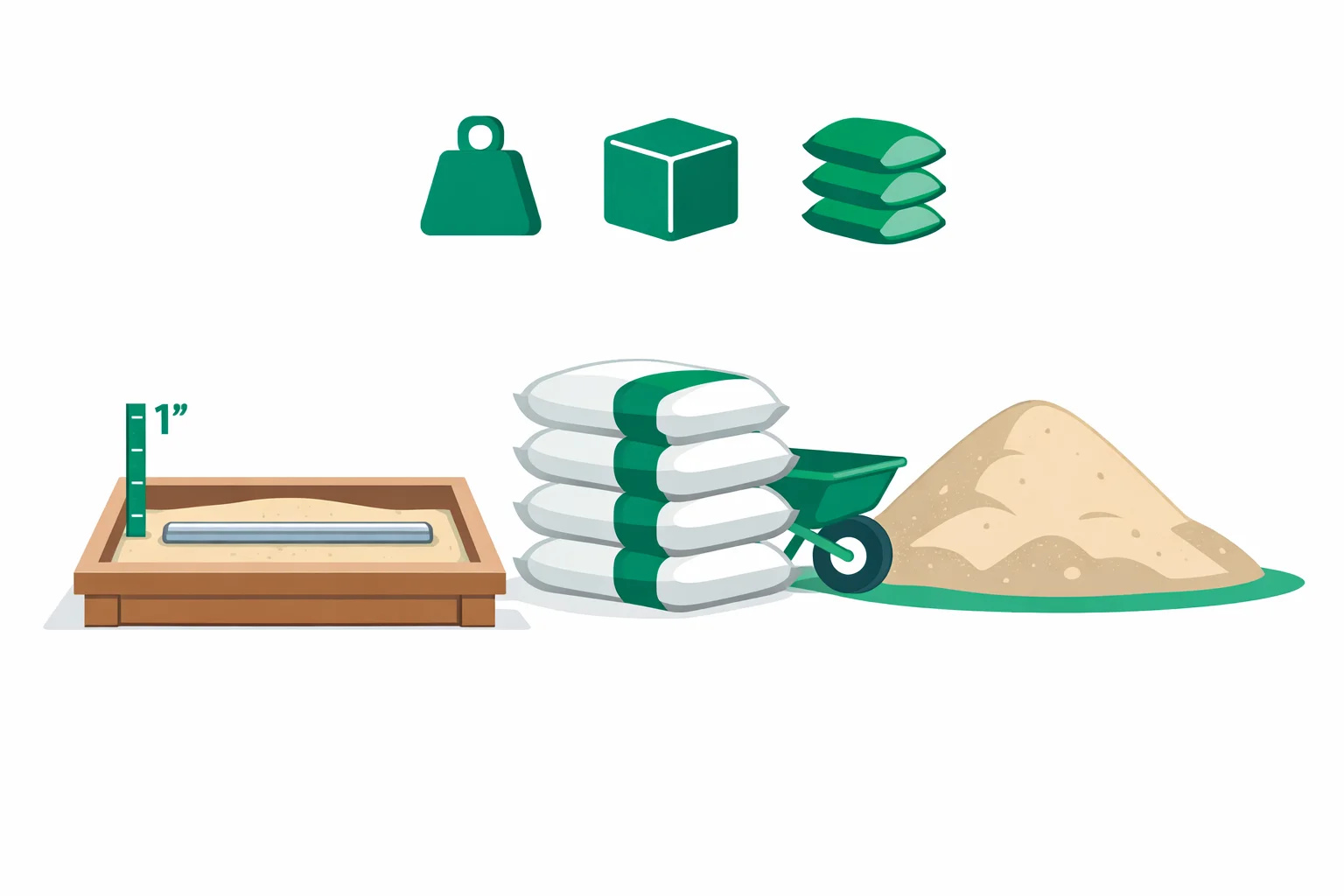
So a sand estimate is really two questions stacked together: how much sand, and which sand — because "sand" on a price board can mean five different products that aren't interchangeable. Get either wrong and the job either costs more than it should or quietly fails a year later. Here's how the math and the material actually work.
Why "Sand" Isn't One Product
The bin labeled "sand" at one supplier is coarse and sharp; at another it's fine and soft. The difference isn't branding — it's grain shape and size, and it decides whether your project holds or fails. The two traits that matter are angular vs. rounded and coarse vs. fine.
Angular, coarse sand — concrete sand and most paver bedding sand — has jagged grains that lock together under load. That's why it goes under pavers and into concrete. Rounded, fine sand — play sand, mason sand — pours soft and smooth, which is perfect for a child's hands and terrible under a patio, because rounded grains keep rolling and the pavers above them sink. Using play sand to bed pavers is the classic swap that looks fine on day one and dips by month twelve.
The One-Inch Rule for Paver Bedding
Bedding sand is not a base. It's a thin leveling course — a setting bed — that sits on top of a compacted gravel base and lets you seat each paver to a flat plane. The whole job of that sand is to take up the tiny differences between paver thicknesses. It only needs to be 1 inch, and it should never go past about 1.5 inches.
Here's the physics of why. Loose sand thicker than an inch compresses unevenly when weight rolls across it. A wheelbarrow, a patio table, a person stepping in the same spot — each presses the sand down a little, and because the layer is thick, that movement shows as ruts and low spots called birdbaths where water pools. Keep the sand at 1 inch over a properly compacted base — build that base with the gravel calculator — and there's not enough sand to move. The pavers ride on the gravel, and the sand just fills the gaps.
One more bedding rule that surprises people: you don't compact the sand before laying pavers. You screed it flat, lay the pavers directly on the loose sand, then run a plate compactor over the finished pavers to seat them. Compact the bedding first and you lose the loose layer that does the leveling.
Bags or Bulk? Where the Crossover Falls
Sand is the one bulk material most people genuinely buy both ways, so the bag-versus-bulk math is worth a minute. A 50-pound bag holds about 0.5 cubic feet, which means a cubic yard takes roughly 54 bags (27 cubic feet ÷ 0.5). At $6 a bag, that yard costs $324 in bags. The same yard in bulk runs about $45 in material — but you pay a delivery fee, usually $60 to $100, on top.
That sets up a clear crossover. For tiny jobs, bags win because you dodge the delivery fee. For anything past a third of a yard or so, bulk pulls ahead fast and never looks back:
| Job size | Bags (~$6 ea) | Bulk (+$80 delivery) | Cheaper |
|---|---|---|---|
| 0.1 yd³ (~5 bags) | $30 | $84 | Bags |
| 0.3 yd³ (~16 bags) | $96 | $94 | About even |
| 0.6 yd³ (~33 bags) | $198 | $108 | Bulk |
| 1 yd³ (~54 bags) | $324 | $125 | Bulk |
The decision framework is simple: under about 0.3 yard, buy bags— they're cleaner, you can carry them in a car, and you skip the fee. Over 0.3 yard, get a bulk delivery and the savings climb steeply. The calculator above runs your exact numbers and highlights the cheaper bar, so you can see where your job lands instead of guessing.
Sand for a 12×16 Paver Patio, Step by Step
Let's price a real patio: 12 feet by 16 feet, with a standard 1-inch bedding layer of coarse paver sand.
Step 1 — Area. 12 × 16 = 192 square feet.
Step 2 — Volume. 192 × (1 ÷ 12) = 16 cubic feet. Divide by 27 and you get 0.59 cubic yards.
Step 3 — Spillage. Add 10% for screed waste and uneven ground: 16 × 1.1 = about 17.6 cubic feet, or 0.65 cubic yards.
Step 4 — Bags or tons. In bags: 17.6 ÷ 0.5 = 36 fifty-pound bags. In bulk: 0.65 × 1.35 = about 0.88 tons.
Step 5 — Cost. Bags at $6 run $216. Bulk at $35 a ton is roughly $31 in sand, plus an $80 delivery — about $111 delivered. Bulk saves you around $105 here, and you skip hauling and splitting open three dozen bags. Don't forget the gravel base underneath: this patio also needs about 4 inches of compacted crusher run, a separate and much larger order.
How Much Play Sand a Sandbox Actually Takes
Play areas flip the depth math completely. Instead of 1 inch, a sandbox wants 6 to 12 inches of sand so kids can dig without hitting the bottom. That depth is why a small box swallows so many bags. A 5×5-foot sandbox filled to 12 inches needs 25 cubic feet — that's 50 fifty-pound bags, or just under a full cubic yard. Drop to a 6-inch play depth and it halves to 25 bags.
Material choice is non-negotiable here: use washed, screened play sandlabeled non-toxic, never mason or concrete sand. Construction sands can carry crystalline silica dust and sharper grains that aren't made for little hands. The U.S. Consumer Product Safety Commission's playground safety guidance treats loose fill like sand as a safety surface, so buy the product made for the job even though it costs a few dollars more per bag.
Mixing Concrete: Sand by Ratio, Not Depth
If you're mixing your own concrete, sand stops being a depth problem and becomes a ratio problem. The classic recipe is 1:2:3— one part cement, two parts sand, three parts gravel by volume. The sand here must be sharp concrete sand; fine play or mason sand weakens the mix because it doesn't bind with the aggregate the same way.
The counterintuitive part: the parts don't add up to the finished volume. Sand fills the gaps between the gravel, and cement paste fills the gaps in the sand, so a batch shrinks as it combines. In practice, one finished cubic yard of concrete needs about 0.45 to 0.5 cubic yards of concrete sand, roughly 0.66 yards of gravel, and around 6 bags of cement. If you're pouring a slab or footing, the concrete calculator handles the full mix, and the cubic yard calculator converts any raw dimensions into yards first.
Sand Types, Density, and Coverage Reference
Five sands cover almost every home project. Densities sit close together — all near 1.3 to 1.4 tons per cubic yard dry — but the grain and the job are what separate them. Prices are 2026 bulk ranges per ton, before delivery:
| Type | Density (t/yd³) | Bulk $/ton | Best for |
|---|---|---|---|
| Paver / bedding sand | 1.35 | $30–$45 | 1" setting bed under pavers — coarse, sharp |
| Concrete (sharp) sand | 1.35 | $32–$45 | Mixing concrete and mortar base — angular grains |
| Mason sand | 1.3 | $35–$50 | Mortar, pool bases, smooth fine fill |
| Play sand | 1.35 | $40–$55 | Sandboxes — washed, screened, non-toxic |
| Fill sand | 1.4 | $15–$30 | Backfill, leveling, raising low ground — cheapest |
A quick coverage rule for thin layers: one ton of sand covers about 80 square feet at 1 inch, or 40 square feet at 2 inches. It's a fast gut-check against whatever the calculator returns. That 2-inch mason-sand layer is also the leveling bed under an above-ground pool — once it's set and filled, the pool calculator sizes the water in gallons and the chemicals to treat it.
Sand Mistakes That Cost Real Money
- Treating sand as the base.Bedding more than 1 inch of sand to "save" on gravel is the costliest mistake — the patio ruts, and re-doing it means lifting every paver. The sand goes on top of a compacted gravel base, not instead of it.
- Buying bags for a big job. Thirty-six bags for a patio at $6 each is $216 plus an afternoon of hauling. The same sand in bulk is about $111 delivered — a $105 swing for one phone call.
- Wrong sand under pavers. Fine play or mason sand keeps migrating, so the surface dips within a year. Coarse, sharp concrete or bedding sand locks and stays put.
- Ignoring wet weight. Wet sand weighs 10 to 20 percent more than the dry density. Ordering by weight off a rained-on stockpile quietly shorts your volume — confirm dry vs. damp pricing.
Where This Estimate Stops
This calculator gives you loose-volume sand — cubic yards, tons, and bag count, plus the cheaper way to buy it. It assumes an even surface and a consistent depth. It doesn't know your supplier's minimum load, whether their sand runs heavier when damp, or how much an irregular or sloped area swallows beyond the 10% allowance.
For polymeric sand — the joint sand swept between finished pavers — use a different rule entirely: that's sold by coverage per bag based on joint width and paver thickness, not by depth, so follow the bag's coverage chart. If you're bedding a patio, the paver calculator sizes the pavers, base, bedding sand, and joint sand together. And if you're still mapping out an irregular patio, the square footage calculator nails down the area first, before you convert it to sand. Measure the area, hold the bedding at a true 1 inch, and buy by whichever column the calculator says is cheaper.