Paver Calculator: The Full Materials List for a Patio, Not Just the Stones
On a $1,400 paver patio, the pavers themselves are about $860 — and everything under and around them is the other $540. That ratio is the whole reason a paver calculator that only counts stones leaves you short at the register. Count the pavers and you've answered maybe half the question. The base gravel, the inch of bedding sand, the polymeric sand swept into the joints, and the plastic edge restraint around the rim are what actually make the patio last — and together they often cost as much as the pavers.
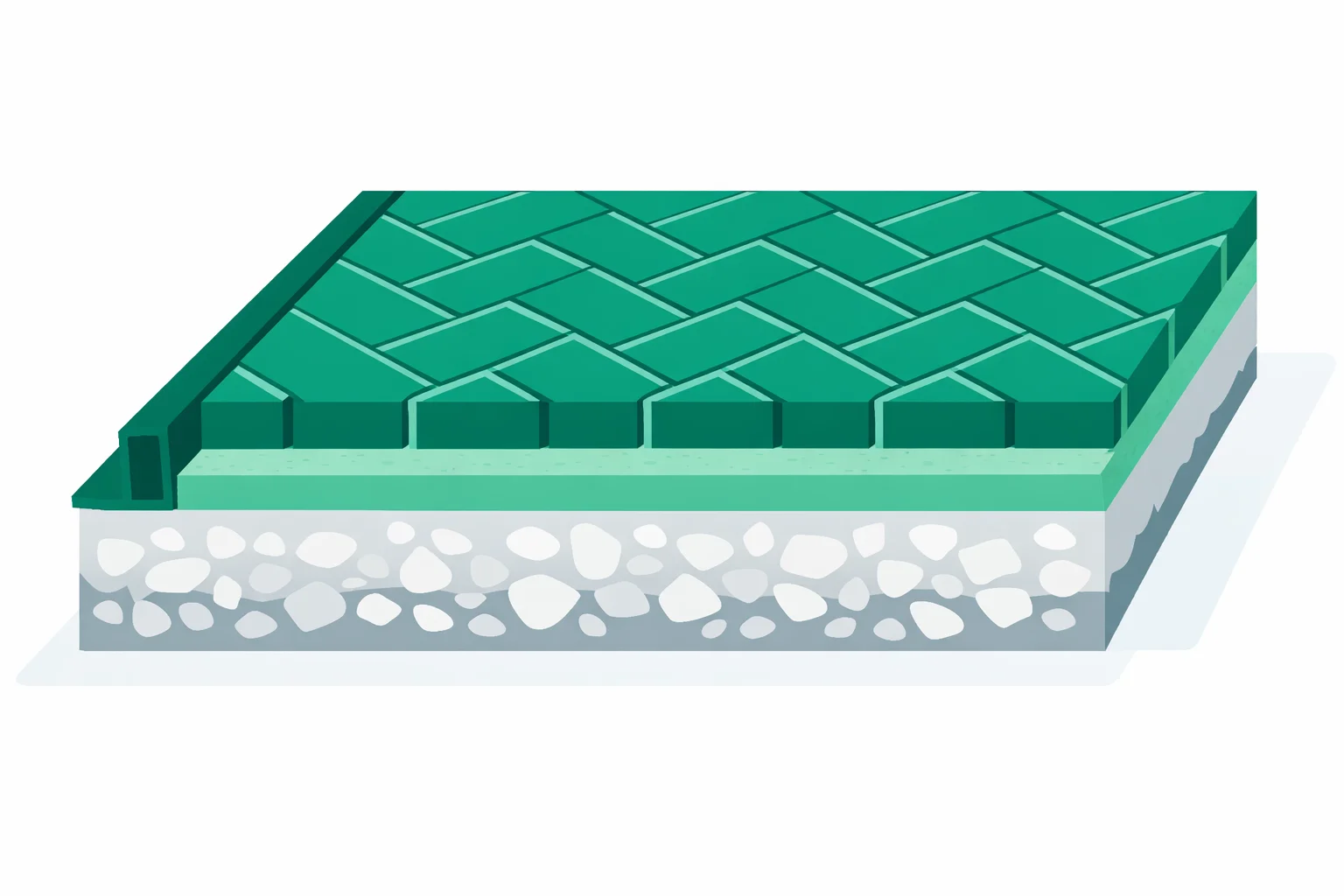
So this tool counts pavers andbuilds the full shopping list beneath them. Below, I'll show how pavers-per-square-foot actually works, why your laying pattern changes the order by 50-plus stones, and how to size the base layers that do the real structural work. Those numbers are what separate a patio that's flat in ten years from one that ripples after a single winter.
Pavers Are the Cheap Part: A Real Cost Breakdown
Here's a 200-square-foot patio, priced line by line at mid-2026 material rates. The pavers are 6×9 Holland stones at about $4.50 a square foot. Everything else is the support system:
| Material | Quantity | Cost |
|---|---|---|
| Pavers (incl. 5% cuts) | ~560 pcs / 210 sq ft | $945 |
| Base gravel, 4" compacted | ~4 tons | $160 |
| Bedding sand, 1" | ~37 bags | $110 |
| Polymeric joint sand | ~3 bags | $90 |
| Edge restraint | ~60 ft | $150 |
| Total materials | ~$1,455 |
The pavers are 65% of the bill here — but on a small walkway with a deep base, or a driveway, the support layers pull even or ahead. The point isn't the exact split. It's that any estimate which stops at the paver count is missing a third to a half of the real cost. Fold the base gravel and bedding sand into the plan before you fall in love with a paver price per square foot.
How Many Pavers Per Square Foot?
The formula is one division: 144 ÷ the paver's area in square inchesgives pavers per square foot. A 6×9 paver covers 54 square inches, so 144 ÷ 54 = 2.67 pavers per square foot. Multiply that by your patio's square footage and you have the bare cover count — before any waste.
Paver size swings that count hard. Small brick pavers pack tighter, so you buy more of them; big-format pavers cover faster:
- 4×8 brick: 32 sq in → 4.5 per sq ft → 900 for a 200 sq ft patio
- 6×9 Holland: 54 sq in → 2.67 per sq ft → 534 pavers
- 12×12: 144 sq in → exactly 1 per sq ft → 200 pavers
One thing the math hides: pavers are sold with the joint built into the quoted size, so a "6×9" lays a hair larger than 6 by 9 once you count the 1/8-inch gap. The 144-divided-by-area rule already lands within a percent or two of reality, which is exactly why a small waste factor on top covers the difference cleanly.
Why Your Pattern Decides Your Waste
Two patios, identical size, identical pavers — order 50 different stones apart purely because of how the pavers are turned. A straight running bond trims pavers only where the field meets the edge. A 45-degree herringbone cuts a wedge at everyborder paver, and a circular layout cuts almost continuously around the curve. That's the waste factor, and getting it wrong is the most common reason a job comes up short mid-lay.
| Pattern | Cut waste | Extra on 534 pavers |
|---|---|---|
| Running bond / straight | 5% | +27 pavers |
| Basketweave | 8% | +43 pavers |
| Herringbone 90° | 10% | +54 pavers |
| Herringbone 45° | 15% | +80 pavers |
| Circular / curved | 20% | +107 pavers |
A habit worth keeping: buy the waste, then buy a handful beyond it and stash them. Pavers fade in the sun, and a dye lot from next spring won't match — so the spares you set aside today are the only way to swap a cracked paver in five years and have it blend in.
The Layers Under a Paver — and Why They're the Real Job
A finished paver surface is three layers, and the pavers are the thinnest structural part of it. From the bottom up: a compacted gravel base, a screeded inch of bedding sand, then the pavers. Get the bottom two right and the top one practically installs itself.
Base graveldoes the load-bearing. A patio wants 4 to 6 inches of compacted crushed stone — crusher run, the kind with stone dust that locks up tight. A driveway carrying a car needs 8 to 12. And you order about 20% more than the finished depth, because tamping a 5-inch loose lift packs it down to roughly 4. The American Concrete Institute's guidance on pavements and their bases reinforces what an installer learns fast: the surface is only as stable as what's compacted underneath it.
Bedding sandis the leveling course, and it's always a true 1 inch — never thicker. It's coarse, sharp sand screeded flat, and the pavers sit directly on it. Size that layer with the sand calculator, which also weighs bags against a bulk delivery. Bed thicker than an inch to "fix" a rough base and the sand ruts and the patio dips — the real fix is fixing the base, not piling on sand.
Worked Example: A 12×16 Herringbone Patio
Let's build the whole list for a real patio: 12 by 16 feet, 6×9 Holland pavers, laid in a 45-degree herringbone over a 4-inch base.
Step 1 — Area and perimeter. 12 × 16 = 192 square feet. Perimeter is 2 × (12 + 16) = 56 linear feet.
Step 2 — Pavers. 192 × 2.67 = 513 to cover. The 45° herringbone carries 15% waste: 513 × 1.15 = 590 pavers.
Step 3 — Base gravel.192 × (4 ÷ 12) = 64 cubic feet, plus 20% for compaction = 76.8 cubic feet, or 2.85 cubic yards. At about 1.5 tons per yard, that's 4.3 tons of crusher run.
Step 4 — Bedding sand.192 × (1 ÷ 12) = 16 cubic feet, plus 10% = 17.6. At 0.5 cubic feet a bag, that's 36 fifty-pound bags — or order it in bulk if a yard works out cheaper.
Step 5 — Polymeric and edging. Roughly 3 bags of polymeric sand for 192 square feet of 6×9 joints, and 56 feet of edge restraint — about 9 sections of plastic edging. Total materials land near $1,300 to $1,500 depending on the paver you pick. Working with an odd-shaped area first? Run it through the square footage calculator before you start counting pavers.
Edge Restraint: The $40 Part That Saves the Patio
Skip the edge restraint and you'll likely rebuild the perimeter within three seasons. The mechanism is simple: every time someone steps on or rolls a load across the patio, the pavers push outward a fraction of an inch. Interior pavers hold each other in place, but the outer row has nothing on its far side — so it slowly migrates outward, the joints open, weeds settle in, and the whole field loosens from the edge inward.
Edge restraint — usually rigid plastic edging spiked into the compacted base with 10-inch spikes — pins that outer row. It runs about $2 to $3 a linear foot installed, so the 56 feet around our example patio is roughly $40 to $60 in plastic plus spikes. Against a house wall or an existing slab you don't need it; that structure already restrains the edge. Run it on every open side, though — it's the cheapest part of the build and it protects everything above it.
Polymeric Sand vs. Regular Joint Sand
People mix up the two sands constantly, so let's be clear: bedding sand is the loose inch the pavers sit on, and joint sandis swept into the gaps between pavers after they're down. Different products, different jobs, different stages of the build.
For the joints, you choose between plain masonry sand and polymeric sand. Plain sand is cheap but washes out in heavy rain and lets ants and weeds settle in — you'll re-sweep it every season. Polymeric sand carries a binder that hardens when you mist it with water, setting like a flexible mortar that resists washout, weeds, and insects. It costs more — about $25 to $35 a bag versus $6 for plain sand — but on a patio you walk and furnish, it earns its price. The one rule: sweep it in bone-dry, blow every grain off the paver faces, thenmist. Polymeric haze that cures on the paver surface is a stain you can't scrub off.
Paver Size and Coverage Reference
Pavers per square foot for the common footprints, with the count for a 200-square-foot patio before waste. Keep this nearby when you compare prices — a cheap-looking small paver just means you buy a lot more of them:
| Paver size | Area (sq in) | Per sq ft | For 200 sq ft |
|---|---|---|---|
| 4" × 8" brick | 32 | 4.50 | 900 |
| 6" × 6" | 36 | 4.00 | 800 |
| 6" × 9" Holland | 54 | 2.67 | 534 |
| 8" × 8" | 64 | 2.25 | 450 |
| 12" × 12" | 144 | 1.00 | 200 |
| 12" × 24" plank | 288 | 0.50 | 100 |
Paver Mistakes That Cost a Second Order
- Skimping the base. A 2-inch base under a patio is the number-one failure. It frost-heaves and ruts, and the only fix is lifting every paver and rebuilding the base — a full redo to save $80 of gravel.
- Underbuying for the pattern. Ordering a straight-bond count and then laying herringbone leaves you 50+ pavers short, and the new batch may not color-match. Match the waste factor to the pattern before you order.
- Bedding sand over an inch. Thick bedding sand compresses unevenly and creates birdbaths where water pools. Hold it to a true 1 inch over a flat, compacted base.
- Polymeric haze.Misting the joints before blowing the paver faces clean leaves a cloudy film bonded to the surface. On a $1,400 patio, that's a permanent stain from rushing the final step.
Where This Estimate Stops
This calculator gives you material quantities and a material-cost estimate — pavers, base, sand, joint sand, and edging. It assumes a roughly level, well-drained site and standard 60mm pavers. It doesn't price labor, excavation, or hauling away the dirt you dig out, and it doesn't size drainage for a low or wet yard, which may need a thicker base or a perforated drain pipe.
It also assumes a single elevation. Steps, retaining walls, a slope you have to terrace, or permeable pavers over an open-graded reservoir base all change the base spec and the math. For those, treat this as the starting list and add the structural pieces separately. Measure the area carefully, match the waste factor to your pattern, and never let anyone talk you into a thinner base than the surface above it deserves.