Concrete Calculator: How to Order the Right Amount for Slabs, Footings, and Foundations
A concrete calculator takes the guesswork out of ordering the right amount of material for slabs, footings, columns, and steps. Whether you're pouring a 10×10 patio pad or a full foundation, the math is straightforward — but the consequences of getting it wrong are expensive. Order too little and you'll get a cold joint that compromises the entire pour. Order too much and you're paying $150+ per extra yard for material you'll need to dispose of. This guide walks through the formula, shows you a real worked example, and covers the most common mistakes that cost homeowners and contractors money every pour season.
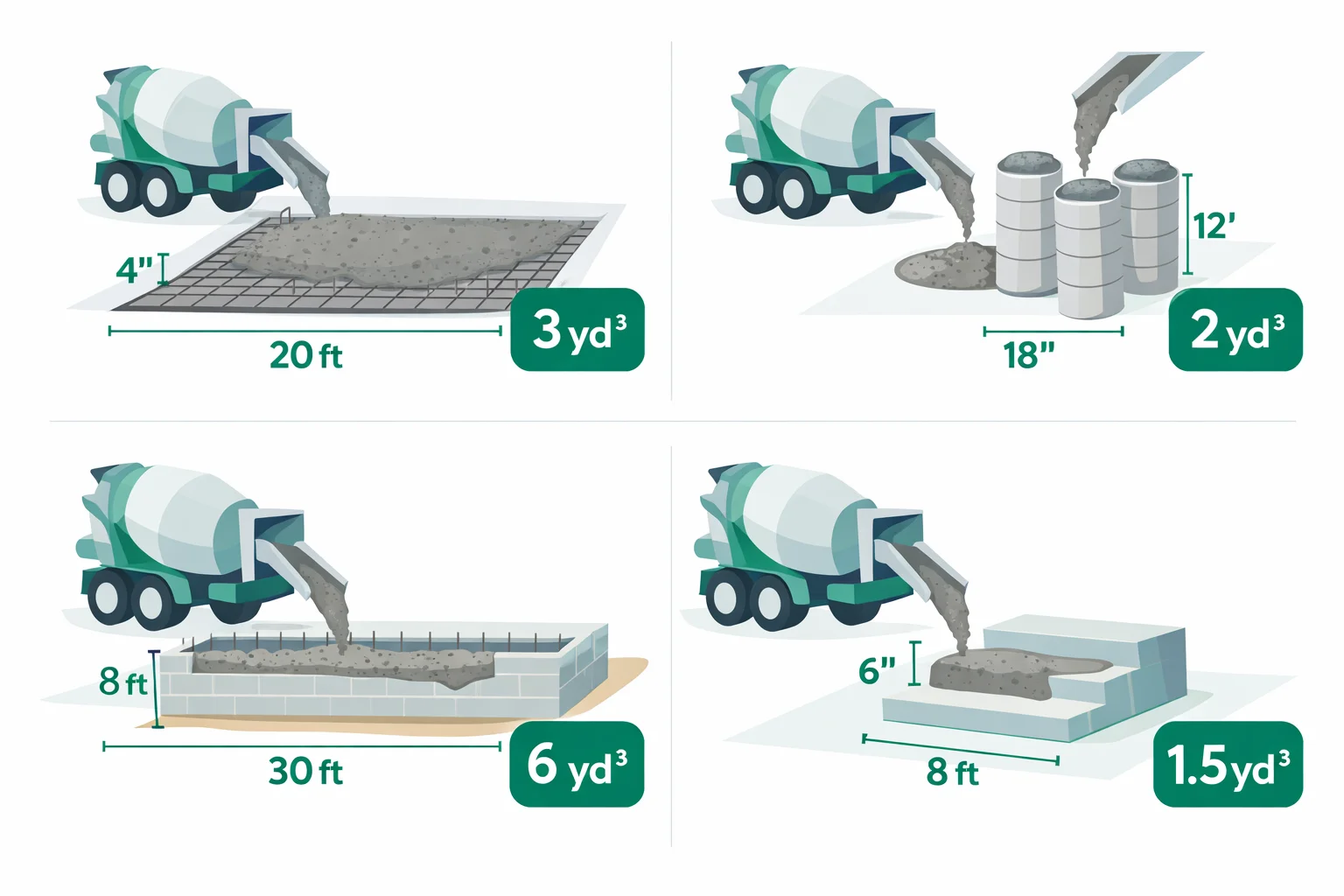
What Is a Concrete Calculator?
It's a tool that converts your project dimensions — length, width, and thickness — into the exact volume of concrete you need, expressed in cubic yards. One cubic yard equals 27 cubic feet, and it's the standard ordering unit for ready-mix trucks in the US. The calculator above goes a step further: it tells you how many bags you'd need for a hand-mix job, estimates cost for both options, and factors in waste so you don't end up short.
Most concrete suppliers won't deliver less than 1 yard, and many charge a short-load fee ($30-75) for orders under 3-5 yards. Knowing your exact volume before you call for a quote saves you from overpaying or making an embarrassing second call mid-pour.
The Concrete Volume Formula
The base formula for any rectangular pour is simple:
Volume (cu ft) = Length (ft) × Width (ft) × Thickness (ft)
Then divide by 27 to convert to cubic yards. The tricky part? Thickness is almost always given in inches. A 4-inch slab means 4 ÷ 12 = 0.333 feet. Forgetting this conversion is the single most common concrete ordering mistake — it inflates your order by 12× the correct amount.
For cylindrical pours like sonotube piers or column footings, the formula changes to:
Volume (cu ft) = π × (Diameter/2)² × Height
where all measurements are in feet. A 12-inch diameter tube that's 3 feet deep holds about 2.36 cubic feet — roughly four 80lb bags of concrete.
Worked Example: 20×24 Driveway Pour
Let's walk through a typical two-car driveway: 20 feet wide, 24 feet long, 5 inches thick (the minimum recommended thickness for vehicle traffic).
Step 1: Convert thickness.5 inches ÷ 12 = 0.417 feet.
Step 2: Calculate volume.20 × 24 × 0.417 = 200 cubic feet.
Step 3: Convert to yards.200 ÷ 27 = 7.41 cubic yards.
Step 4: Add waste.7.41 × 1.10 = 8.15 cubic yards. Round up to 8.5 yards when ordering from a ready-mix plant.
At $155 per yard, that's about $1,318 for material. Compare that to 80lb bags: you'd need roughly 367 bags at $5.50 each — $2,019 total, plus an entire weekend of mixing. For anything over 2-3 cubic yards, the ready-mix truck wins on both cost and quality.
Need to calculate the area before you figure concrete volume? Our square footage calculator handles irregular shapes and multi-room layouts. Pouring pier footings for a deck? Our deck calculator counts the footings and bags alongside the decking and framing.
Bags vs. Ready-Mix: Which Is Right for Your Project?
The crossover point sits around 1-2 cubic yards. Below that, bags are cheaper and don't require coordinating a truck delivery. Above that, ready-mix is cheaper per yard, faster to place, and produces a more consistent product because the plant controls the water-cement ratio.
Here's the real comparison most guides skip: mixing bags isn't just about money. An 80lb bag takes 3-5 minutes to mix in a wheelbarrow and yields 0.6 cubic feet. At that rate, mixing 1 cubic yard (45 bags) takes a strong person 3-4 hours of continuous physical labor. A ready-mix truck delivers 10 yards in 10 minutes. Factor in your time — especially if you're paying helpers — and the ready-mix option is almost always the smarter call for pours above 1.5 yards.
For small projects like setting fence posts or pouring individual pier footings, bags are the obvious choice. You can mix exactly what you need, when you need it, without worrying about a truck's 45-minute unload window.
Concrete Cost Reference Table
Costs vary by region and mix design. The table below shows typical 2026 pricing for standard residential concrete.
| Option | Cost per Cubic Yard | Best For |
|---|---|---|
| 80lb bags (hand mix) | $248 (45 bags × $5.50) | Under 1 cu yd — posts, piers, small pads |
| 60lb bags (hand mix) | $270 (60 bags × $4.50) | When 80lb bags are too heavy to lift |
| Ready-mix (3,000 PSI) | $140-165 | Patios, sidewalks, non-vehicle slabs |
| Ready-mix (4,000 PSI) | $155-185 | Driveways, garage floors, footings |
| Ready-mix (5,000 PSI) | $170-210 | Structural foundations, heavy loads |
| Short-load fee | $30-75 per yard under minimum | Orders under 3-5 yards (varies by company) |
These prices cover material only. Pour labor runs $3-8 per square foot depending on complexity. For slab-specific projects like patios and driveways, our concrete slab calculator adds reinforcement quantities and gravel base estimates on top of the yardage. Need to figure out how much rebar to order separately? Our rebar calculator gives you exact linear feet, piece counts, and weight for any bar size and spacing. For a full project estimate including framing, drywall, and roofing alongside your foundation, try our construction calculator.
Waste Factors: How Much Extra to Order
Every concrete pour needs extra material. The question is how much. Here's what experienced contractors actually use:
- 5% waste: Simple rectangular slabs on flat, well-prepared ground with professional formwork
- 10% waste (standard): Most residential projects — patios, driveways, sidewalks, footings on reasonably level ground
- 15% waste: Irregular shapes, sloped ground, first-time DIY pours, or any project with hand-built forms that might flex under pressure
- 20%+ waste: Stepped foundations, curved walls, or pours over rocky/uneven subgrade where ground absorption is a factor
Ground absorption is the variable most people miss. If you're pouring on compacted gravel over clay, you'll lose almost nothing. Pouring directly on sandy or loose soil? The ground can absorb 5-10% of your concrete before the forms even start to fill. A 6-mil vapor barrier under the pour eliminates this problem entirely and costs about $0.10 per square foot.
Common Concrete Ordering Mistakes
These mistakes cost homeowners and contractors real money. Every one of them is avoidable.
- Measuring in inches but calculating in feet. Entering "4" for a 4-inch slab thickness without dividing by 12 gives you a volume 12 times too large. At $155/yard, that's ordering $1,860 of concrete instead of $155. The calculator above handles this conversion automatically.
- Forgetting the waste factor. Ordering the exact calculated amount means any imperfection in your forms, any slight slope in the ground, or any spillage during the pour leaves you short. A cold joint from running out of concrete mid-pour creates a structural weak point that can crack within the first winter.
- Not accounting for footing depth below the slab. A garage slab isn't just 4 inches thick — the perimeter footing is typically 12-18 inches deep and 12-16 inches wide. Those footings can add 1-3 cubic yards to a project that looks like 6-8 yards on paper.
- Ordering on Friday afternoon. Ready-mix plants run on tight schedules. Friday afternoon orders often get bumped to the following week, and same-day requests may incur express delivery fees of $50-100. Call 2-3 days in advance and confirm the delivery window.
How Thick Should Your Concrete Be?
Thickness depends entirely on what the slab needs to support. The IRC building code sets minimums, but practical experience often calls for more.
| Application | Min. Thickness | Recommended | Extra Concrete per 100 sq ft |
|---|---|---|---|
| Sidewalk / path | 3.5" | 4" | 0.06 cu yd per extra inch |
| Patio | 3.5" | 4" | 0.06 cu yd per extra inch |
| Driveway (cars) | 4" | 5" | 0.06 cu yd per extra inch |
| Driveway (trucks/RVs) | 5" | 6" | 0.06 cu yd per extra inch |
| Garage floor | 4" | 4-6" | 0.06 cu yd per extra inch |
| Shed / workshop | 4" | 4" | 0.06 cu yd per extra inch |
Going from 4 to 6 inches adds 50% more concrete volume but roughly doubles load capacity. For a 20×24 driveway, that's the difference between 5.9 and 8.9 cubic yards — about $465 more in material, but it'll handle a loaded pickup truck without cracking over time. If concrete's price tag has you reconsidering, an asphalt driveway covers the same area for roughly 40-50% less upfront — though it requires sealcoating every few years.
Tips for Ordering Concrete
Twenty years of pouring has taught me a few things that don't show up in any textbook. Here's what actually matters on pour day:
- Round up, not down. If you calculate 5.3 yards, order 5.5 or 6. The cost of 0.5 extra yards ($75-80) is nothing compared to a short-load fee plus a cold joint repair. You can always pour the extra into a small stepping stone mold or a post base.
- Get your forms perfect before the truck arrives. A ready-mix truck holds 8-10 yards and needs to unload within 90 minutes of batching. You won't have time to fix a form that blows out mid-pour. Brace every 3-4 feet with stakes, especially on longer runs.
- Know your site access. A full concrete truck weighs 60,000-70,000 pounds. It needs a path at least 10 feet wide with no overhead obstructions under 14 feet. If the truck can't reach the pour site, you'll need a concrete pump ($200-500 extra) or wheelbarrow crews.
- Check the weather forecast. Concrete shouldn't be poured when temperatures drop below 40°F within 24 hours or above 90°F during placement. Rain during finishing ruins surface quality. Schedule your pour for a mild, dry day — even if it means waiting a week.
- Have help ready. Moving and finishing concrete is a team sport. One person can't pour, screed, and finish a slab larger than about 50 square feet. For a driveway, you need a minimum of 3 people: one moving concrete, one screeding, and one floating.
If your project involves converting between cubic yards and cubic feet for gravel, fill, or other bulk materials, our cubic yard calculator handles those conversions with support for any shape. Mixing your own batch by the 1:2:3 ratio? Our sand calculator estimates the sharp concrete sand each yard of mix needs.
When to Use This Calculator
- Before calling a ready-mix supplier — know your exact yardage so you can get an accurate phone quote and avoid short-load fees.
- Planning a DIY weekend project — figure out how many bags to buy for a small pad, fence post holes, or a set of front steps. Setting a fence? Our fence post calculator counts the posts and concrete bags for the whole run, and our Quikrete calculator tells you exactly how many 40, 60, or 80 lb bags to grab.
- Comparing bids from contractors — if a contractor quotes 12 yards for your driveway but the calculator says 8.5, that's either a generous waste factor or an inflated estimate. Either way, you'll know enough to ask the right question.
- Multi-part projects — combine a driveway slab, walkway, and porch steps in a single calculation to order one truck instead of three separate deliveries.
- Estimating footing pours under block walls — calculate the footing volume, then use our concrete block calculator to size the CMU order for the wall that sits on top.