Cubic Yard Calculator: How to Convert Dimensions to Yards for Material Orders
A cubic yard calculator converts your project's length, width, and depth measurements into the exact number of cubic yards you need to order. Whether you're pouring a concrete driveway, spreading mulch across garden beds, or filling a gravel path, ordering the wrong amount wastes money — too little means a second delivery fee, and too much leaves a pile in your driveway. This guide walks you through the formula, shows worked examples for real projects, and gives you the reference tables contractors rely on to get material orders right the first time.
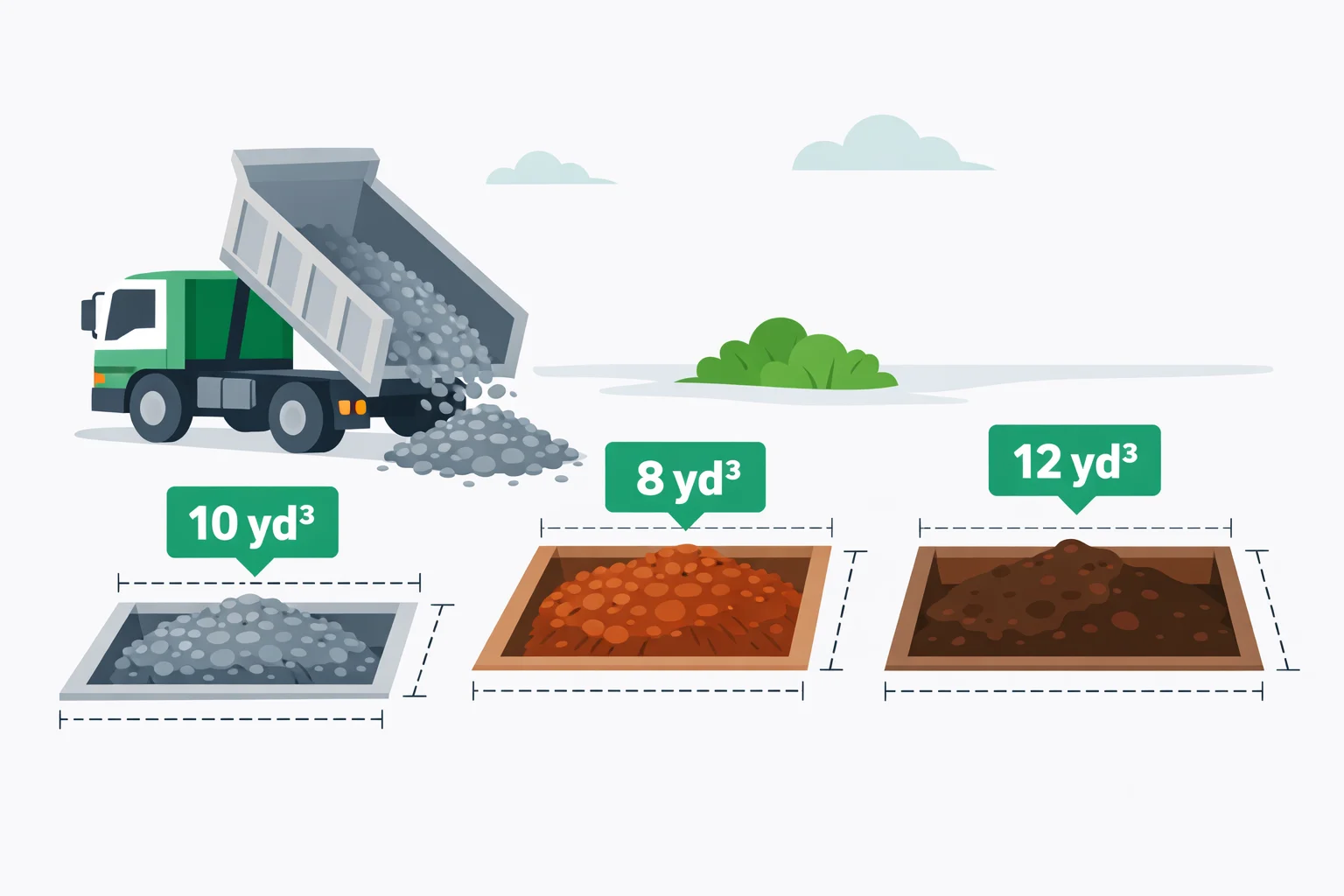
What Is a Cubic Yard?
A cubic yard is a unit of volume equal to a cube that measures 3 feet on every side — 3 feet long, 3 feet wide, and 3 feet tall. That works out to 27 cubic feet of space. In construction and landscaping, bulk materials like concrete, gravel, mulch, topsoil, and sand are sold by the cubic yard because it's a practical quantity for truck and trailer loads.
One cubic yard of material is roughly the size of a standard kitchen oven or a large washing machine. A full-size dump truck carries 10 to 14 cubic yards, and a pickup truck bed holds roughly 2 to 3 cubic yards depending on how high you load it. Knowing this helps you plan delivery logistics — if your project needs 6 cubic yards of gravel, that's one dump truck load, not three separate pickup runs.
The Cubic Yard Formula Step by Step
The formula for calculating cubic yards is straightforward — you just need three measurements:
Cubic Yards = (Length × Width × Depth) ÷ 27
All three measurements must be in the same unit. Since most people measure length and width in feet but depth in inches, the most common version of the formula is:
Cubic Yards = Length (ft) × Width (ft) × Depth (in) ÷ 324
Where does 324 come from? Dividing depth in inches by 12 converts it to feet, then dividing by 27 converts cubic feet to cubic yards: 12 × 27 = 324. This shortcut saves a step when your depth is in inches. If you need to convert results to other units, use our volume calculator for cubic feet, gallons, liters, and more.
Worked Examples for Common Projects
Example 1: Concrete patio slab (10 × 12 feet, 4 inches deep)
10 × 12 × 4 ÷ 324 = 1.48 cubic yards. With a 10% waste factor, order 1.63 cubic yards. Most ready-mix companies sell in 0.25-yard increments, so you'd order 1.75 cubic yards. At $125–$175 per yard for ready-mix concrete, budget $219–$306 for materials. For rebar spacing, gravel base tonnage, and a full cost breakdown, try our concrete slab calculator. For a detailed bags-vs-truck comparison with cost estimates, try our concrete calculator. If your project is small enough for bagged mix, the Quikrete calculator shows bag counts for 40, 60, and 80 lb sizes. Ordering bulk sand for paver bedding or fill instead? The sand calculator converts the same volume into tons and 50-lb bags.
Example 2: Gravel driveway (20 × 40 feet, 3 inches deep)
20 × 40 × 3 ÷ 324 = 7.41 cubic yards. Add 10% waste: 8.15 cubic yards. At roughly 2,800 lbs per cubic yard, that's about 22,800 lbs (11.4 tons) — a single dump truck delivery. Gravel costs $30–$65 per cubic yard, so expect to pay $245–$530. Since quarries price by weight, our gravel calculator converts this volume straight to tons by stone type and adds a compaction allowance for base layers.
Example 3: Mulch for landscaping beds (three beds totaling 200 sq ft, 3 inches deep)
When you have the total square footage already, use this shortcut: 200 × 3 ÷ 324 = 1.85 cubic yards. Add 5%: about 1.95 cubic yards. Round up to 2 cubic yards. You can calculate the square footage of each bed first with our square footage calculator, then plug the total into this formula. For mulch specifically, our mulch calculator adds depth presets and a bulk-vs-bagged cost comparison so you can see whether a delivery or a carload of bags is cheaper. Filling beds or grading instead? The soil calculator adds soil-type weights, a settling factor, and tonnage so you know if a load will even fit in your truck.
Material Weight and Coverage Reference Table
Different materials vary dramatically in weight per cubic yard. This affects delivery costs (charged by weight or distance), vehicle requirements, and the number of truckloads you need.
| Material | Lbs per Cubic Yard | Tons per Cubic Yard | Cost Range per CY |
|---|---|---|---|
| Concrete (ready-mix) | 3,700 | 1.85 | $125 – $175 |
| Gravel / Crushed stone | 2,800 | 1.40 | $30 – $65 |
| Sand | 2,700 | 1.35 | $30 – $60 |
| Topsoil | 2,200 | 1.10 | $25 – $55 |
| Fill dirt | 2,000 | 1.00 | $10 – $30 |
| Compost | 1,400 | 0.70 | $30 – $60 |
| Mulch (wood chips) | 800 | 0.40 | $25 – $50 |
Prices reflect material cost only and vary by region. Delivery typically adds $50–$150 per truckload depending on distance. Wet materials weigh 20–30% more than the dry weights listed above.
How Much Material to Order: Waste Factors by Type
Always order more than the exact calculated amount. Uneven subgrade, compaction, spillage during placement, and imprecise measurements all consume material. Here are the waste factors experienced contractors use:
- Concrete: Add 10% — uneven forms and subgrade eat volume. A 2-cubic-yard pour should be ordered as 2.2 cubic yards.
- Gravel and crushed stone: Add 10–15% — loose material compacts 10–15% after traffic and rain.
- Mulch: Add 5–10% — mulch settles 15–25% within the first year as it decomposes, but initial waste from spreading is low.
- Topsoil and compost: Add 10% — organic material compresses when watered and settles into uneven ground.
- Sand: Add 5–10% — sand compacts about 10% and migrates into surrounding soil at the edges.
The cheapest mistake in material ordering is having a small surplus. A second delivery of 0.5 cubic yards might cost $200+ just for the truck — more than the material itself. When in doubt, round up.
Cubic Yards vs. Cubic Feet: When to Use Each
Cubic yards and cubic feet measure the same thing — volume — but at different scales. One cubic yard equals 27 cubic feet. In practice:
- Use cubic yards when ordering bulk delivery of gravel, concrete, soil, mulch, or sand. Suppliers price and deliver by the cubic yard.
- Use cubic feet when buying bagged materials at a hardware store. A standard bag of mulch is 2 cubic feet, and a bag of concrete mix is typically 0.6 cubic feet. To find how many bags you need, use our cubic feet calculator to get the total cubic feet, then divide by the bag size.
Quick conversion: 1 cubic yard = 27 cubic feet = 201.97 US gallons = 764.55 liters. The yard has been defined as exactly 0.9144 meters since 1959, so every figure in that chain is exact rather than rounded — see NIST Special Publication 811 for the full conversion tables. For concrete, 1 cubic yard equals about 45 standard 80-lb bags of concrete mix.
Common Mistakes When Calculating Cubic Yards
- Mixing inches and feet:Entering a 4-inch depth as "4" when the calculator expects feet gives you 12 times too much material. A $300 mulch order becomes $3,600. Always check your units before ordering.
- Forgetting to add waste:Ordering exactly 3.00 cubic yards of gravel means you'll run short after compaction. Order 3.3–3.45 cubic yards instead, saving yourself a $150+ second delivery fee.
- Treating irregular areas as simple rectangles: An L-shaped driveway needs to be split into two rectangles calculated separately and added together. A single length × width measurement overestimates the area and wastes material.
- Ignoring compaction: Gravel compacts 10–15% after installation. A 3-inch gravel base will settle to 2.5–2.7 inches without overfilling. Factor this into your depth before calculating.
Tips for Accurate Yardage Estimates
- Measure depth in multiple spots.Ground is rarely perfectly level. Take 3–5 depth readings across your area and use the average. A slab site that varies from 3" to 5" should be calculated at 4" depth, not 3".
- Break complex shapes into rectangles.An L-shaped patio, a curved garden bed, or a tapered walkway can all be approximated as the sum of 2–3 simple rectangles. Use the "Add Another Area" feature in the calculator above.
- Confirm with your supplier. Tell them your calculated cubic yards AND your project dimensions. Good suppliers will double-check your math and may suggest a slightly different amount based on the specific material grade.
- Account for subgrade preparation.If you need to dig out 2 inches of existing soil before laying 4 inches of gravel, you're effectively filling 4 inches, not 2. Measure from the bottom of the prepared subgrade to the finished surface.
- Convert bag counts to cubic yards for comparison. A 2-cubic-foot bag of mulch at $4.50 means 13.5 bags per cubic yard — that's $60.75 per cubic yard in bags vs. $25–$50 bulk delivered. Bulk delivery almost always wins for projects over 2 cubic yards.
When to Use This Calculator
- Before ordering bulk delivery: Calculate exact cubic yards for concrete, gravel, mulch, topsoil, or sand so you order the right amount and avoid expensive second deliveries.
- Planning a landscaping project: Estimate how much mulch, soil, or compost you need for garden beds, raised planters, and lawn leveling — especially for multiple areas with different depths.
- Budgeting for construction: Get material cost estimates before the project starts. Knowing you need 5 cubic yards of gravel at $30–$65/yard tells you to budget $150–$325 for that line item. For a full material takeoff across all building phases, our construction calculator combines concrete, framing, drywall, and roofing estimates in one pass.
- Comparing bulk vs. bagged pricing: Convert your cubic yard total to bags (divide cubic feet by bag size) and compare the per-yard cost of bulk delivery vs. store-bought bags.