Gravel Calculator: Tonnage and Cubic Yards for Driveways, Paths, and Drainage
A gravel calculator has to clear one hurdle no mulch or soil tool does: gravel is sold by weight, but you measure your project in volume. One cubic yard of crushed stone weighs roughly 1.4 tons — about 2,800 pounds, the weight of a small car. So when the quarry quotes "$38 a ton" and your driveway needs 12 cubic yards, you can't order until you turn that volume into tonnage. Get the conversion wrong and you either pay for a half-load you don't need or come up short and eat a second $90 delivery fee.
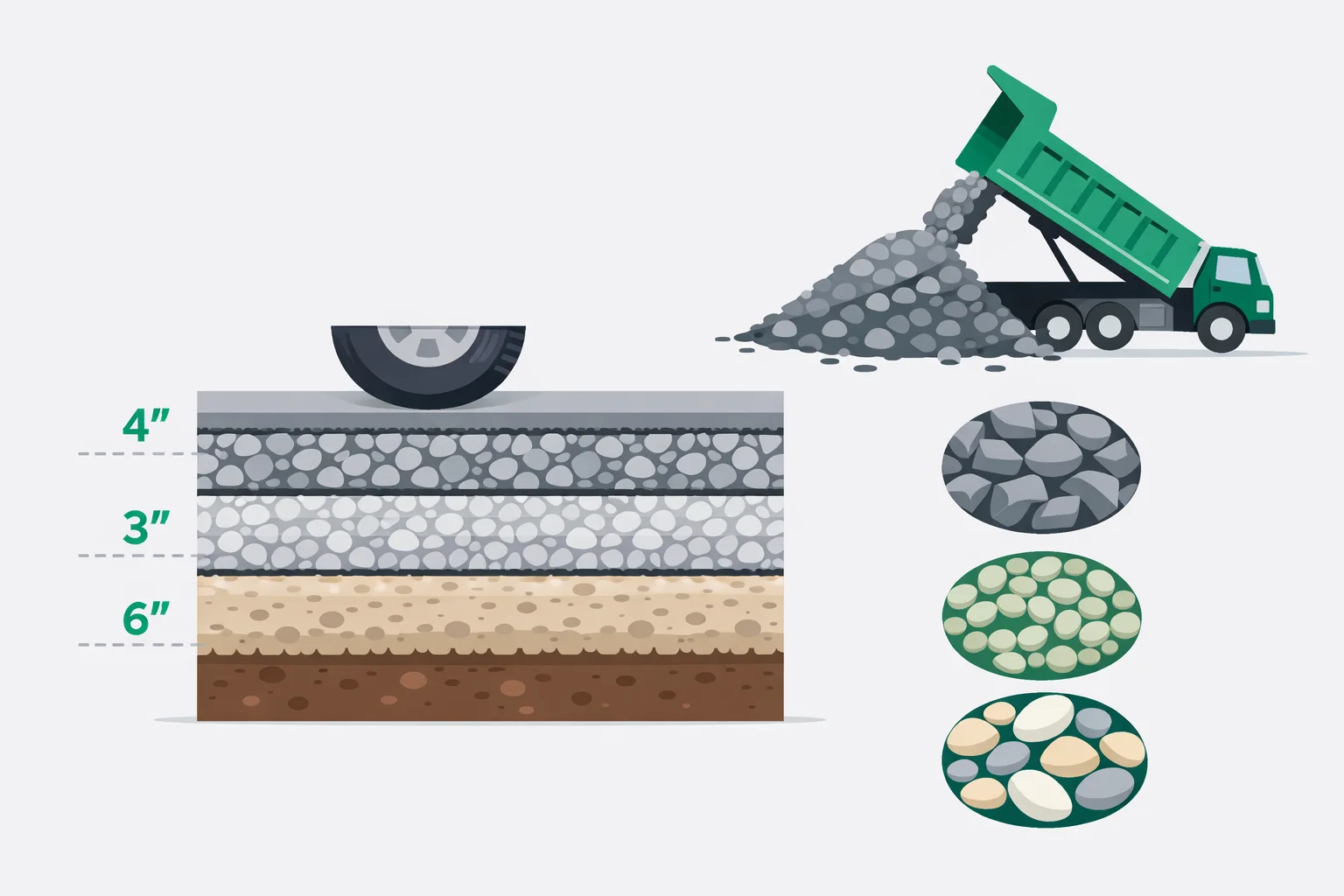
Why Gravel Is Sold by the Ton, Not the Yard
Walk into a quarry and the price board reads in dollars per ton, not per cubic yard. The reason is simple: they load your truck on a scale, and weight is the only thing they can charge for honestly. Stone density varies — a yard of clean #57 stone weighs less than a yard of crusher run packed with stone dust — so weight is the fair unit.
That leaves you doing a conversion the seller never has to. Gravel density runs from about 1.35 tons per cubic yard for loose pea gravel up to 1.5 tons for dense crusher run. The U.S. produces well over a billion tons of crushed stone a year, and the USGS tracks every ton of it — all priced and shipped by weight, never by the scoop. The calculator above stores the density for each stone so the tonnage updates the moment you switch types.
The Volume-to-Tonnage Formula
The math runs in two steps. First find the volume in cubic yards, then multiply by the stone's density to get tons:
Cubic yards = (length × width × depth-in-inches ÷ 12) ÷ 27
Tons = cubic yards × density (≈1.4 for most gravel)
Say you have a 30-by-10-foot pad you want 4 inches deep. Area is 300 square feet. Depth in feet is 4 ÷ 12 = 0.333. Volume is 300 × 0.333 = 100 cubic feet, divided by 27 gives 3.7 cubic yards. Multiply by 1.4 and you need about 5.2 tonsof crushed stone. If you only need the volume — say you're ordering by the yard for a small job — our cubic yard calculator stops at that step.
A quick shortcut for surface gravel: one ton covers about 80 to 100 square feet at 2 inches deep, or roughly 65 square feet at 3 inches. So a 600-square-foot path at 2 inches is around 6 to 7 tons before you account for spread. It's a handy gut-check against whatever number the calculator returns.
How Deep? Depth by Project Type
Depth is where people guess, and guessing wrong doubles or halves the order. A surface refresh is shallow; a base that has to carry vehicle weight is deep. Here's what each job actually needs:
- Walkways and decorative paths:2 inches of pea gravel or DG over landscape fabric. Light foot traffic doesn't need more.
- Gravel driveway surface: 2 to 3 inches of angular stone, refreshed every few years as it works into the base.
- New driveway or shed base:4 to 6 inches of crusher run, compacted in lifts. On soft clay, go to 8 inches and add a geotextile fabric so the stone doesn't sink.
- French drains and drainage beds: 4 to 6 inches (or more) of clean, washed #2 or #57 stone — no fines, so water moves freely.
Because gravel is a volume, depth scales the cost dollar-for-dollar. Going from 3 inches to 4 inches on that same 300-square-foot pad adds a full third to your tonnage — about 1.7 extra tons, or $60 more in stone. Pick the depth deliberately, not by rounding up "to be safe."
The Compaction Factor That Leaves Driveways Short
Here's the gotcha that catches almost every first-timer. When you tamp gravel into a base, it compresses. A layer you want to finish at 4 inches starts as nearly 5 inches of loose stone, because compaction squeezes out 15 to 20 percent of the volume. Order the finished thickness and you'll be a fifth short the day you run the plate compactor over it.
The fix is to multiply any compacted base by about 1.2. Crusher run — the stone-and-dust mix made for bases — packs the hardest and needs the full allowance. Clean drainage stone barely compacts at all, so skip the factor there. The calculator's compaction toggle does this for you; leave it on for driveways, pads, and patio bases, and off for loose surface gravel or drainage.
Graveling a 40-Foot Driveway, Step by Step
Let's price a real one. You have a 40-foot-long, 10-foot-wide driveway and you're laying a fresh 3-inch surface coat of crusher run over an existing base.
Step 1 — Area. 40 × 10 = 400 square feet.
Step 2 — Volume. 400 × (3 ÷ 12) = 100 cubic feet. Divide by 27: 3.7 cubic yards.
Step 3 — Compaction.It's a tamped surface, so add 20 percent: 3.7 × 1.2 = 4.4 cubic yards.
Step 4 — Tonnage. Crusher run is about 1.5 tons per yard: 4.4 × 1.5 = 6.6 tons.
Step 5 — Cost.At $35 a ton that's $231 in material, plus a $90 delivery fee — about $321 delivered. That's comfortably under one dump-truck load, so you pay a single delivery. Bump the driveway to a full new 6-inch base and you'd be near 13 tons — still one tandem load, roughly $545 delivered.
Gravel Types, Density, and What Each Costs
Not all gravel does the same job, and the wrong stone in the wrong place scatters, washes out, or never compacts. Here are the common bulk types with 2026 price ranges per ton, before delivery:
| Type | Density (t/yd³) | Bulk $/ton | Best for |
|---|---|---|---|
| Crusher run (crush & dust) | 1.5 | $30–$45 | Driveway bases, pads — compacts hard |
| Crushed #57 | 1.4 | $35–$50 | Driveways, drainage — drains, stays put |
| Pea gravel | 1.35 | $40–$55 | Paths, patios, decorative beds |
| Drainage #2 (washed) | 1.4 | $38–$50 | French drains, dry wells — clean, no fines |
| Decomposed granite | 1.45 | $45–$60 | Walkways, xeriscape — packs to firm surface |
| River rock | 1.4 | $55–$80 | Decorative, drainage swales — never compacts |
The split that matters: angular vs rounded. Crushed stone has fractured faces that interlock and hold on a slope or under tires. Rounded stone — pea gravel, river rock — rolls and migrates, so it belongs where nothing drives and edging keeps it corralled. And clean vs crusher run: clean stone drains, crusher run binds. Use clean for water, crusher run for a hard surface.
Gravel Mistakes That Cost a Second Delivery
- Skipping the compaction allowance.Order a 4-inch base at face volume and you're 20 percent short. On a 13-ton job that's 2.5 tons missing — and a second $90 delivery for a scoop.
- Using the wrong density. Plugging 1.4 tons per yard into a crusher run order undercounts by 7 percent because crusher run is 1.5. Small percentage, real shortfall on a big driveway.
- No fabric on soft soil. Stone laid on bare clay sinks and vanishes — you lose an inch a year and keep re-buying. A $0.30 per square foot geotextile fabric stops it cold.
- Rounded stone where cars drive. Pea gravel on a driveway migrates into the lawn and the street within a season. You pay twice: once to buy it, again to rake it back.
Where This Estimate Stops
This calculator gives you loose-volume tonnage and a material cost — the number you need to place an order. It doesn't know your supplier's minimum load, whether their crusher run runs heavier than 1.5 tons per yard, or how much extra a steep or rutted site swallows. Wet gravel also weighs more than the dry densities here, so a rained-on stockpile can run 5 to 10 percent heavier on the scale.
For multi-layer driveways, run the base and surface as two separate calculations — different stone, different depth, different compaction — and add the tons. If you're weighing gravel against a paved surface, our asphalt calculator prices the same area in hot-mix tonnage, and the soil calculator handles any topsoil you need to grade and shape before the stone goes down. When that compacted gravel becomes the base under a paver patio, the paver calculator builds the full materials list above it — pavers, the 1-inch bedding sand, polymeric joint sand, and edge restraint. When the pad is for an above-ground pool, the pool calculator then sizes the water and chemicals once it's filled. Measure the area, set the depth honestly, add for compaction, and order once.