Soil Calculator: How to Estimate Topsoil, Fill Dirt, and Garden Soil for Any Project
A soil calculator tells you how many cubic yards to order — but it can't stop you from ordering the wrong dirt entirely. Topsoil, garden-soil blend, and fill dirt look nearly identical in a pile, yet they run from $15 to $50 a yard and do completely different jobs. Buy a truckload of cheap fill dirt for a vegetable bed and nothing grows. Pay garden-blend prices to backfill a low spot and you've spent $200 on dirt no one will ever see. So before the "how much" question, the smarter one is "which soil" — and then how much extra to add for settling.
Topsoil, Garden Soil, or Fill Dirt? Pick First
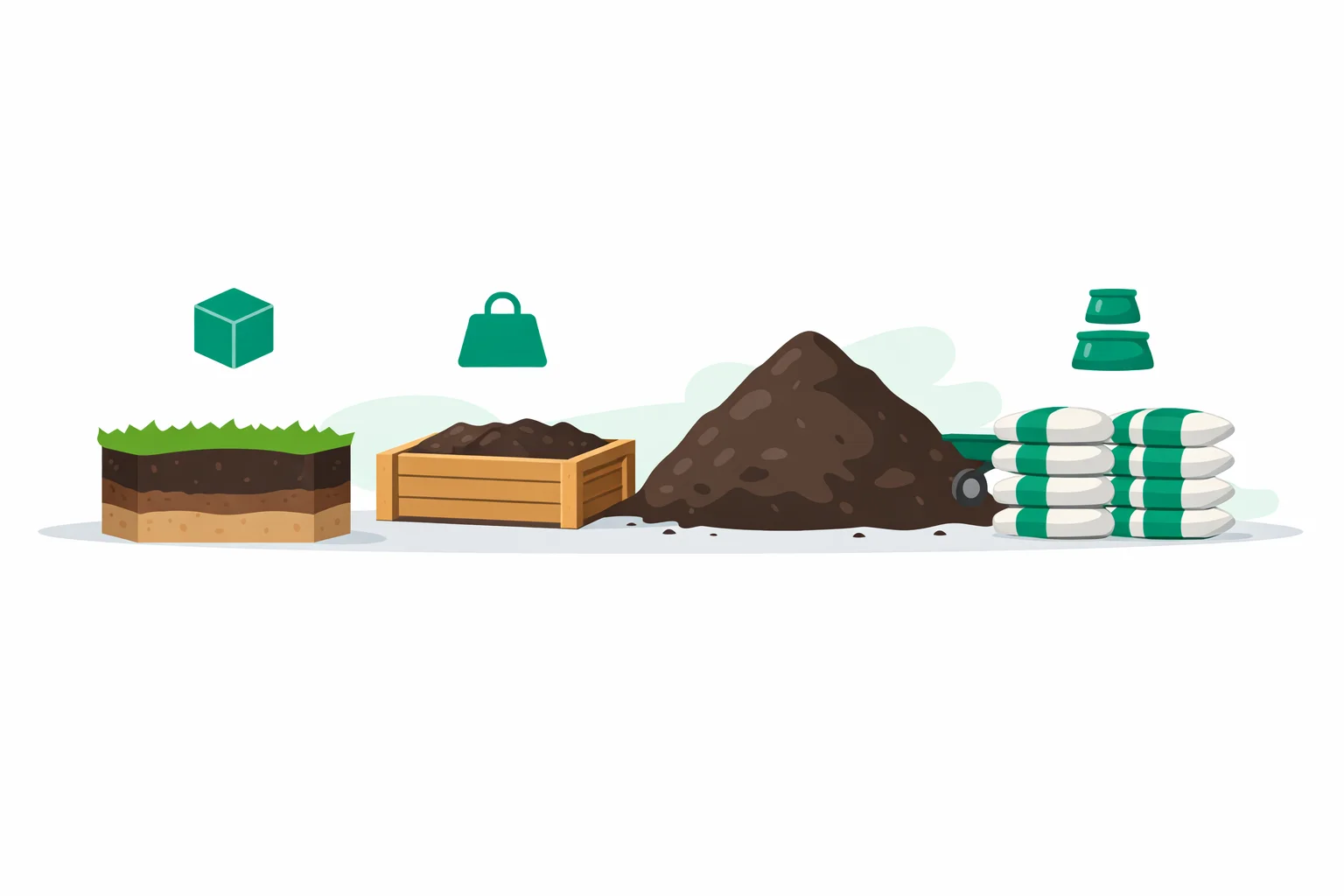
These three products share a yard at most suppliers and confuse nearly every first-time buyer. They're not interchangeable. Fill dirt is subsoil with the organic matter stripped out — dense, cheap, and meant for building grade or filling holes, not growing anything. Topsoil is the screened upper layer with some organic content, fine for leveling a lawn or patching bare spots. Garden soil (often sold as a "raised-bed blend") is topsoil mixed with compost and amendments, built specifically for planting.
| Product | Bulk $/yard | What it's for | Don't use it for |
|---|---|---|---|
| Fill dirt | $10–$25 | Grading, filling holes, raising low ground | Anything you plant |
| Topsoil (screened) | $25–$35 | Leveling lawns, base layer under sod | Raised-bed planting on its own |
| Screened loam | $30–$40 | Lawn repair, general beds | Heavy clay drainage fixes |
| Garden / raised-bed blend | $40–$55 | Raised beds, vegetable gardens | Bulk grading (too expensive) |
| Compost | $35–$45 | Amending and topdressing | Filling a bed 100% (too rich, settles hard) |
A common money-saver: build a raised bed with about 70% garden blend on top and 30% cheaper topsoil or fill on the bottom, where roots rarely reach. On a 12-inch-deep bed, that swap can trim your soil bill by a third without hurting what grows. Once you've settled on the product, the calculator above turns your bed size into yards, bags, and weight.
Filling a Raised Bed Without Overbuying
Raised beds are where most soil math goes wrong, because people fill them to the brim and pay for it. Take a classic 4'×8' bed. Filled a full 12 inches, it holds 4 × 8 × 1 = 32 cubic feet, or 1.19 cubic yards. That's 22 bags of 1.5-cubic-foot soil at the store — roughly $100 — versus about $50 for the same volume bulk-delivered when you're buying a few yards at once.
Here's the part the brim-fillers miss: vegetable roots live in the top 8 to 10 inches. Filling that same bed to 10 inches instead of 12 drops you to 26.7 cubic feet — you just saved 5.3 cubic feet, about 4 bags, per bed. Multiply that across four beds and it's 16 fewer bags. Extension programs, including Oregon State University's raised-bed guidance, note that 8 to 12 inches of good soil is plenty for most crops. To double-check the raw volume of an odd-sized bed, our cubic feet calculator handles any length, width, and height.
The Settling Factor Almost Nobody Orders For
Loose soil is full of air. Once it's spread, rained on, and watered in, it compacts — and a bed you measured at exactly 1 cubic yard settles down to look 10 to 20 percent short within a few weeks. This is the single most common reason people make a second trip for "just a little more."
The fix is to order for the settled volume, not the empty one. For general beds and lawns, add about 15 percent. For graded fill that gets compacted with a plate or just driven over, push it to 20 to 25 percent, because compaction is the whole point of fill work. On a 5-yard grading job, skipping a 20 percent allowance leaves you a full yard short — one more delivery and one more $80 fee for material you should have ordered the first time. The calculator's settling slider folds this into the cubic-yard total, so the number you see is the number to buy.
Soil Is Heavy: Why a Yard Maxes Out Your Truck
Mulch is light enough to throw a couple of yards in a pickup. Soil is not. A single cubic yard of dry topsoil weighs around 2,100 pounds, and after a rain it climbs past 2,700. Fill dirt is heavier still. A typical half-ton pickup has a real payload of only 1,000 to 1,500 pounds — so one yard of topsoil is already over the truck's safe limit.
That changes how you get it home. Three yards of topsoil weighs over three tons; in a half-ton truck that's four or five white-knuckle trips with sagging springs and a long brake distance — both unsafe and illegal once you're overloaded. This is why the calculator shows weight in tons and pickup loads, not just volume: the moment you pass roughly one yard, a bulk delivery almost always beats hauling it yourself. For a cross-check on the volume-to-weight math on any material, the cubic yard calculator carries weight and truckload estimates too.
The Formula: Square Feet to Cubic Yards
The core math is the same one contractors use for any bulk material. Multiply the area in square feet by the depth in feet to get cubic feet, then divide by 27 for cubic yards:
Cubic yards = (length × width × depth-in-inches ÷ 12) ÷ 27
For a quick mental estimate, remember that one cubic yard covers 324 ÷ depth square feet — so 162 square feet at 2 inches, 81 at 4 inches, and 54 at 6 inches. A 600-square-foot lawn you want to topdress with 2 inches of topsoil needs 600 ÷ 162 = 3.7 yards before settling, or about 4.3 with a 15 percent allowance. Round beds use the same idea with area = π × radius². A 6-foot-wide round bed has an area of about 28 square feet, so 4 inches of soil is roughly 0.35 yards. To turn an irregular lawn into one clean square-footage number first, the square footage calculator adds up multiple sections for you.
Soil Weight & Coverage Reference Table
Keep this handy at the supply yard. It pairs how far one cubic yard stretches at common depths with how much each soil type actually weighs — the number that decides whether you're hauling or delivering.
| Depth | 1 yard covers | Yards per 100 sq ft | 1.5-cu-ft bags per 100 sq ft |
|---|---|---|---|
| 2 inches | 162 sq ft | 0.62 yd | 12 bags |
| 4 inches | 81 sq ft | 1.23 yd | 23 bags |
| 6 inches | 54 sq ft | 1.85 yd | 34 bags |
| 12 inches | 27 sq ft | 3.70 yd | 67 bags |
| Soil type | Weight per yard (dry) | Tons per yard | ½-ton pickup capacity |
|---|---|---|---|
| Compost | ~1,100 lb | 0.55 | ~1.3 yd |
| Garden blend | ~1,800 lb | 0.90 | ~0.8 yd |
| Topsoil | ~2,100 lb | 1.05 | ~0.7 yd |
| Fill dirt | ~2,300 lb | 1.15 | ~0.6 yd |
Soil-Ordering Mistakes That Cost Real Money
- Buying fill dirt to grow in. Fill has no nutrients and often compacts like concrete. Planting in it means digging it back out later and re-buying garden blend — paying twice for the same hole.
- Ordering the measured volume with no overage. Skip the 15 percent settling allowance and a 1-yard bed comes up short after the first rain. The fix is a second $80 delivery for a third of a yard.
- Hauling soil in a half-ton pickup.One yard of topsoil is over a ton — past the truck's payload. Beyond the safety risk, an overloaded truck is a ticket and a brake job waiting to happen. Past a yard, pay for delivery.
- Filling 100% compost. It looks rich, but pure compost settles dramatically and dries out fast. Cap it at roughly a third of the blend; the rest should be topsoil or garden mix.
Where This Estimate Stops
This calculator estimates loose volume, weight, and cost — it doesn't know your supplier's minimum order, whether they sell in half-yard increments, or that a "yard" of wet soil after rain weighs noticeably more than the dry figure shown. It assumes level beds; a sloped yard needs extra on the downhill side to hold depth. And for true grading or drainage work, where compaction targets and soil type drive stability, follow local guidance — the USDA Natural Resources Conservation Service has solid background on soil structure and density. Once the beds are filled, our mulch calculator handles the top dressing, and a base of crushed stone usually goes underneath any path or pad you build alongside the beds — the gravel calculator works out that tonnage. Measure twice, add your settling allowance, and order once.