Mulch Calculator: How Much Mulch Do You Need for Your Landscape Beds?
A mulch calculator settles a question that quietly costs homeowners $40 to $80 every spring: bags or bulk. Spread three inches of mulch across a 200-square-foot bed and you need just under 1.9 cubic yards — about 25 bags at the garden center, or one small bulk delivery. The bags ring up around $100. The same mulch in bulk runs roughly $65 in material. Which one actually saves money depends entirely on one number most people forget: the delivery fee.
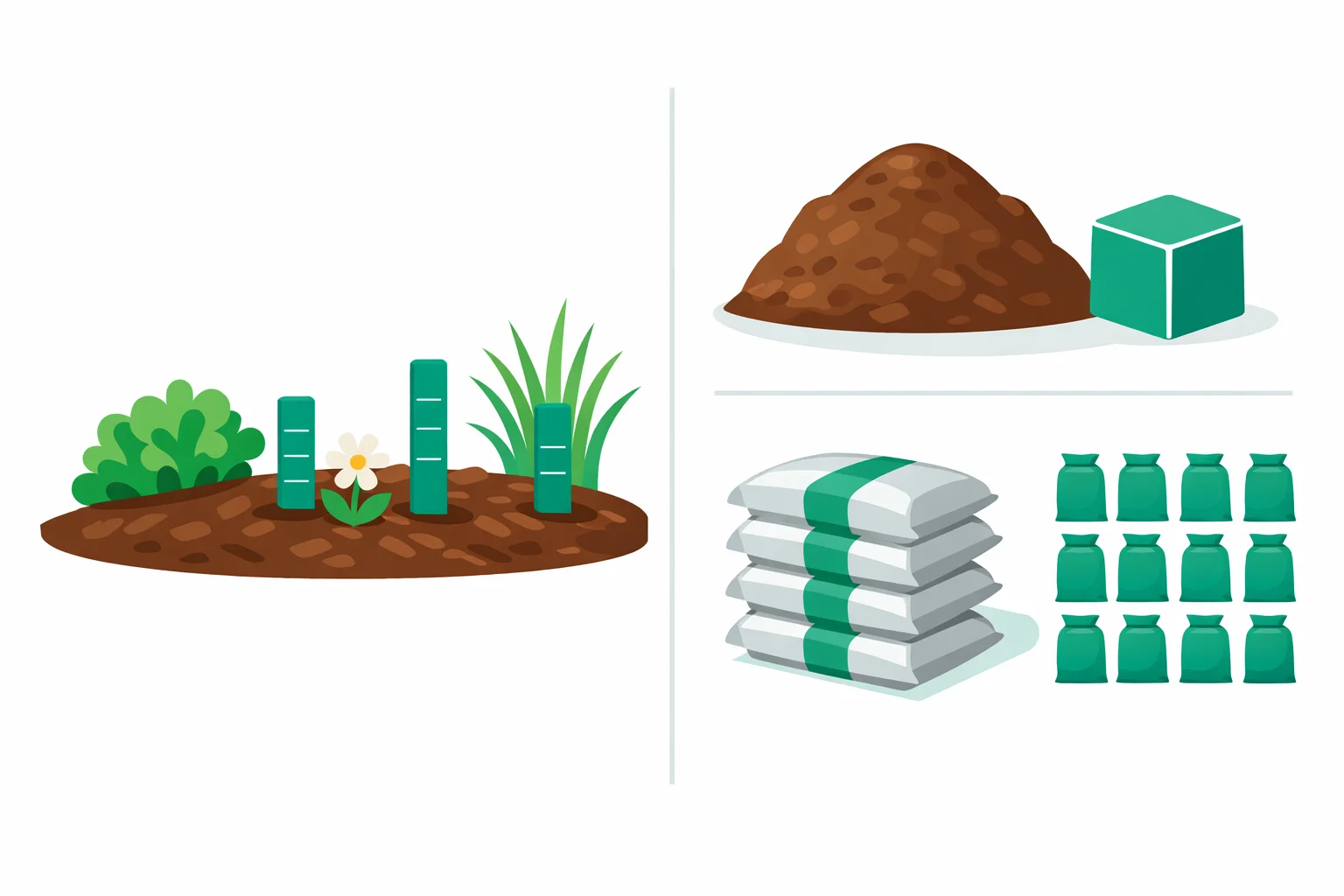
Bags or Bulk? The Math That Decides It
Bulk mulch is cheaper per cubic yard — almost always. A yard of shredded hardwood runs $30 to $40 delivered as a loose pile. To buy that same yard in standard 2-cubic-foot bags, you need 13.5 bags, and at $4 a bag that's $54 in plastic-wrapped mulch before tax. So the material itself favors bulk by 30 to 45 percent.
Then the delivery fee flips the table on small jobs. Most yards charge $60 to $90 to drop a load, no matter how little you order. Run the numbers on a single 1-yard project: bulk is $35 material plus $75 delivery, or $110 total. Bagged is 14 bags at $4, or $56 — half the price. The bags win because you're not paying a truck to make a trip for one scoop.
The crossover usually lands between 2 and 3 yards. Here's the same comparison at three project sizes, using $37 per yard bulk, a $75 delivery fee, and $4 bags:
| Project | Bulk (material + $75) | Bagged ($4/bag) | Winner |
|---|---|---|---|
| 1 yard (≈108 sq ft @ 3") | $112 | $56 (14 bags) | Bagged |
| 3 yards (≈324 sq ft) | $186 | $162 (41 bags) | About even |
| 6 yards (≈648 sq ft) | $297 | $324 (81 bags) | Bulk |
The lesson isn't "bulk is cheaper." It's that the delivery fee is a fixed cost you spread across however much you order, so the more mulch you need, the better bulk looks. The calculator above does this comparison with your real numbers — change the delivery fee and watch the winner switch. If you'd rather just confirm the raw volume first, our cubic yard calculator handles any length, width, and depth.
How Deep Should Mulch Go — and Why 3 Inches Wins
Depth changes everything, because mulch is a volume, not a coverage. Double the depth and you double the cost. Three inches is the number most landscapers land on — deep enough to block sunlight from weed seeds and hold soil moisture, shallow enough that air and water still reach the roots.
Two inches is a refresh layer for a bed that already has intact mulch underneath. Four inches is for aggressive weed suppression or a brand new bed with bare soil. Push past four inches and you create problems: mulch that thick stays soggy, breeds fungus, and can starve roots of oxygen. The University of Minnesota Extension and most horticulture programs warn specifically against deep mulch piled against trunks and stems — the "mulch volcano" that rots bark and invites pests.
Turning Bed Size Into Cubic Yards
The formula is short. Multiply the bed area in square feet by the depth in feet to get cubic feet, then divide by 27 to get cubic yards:
Cubic yards = (length × width × depth-in-inches ÷ 12) ÷ 27
There's a faster shortcut landscapers use. Because mulch is sold by the yard and most beds get 2 to 3 inches, you can skip the unit conversion: divide your square footage by the coverage-per-yard for your depth. One cubic yard covers 324 ÷ depth square feet — so 162 square feet at 2 inches, 108 at 3 inches, 81 at 4 inches. A 500-square-foot bed at 3 inches is just 500 ÷ 108 = 4.6 yards.
Bagged math works the same way but in cubic feet. A 2-cubic-foot bag covers 12 square feet at 2 inches deep or 8 square feet at 3 inches. For odd-shaped beds, measure each section as a rectangle and add them — the same approach our square footage calculator uses for multi-room jobs.
Mulching a Real 400-Square-Foot Yard
Say you have three beds: a 20×8 front bed (160 sq ft), a 12×10 side bed (120 sq ft), and a curved foundation bed you measure as roughly 24×5 (120 sq ft). Total area: 400 square feet. You want a standard 3-inch layer of dyed brown mulch.
Step 1 — Volume.400 sq ft × (3 ÷ 12 ft) = 100 cubic feet. Divide by 27: 3.7 cubic yards. Add 5 percent for the curves and settling, and you're at about 3.9 — round to 4 cubic yards.
Step 2 — Bulk cost. Dyed mulch runs around $40 a yard. Four yards is $160 in material plus a $75 delivery fee: $235 total.
Step 3 — Bagged cost.Four yards equals 54 bags of 2-cubic-foot mulch (4 × 13.5). At $4.50 a bag for dyed, that's $243 — plus you're fitting 54 bags into your car over two or three trips.
At this size the costs nearly tie ($235 vs $243), so the tiebreaker is effort. Bulk lands in one pile you shovel from; bags mean hauling, opening, and hauling away 54 empty plastic sacks. Most people pick bulk the moment the totals are this close. Bump the yard up to six beds and bulk pulls clearly ahead.
Mulch Coverage by Depth: A Reference Table
Keep this handy when you're standing in the garden center doing mental math. It shows how far one cubic yard stretches, plus the bags and yards you need per 100 square feet at each common depth.
| Depth | 1 yard covers | Yards per 100 sq ft | 2-cu-ft bags per 100 sq ft |
|---|---|---|---|
| 1 inch | 324 sq ft | 0.31 yd | 5 bags |
| 2 inches | 162 sq ft | 0.62 yd | 9 bags |
| 3 inches | 108 sq ft | 0.93 yd | 13 bags |
| 4 inches | 81 sq ft | 1.23 yd | 17 bags |
What Mulch Actually Costs, by Type
Not all mulch is priced the same. Wood chips from a tree service are often free if you can take a whole load; cedar and premium dyed products cost double that. Here are typical 2026 ranges per cubic yard in bulk, before delivery:
| Type | Bulk $/yard | Lasts | Best for |
|---|---|---|---|
| Wood chips (arborist) | $0–$30 | 1 year | Paths, large natural areas |
| Shredded hardwood | $30–$40 | 1–2 years | General beds, slopes (knits together) |
| Dyed / colored | $35–$45 | 1–2 years | Color that holds through the season |
| Pine bark | $40–$50 | 2–3 years | Acid-loving plants, decorative beds |
| Cedar | $50–$60 | 2–3 years | Insect resistance, long life |
A pro tip the price tag hides: shredded hardwood knits into a mat that stays put on a slope, while bark nuggets float and wash away in a hard rain. On a graded bed, paying less for hardwood often beats paying more for nuggets you'll be raking out of the lawn.
Four Mulching Mistakes That Cost Money or Kill Plants
- The mulch volcano. Piling mulch in a cone against a tree trunk traps moisture against the bark, rots it, and invites borers. Keep mulch 3 to 6 inches clear of trunks and stems — a flat ring, not a cone.
- Ignoring the old layer. Dumping 3 fresh inches on top of 2 existing inches buries roots under 5 inches. Measure first; if you have 2 inches, you only need 1 more — that cuts a $235 order to about $90.
- Ordering exact square footage of volume. Beds curve, slope, and have low spots. Skipping the 5 to 10 percent overage is how people end up 30 square feet short and make a second $75 delivery for half a yard.
- Mulching over weeds instead of pulling them.Three inches won't stop established perennial weeds — they punch right through. Pull or treat first, then mulch, or you're paying to decorate a weed patch.
When Bagged Wins and Where This Estimate Stops
Bagged mulch isn't just for small jobs. It wins anytime access is the problem — a townhouse with no driveway for a dump truck, a backyard bed you can only reach through a gate, or a job you want to spread over several weekends without a pile decomposing on your driveway. Bags also let you buy exactly what you need with no leftover heap. And if those beds are brand new, fill them first: our soil calculator works out the topsoil or garden blend you need underneath before the mulch goes on top.
This calculator estimates loose volume and cost. It doesn't know your supplier's minimum order, whether they sell in half-yard increments, or that dyed mulch sometimes comes in 1.5-cubic-foot bags instead of 2. It also assumes flat, level beds — steep slopes need a touch more to hold depth, and rubber or stone mulch weighs far more per yard than wood, which matters for delivery and hauling. For poured edging, stepping pads, or a mow strip around those freshly mulched beds, the concrete calculator handles the cubic-yard and bag math for the hard surfaces. Measure twice, add 5 percent, and order once.