Electricity Cost Calculator: How to Find the Appliances Draining Your Bill
Your light bulbs aren't the problem. In a typical all-electric home, three appliances — central air conditioning, the water heater, and the clothes dryer — make up 55 to 65% of the bill, while every bulb in the house combined often runs under 10%. An electricity cost calculator sorts your appliances by what each one actually costs per month, so you stop chasing $2 savings and start seeing the $40 ones. The math behind it is a single line: watts × hours ÷ 1,000 × your rate. All the value is in the ranking.
The One Formula (and the Duty-Cycle Trap Inside It)
Every line on your electric bill traces back to one equation. No exceptions, no hidden multipliers — just this:
Monthly cost = (Watts ÷ 1,000) × Hours per day × 30.4 × Rate per kWh.
Watts divided by 1,000 gives kilowatts. Multiply by the hours you run the device and you get kilowatt-hours — the unit your utility bills. Multiply by 30.4 (the average days in a month) and your rate, and you have a monthly dollar figure. A 1,000-watt microwave used 20 minutes a day is 1 kW × 0.33 hr × 30.4 × $0.17 = about $1.70 a month. That's the whole engine.
The trap is the word "hours," and it's where most people triple their fridge estimate. A refrigerator is rated at roughly 150 watts, but the compressor only cycles on about a third of the time. Plug in 24 hours and you get 110 kWh a month; use its effective run-time of 8 hours and you get the real answer, around 37 kWh. Same with a well pump, a furnace, or anything with a thermostat — bill the time it's actually drawing power, not the time it's plugged in. If you want just the kilowatt-hours without the dollars, the kWh calculator isolates that step.
A Real All-Electric Home, Appliance by Appliance
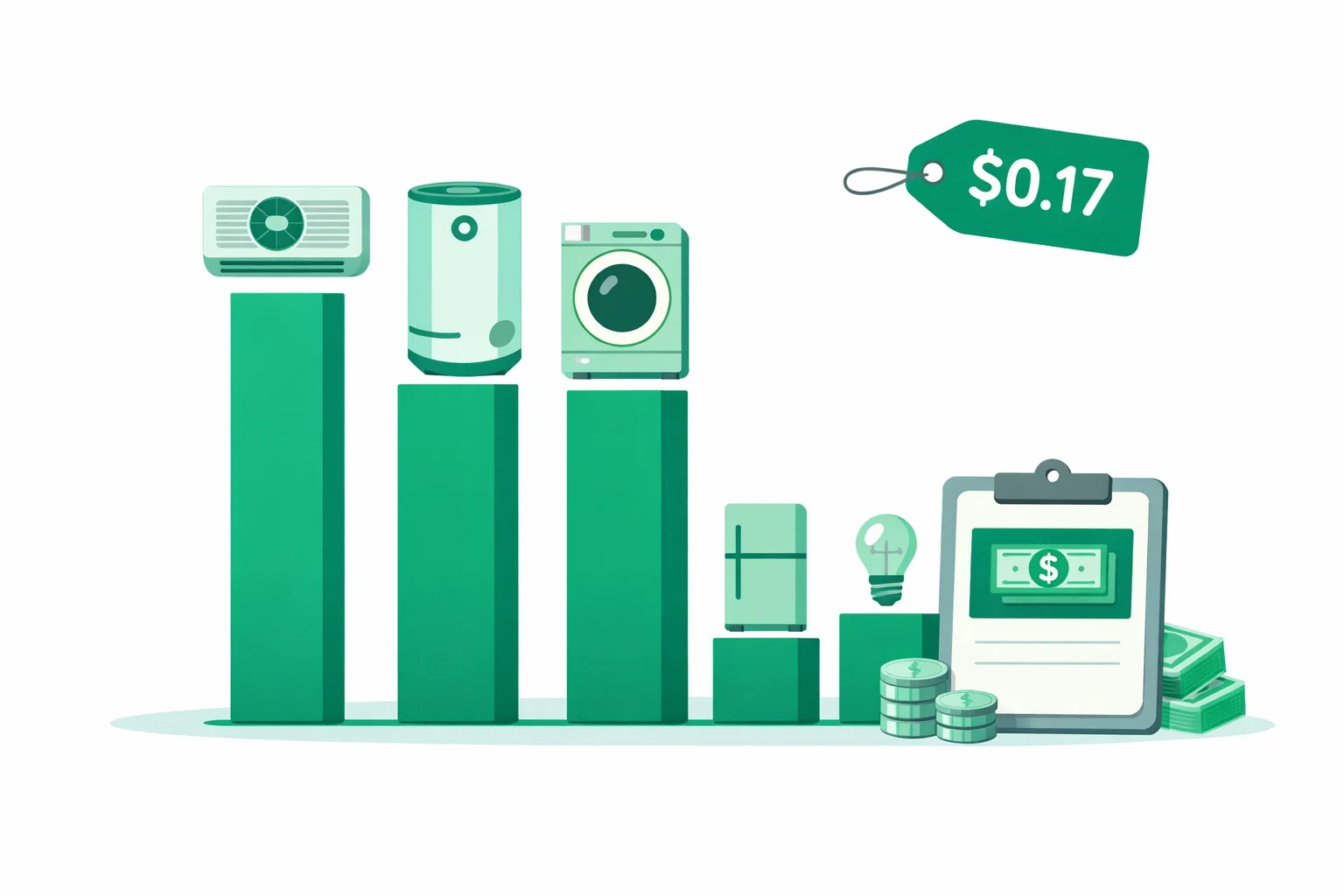
Numbers make this concrete. Here's a summer month for an all-electric home at the U.S. average rate of $0.17 per kWh. Watch how fast the top of the list runs away from the bottom.
| Appliance | Watts | Hrs/day | kWh/mo | Cost/mo |
|---|---|---|---|---|
| Central AC | 3,500 | 6 | 639 | $108.65 |
| Electric water heater | 4,000 | 3 | 365 | $62.09 |
| Clothes dryer | 3,000 | 1 | 91 | $15.52 |
| Refrigerator | 150 | 8 | 37 | $6.21 |
| Home lighting (LED) | 100 | 5 | 15 | $2.59 |
| Total | — | — | 1,147 | $195.06 |
The AC alone is 56% of a $195 bill. The water heater is another 32%. Together those two — the ones you never think about — are 88% of the month. Switching every remaining light to LED, the move people reach for first, touches the $2.59 line. That's the whole argument for ranking before you act: the biggest bar tells you where an hour of effort turns into real money.
What Common Appliances Cost Per Month
Keep this table handy. It shows typical running wattage, a realistic daily run-time, and the resulting monthly cost at $0.17 per kWh. Slide your own rate up or down and the costs scale with it — at $0.30 per kWh, every figure here is about 76% higher.
| Appliance | Watts | Typical use | Cost/mo |
|---|---|---|---|
| EV charger (Level 2) | 7,200 | 3 hr/day | $111.60 |
| Central AC | 3,500 | 6 hr/day | $108.65 |
| Electric water heater | 4,000 | 3 hr/day | $62.09 |
| Pool pump | 1,500 | 8 hr/day | $62.04 |
| Space heater | 1,500 | 6 hr/day | $46.53 |
| Dehumidifier | 700 | 12 hr/day | $43.43 |
| Clothes dryer | 3,000 | 1 hr/day | $15.52 |
| Gaming PC | 500 | 4 hr/day | $10.34 |
| Refrigerator | 150 | 8 hr/day | $6.21 |
| TV (LED, 55") | 100 | 5 hr/day | $2.59 |
| LED bulb | 10 | 5 hr/day | $0.26 |
Two things jump out. First, the EV charger tops the list at over $110 a month, which surprises people who assume home charging is nearly free — it's cheaper than gas per mile, but it's still real money on the electric bill. Second, a single LED bulb costs a quarter a month. You'd have to run 400 of them to match the AC. That gap is exactly why chasing bulbs while ignoring the thermostat is backwards. The same ranking matters when the power goes out: the heavy hitters here are the loads you'll likely leave off a backup circuit, which is why the generator sizing calculator asks what you truly need running before it picks a unit.
Your Rate Is Half the Bill — and Rarely One Number
Every figure above assumes $0.17 per kWh, but your rate might be nothing like that. According to the U.S. Energy Information Administration, residential prices range from around $0.11 per kWh in Idaho and Utah to over $0.40 in Hawaii and parts of California. That's not a rounding difference — the same $195 all-electric month becomes about $126 in a cheap state and $460 in an expensive one. Your rate is genuinely half the equation, and it's the half you didn't choose.
It's also rarely a single flat number. Many utilities use tiered pricing, where the first block of kWh is cheap and heavy use tips you into a pricier tier — so the last 300 kWh of a big month can cost more per unit than the first 300. Others use time-of-userates that charge two to three times more during late-afternoon peak hours than overnight. Running the dryer at 11 p.m. instead of 6 p.m. can cost half as much on a time-of-use plan, even though the calculator shows the same kWh. Divide your total bill by the kWh you used and you'll get the effective rate that actually reflects your plan — a better number to type in than the national average.
The $165 a Year You Pay for Nothing
Standby power — the trickle electronics draw while "off" — costs the average U.S. home roughly $165 a year, and the Department of Energy puts it at 5 to 10% of residential electricity use. It hides in plain sight: a cable box pulling 25 watts around the clock is 18 kWh a month — about $37 a year — whether or not the TV is on. A game console left in instant-on, a second fridge in the garage humming for six cans of soda, a desktop that never sleeps: each is a small always-on load the calculator will surface if you enter it at 24 hours a day.
Not every device is worth chasing. A phone charger with nothing plugged in draws almost zero. The rule of thumb: hunt down anything with a clock, a standby light, a network connection, or a remote — those keep drawing. Put the worst offenders on a switched power strip and that $165 mostly disappears without changing a single habit.
Where the Real Savings Hide
Once the ranking is in front of you, the priority list writes itself. Attack the top bars, in this order of typical payoff:
- Heating and cooling. The single biggest lever. Every degree you nudge the thermostat in summer trims cooling costs 2 to 3%. Cutting AC from 8 to 6 hours a day on a 3,500-watt unit saves about $36 a month. An oversized unit quietly costs more here, so it pays to size the AC to the room's BTU load rather than overbuy. Better attic insulation attacks the same load from the other side by slowing the heat gain that makes the compressor run.
- Water heating. Drop the tank thermostat from 140°F to 120°F and you cut standby losses 6 to 10% — often $30 to $60 a year. A timer that skips heating overnight adds more.
- The dryer. At about $0.50 a load, line-drying half your laundry saves roughly $8 a month. Cleaning the vent so cycles run shorter saves nearly as much.
- Standby loads. Power strips on the worst offenders reclaim that $100 to $165 a year, as covered above.
- Lighting, last.Swapping ten 60-watt incandescents for LEDs saves about $15 a month — real, but a fraction of the top three. Do it; just don't do it first.
If trimming the bill isn't enough and you want to erase it, the solar calculator takes the monthly total you just built and estimates the panel system and payback period to cover it.
Where the Meter and the Math Disagree
This calculator estimates — and it's honest to know when the estimate drifts from the meter. Four situations bend the numbers:
- Duty-cycle appliances.Anything with a thermostat (fridge, freezer, AC, heat pump) cycles on and off. Enter plugged-in hours instead of running hours and you'll overshoot — sometimes by 3x on a fridge.
- Motor surge.Compressors and pumps briefly pull two to three times their rated watts at startup. Over a month it barely registers, but it's why a nameplate figure and a plug-in meter never match perfectly.
- Fixed charges and demand fees. Utilities add a flat monthly service charge ($10 to $30) and sometimes a demand charge based on your single highest 15-minute spike — neither shows up in a per-appliance estimate.
- Seasonal swings.A July bill with heavy AC and an October bill with none aren't the same home using power differently — they're the same appliances run for wildly different hours. Model the season you care about, not an average month.
For a device you truly can't pin down, a $15 plug-in energy meter reads real kWh over a week — then you plug that measured number back in and the whole-home total sharpens. Get the hours right on the three tallest bars and your estimate will land within a few dollars of the meter every time.