Generator Sizing Calculator: How to Find the Watts You Actually Need
A generator sizing calculator exists to catch the mistake almost everyone makes: they add up the running watts of a fridge, a few lights, and a sump pump, land around 2,600 watts, and buy a 3,000-watt unit. Then the first night of the outage the fridge compressor and the sump pump both call for power, the engine bogs, the breaker trips, and the freezer starts thawing. The running watts were never the problem. The starting surgewas — and it's the number that decides what generator you actually need.
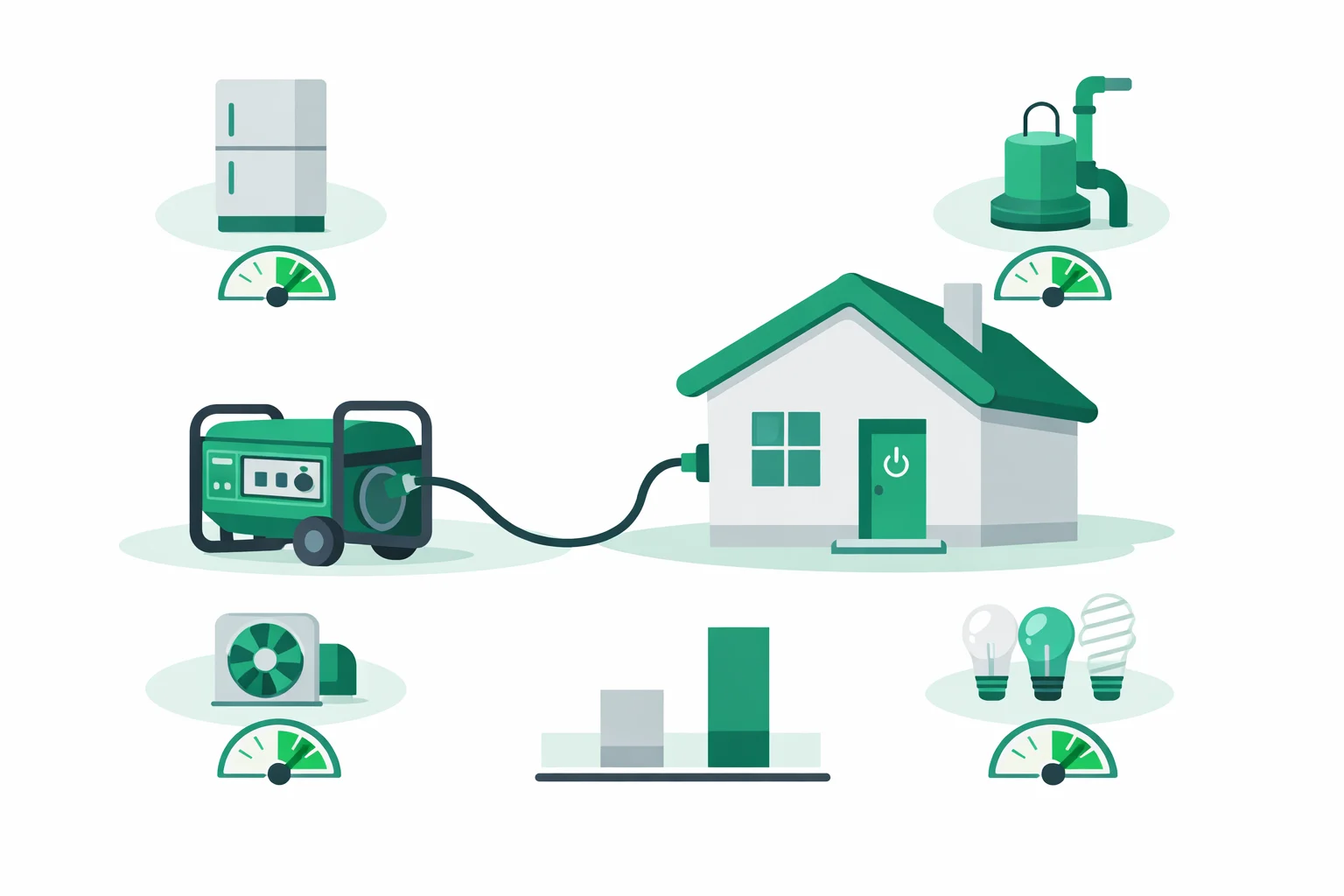
The Number That Stalls Generators
Every appliance with a motor has two power ratings. Running watts is the steady draw once it's spinning. Starting watts — the surge — is the jolt it pulls in the first half-second, while the motor fights inertia to get moving. That spike runs two to three times the running number.
A refrigerator is the classic example. It hums along at about 700 watts, but the instant the compressor cycles on it demands roughly 2,200 watts for a heartbeat. A 1-horsepower well pump runs at 2,000 and surges to 4,000. Resistive loads — a space heater, a coffee maker, incandescent bulbs — have no motor and no surge, so their running and starting numbers match. That's why a 1,500-watt space heater is easier to power than a 1,050-watt sump pump: the pump's surge is more than double its running draw.
Sizing a Generator in Three Steps
The math looks intimidating until you realize only one motor starts at a time. Here's the whole method:
Generator size = (running watts of everything on at once) + (the single largest starting surge), then add ~20% headroom.
Step one: add the running watts of every appliance you'll power simultaneously. Step two: find the one device with the biggest gap between its starting and running watts, and add only that gap on top — because in the real world your well pump and your fridge don't spin up at the exact same millisecond. Step three: don't buy a generator that just barely clears the total. Size it so your steady load sits around 80% of its rated output, which leaves room for the surge and keeps the engine off the redline. The calculator above runs all three steps live and tells you which appliance is setting your surge ceiling.
One Outage, Watt by Watt
Walk a real essentials load through it. Say you want to keep a refrigerator (700 W), household LED lights (400 W), phones and a router (300 W), a TV (200 W), and a sump pump (1,050 W) alive. Add the running watts: 700 + 400 + 300 + 200 + 1,050 = 2,650 watts. That's the number most people size to.
Now the surge. The fridge jumps 1,500 watts at startup (2,200 − 700); the sump pump jumps 1,150 (2,200 − 1,050). The fridge wins, so you add its 1,500-watt surge to the running total: 2,650 + 1,500 = 4,150 watts peak. Here's the kicker — a 3,500-watt inverter generator carries a surge rating of about 4,000 watts. It can't clear 4,150. Buy that unit and it trips the first time the fridge kicks on while the pump is running. You need a 5,000-watt portable, whose 6,250-watt surge rating swallows the spike with margin. A $150 difference in generator class, decided entirely by a number that never appears on the running-watts spec sheet. Once you've got the load in watts, you can convert it to kilowatt-hours per day and know exactly how much fuel the outage will burn through.
Running and Starting Watts, Appliance by Appliance
Nameplate ratings vary by model, but these mid-range figures are close enough to size with. Bookmark this — the surge column is the one nobody prints on the box.
| Appliance | Running W | Starting W |
|---|---|---|
| Refrigerator / freezer | 700 | 2,200 |
| Sump pump (1/2 HP) | 1,050 | 2,200 |
| Well pump (1 HP) | 2,000 | 4,000 |
| Gas furnace blower | 800 | 2,350 |
| Window AC (10,000 BTU) | 1,200 | 1,800 |
| Central AC (2-ton) | 3,800 | 8,000 |
| Electric water heater | 4,000 | 4,000 |
| Space heater | 1,500 | 1,500 |
| Microwave | 1,000 | 1,000 |
| Washing machine | 1,200 | 2,300 |
| Electric dryer | 5,400 | 6,750 |
| Well/air compressor tools | 1,500 | 4,000 |
| LED lights (whole floor) | 400 | 400 |
Notice the pattern: pumps, compressors, and blowers — anything with an induction motor — carry surges that dwarf their running draw. The resistive loads at the bottom don't budge. When you're deciding what to leave off the backup circuit, dropping one deep-well pump does more for your required surge rating than cutting five lights.
Inverter, Portable, or Standby?
The watt number points you at a class of machine, and each class has a job it's built for:
- Inverter generators (2,000–4,000 W). Quiet, fuel- sipping, and clean enough for laptops and TVs. Perfect for the bare essentials — a fridge, lights, and devices — but they run out of surge fast. Expect $500–$1,200.
- Portable generators (5,000–10,000 W). The workhorse for a real outage: fridge, furnace blower, well pump, a window AC, and the kitchen, one or two at a time. Louder and thirstier, wired in through a transfer switch. Roughly $700–$2,000.
- Standby generators (12,000–24,000 W). Permanently installed, fed by natural gas or a large propane tank, and started automatically within seconds of an outage. This is the only class that runs central air, an electric water heater, and the whole kitchen at once. Installed cost typically runs $5,000–$12,000.
The jump from portable to standby usually isn't about total wattage — it's about which loads you refuse to give up. Central AC and electric heat are the deciders.
Why You Never Run a Generator at 100%
A generator rated for 7,500 running watts is not meant to feed a 7,500-watt load all day. Manufacturers rate continuous output lower than peak, and running an engine pinned at full throttle for a multi-day outage cooks the oil, spikes fuel burn, and shortens its life. The working rule is to keep the steady load at about 75–80% of the rating.
That's why this calculator sizes up. A 6,000-watt running load points to a 7,500-watt generator, not a 6,000, so it's loafing at 80% instead of straining at 100%. The headroom also absorbs the surge: when that well pump kicks on, the generator has somewhere to go. Size to the exact number and you've built a machine that trips on its own success.
What a Day of Backup Power Costs
Fuel is the running cost people forget. A mid-size portable feeding a 4,000–5,000-watt load burns roughly 0.6 to 0.8 gallons of gasoline an hour. Run it 12 hours a day and that's 7 to 10 gallons — about $23 to $33 at $3.30 a gallon, or $160–$230 across a week-long outage. Lean on it around the clock and the fuel bill alone can top $50 a day.
The lighter you load it, the further each gallon stretches, which is another argument for shedding the power hogs. If you want to see which appliances dominate the draw, the electricity cost calculator ranks every device by what it costs to run, so you know whether that second freezer is worth the gasoline. For a backup source with no fuel line at all, a solar-plus-battery system covers a different set of tradeoffs — higher upfront cost, zero running cost, quiet, but capped by battery capacity.
Four Sizing Mistakes That Cost Real Money
- Sizing to running watts only.The most common error. Ignore the surge and you buy a unit that trips whenever two motors overlap — a $600 generator that can't reliably run a $200 fridge.
- Oversizing "to be safe."A 12,000-watt unit feeding a 3,000-watt load runs at 25% capacity, wet-stacks (unburned fuel fouling the engine), and wastes $10–$15 a day in gasoline you didn't need to burn. Bigger is not free.
- Forgetting the well pump. Rural homeowners size for the fridge and lights, then discover the water stops. A 1 HP deep-well pump surges to 4,000 watts and single-handedly resets your minimum generator to a 7,500-watt unit.
- Backfeeding through an outlet. Not a sizing mistake — a lethal one. Plugging a generator into a wall receptacle can energize the utility line and kill a lineman. Per the U.S. Consumer Product Safety Commission, generators must connect through a transfer switch or interlock, and never run indoors or in a garage — carbon monoxide from a portable can be fatal within minutes.
When a Portable Isn't Enough
A portable generator is the wrong tool in a few specific situations, and it's worth naming them before you buy. If someone in the home depends on powered medical equipment, an automatic standby that starts itself within seconds beats a portable you have to wheel out and pull- start in the dark. If you insist on running central air or electric heat through an outage, no reasonable portable will do it — those loads live in standby territory.
There's also a fuel-logistics limit. A portable holds a few gallons and needs refueling every few hours, which means someone awake to feed it during a multi-day event. A standby on natural gas never runs dry. The U.S. Department of Energy frames the choice as convenience and capacity versus upfront cost: portables are cheaper and flexible, standbys are hands-off and far larger. Size the load first with the tool above, and the machine class usually picks itself — most homes that only need essentials are a 5,000-watt portable, and only the "I refuse to lose the AC" crowd truly needs a standby.