Solar Calculator: Is Going Solar Worth It? Costs, Savings, and Payback
$18,000 out of pocket, roughly $1,900 a year back. That's a solar system in two numbers, and it's the entire question this solar calculator answers: how many years until the savings claw back what you paid, and how much is left over across the panels' 25-year life. For a typical home the break-even lands around year 9, and the two decades after that are close to free electricity. But those numbers swing hard on two inputs — your electricity rate and your sun hours — so a system that's a no-brainer in Phoenix can be a coin-flip in Seattle.
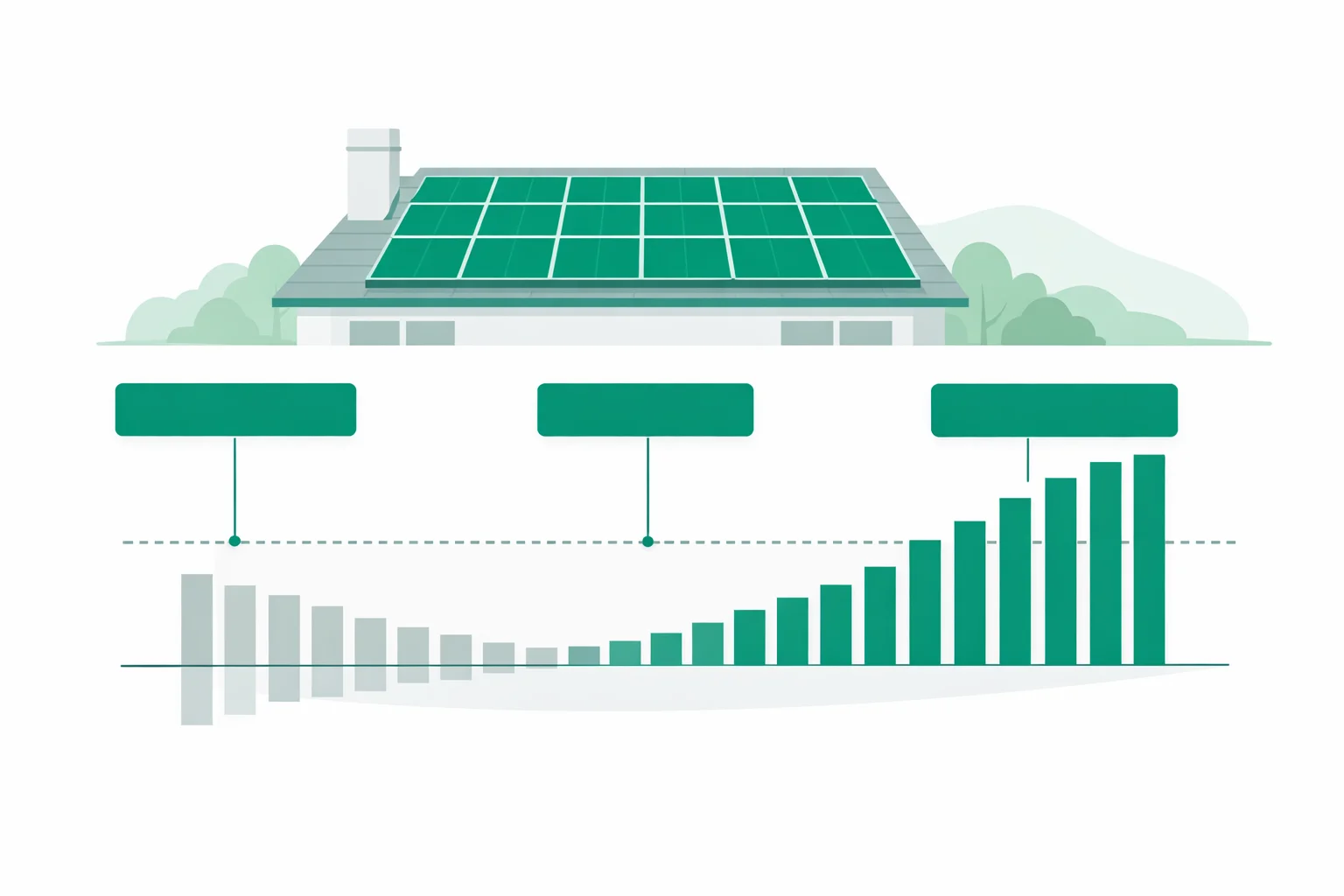
Going Solar Comes Down to Two Numbers
Forget the brochures for a second. Every honest solar decision reduces to net cost and annual savings. Net cost is the sticker price minus the 30% federal tax credit and any state rebate. Annual savings is the value of the power your roof makes instead of buying — your production in kWh times your rate. Divide one by the other and you have a rough payback in years.
Here's why rate matters so much. Two identical 8 kW systems produce the same kilowatt-hours, but one owner pays $0.11 per kWh and the other $0.33. The second owner's panels are worth three times as much every single year — same hardware, triple the savings. Solar isn't really an energy product; it's a hedge against your specific utility rate. The higher and faster-rising that rate, the better solar looks. You can see exactly which appliances make up that rate on the electricity cost calculator.
How Payback Is Actually Calculated
The calculator runs a 25-year projection, not a single division, because three things change every year. Rates rise, panels age, and savings compound. The core loop looks like this:
Year's savings = (system kW × annual production per kW × 0.995^year) × (your rate × 1.03^year)
The 0.995 is panel degradation — modern panels lose about 0.5% of output per year, so a system making 11,300 kWh in year 1 makes about 10,000 kWh by year 25. The 1.03 is utility inflation; U.S. residential rates have climbed roughly 3% a year for decades. Those two forces pull in opposite directions, but inflation wins: your annual savings still grow about 2.5% a year, because your rate rises faster than your panels fade. Payback is simply the year the running total of those savings crosses your net cost.
Production per kW comes from your peak sun hourstimes 365 days times a 0.80 performance ratio — the derate for inverter losses, wiring, heat, and dust. At 4.5 sun hours that's about 1,314 kWh per kW each year. If you want to sanity-check the raw energy math behind that, the kWh calculator breaks down how watts become kilowatt-hours.
A Real $160 Bill, Year by Year
Let's walk a full example. A home pays $160 a month at $0.17 per kWh, which is $1,920 a year and about 11,300 kWh of usage. In a 4.5-sun region, covering that usage needs roughly an 8.6 kW system.
- Sticker price: 8.6 kW × 1,000 × $3.00/W = $25,800
- Federal tax credit (30%): −$7,740
- Net cost: $18,060
- Year-1 savings: 11,300 kWh × $0.17 = $1,920
A naive payback is $18,060 ÷ $1,920 = 9.4 years. But savings don't stay flat. By year 5 the rate has risen to about $0.19 and savings are near $2,100; by year 10 they're around $2,400. Add those growing numbers and the running total actually crosses $18,060 in year 8.4 — a full year sooner than the flat estimate. Keep going to year 25 and the panels have saved roughly $66,000. Subtract the $18,060 you paid and the net gain is about $48,000, a 265% return on the net cost. Framed another way, that system produces electricity at about $0.07 per kWh over its life, less than half the $0.17 grid price it replaces.
What Solar Costs in 2026 (Before Incentives)
Solar is priced per watt of capacity, which lets you compare a 6 kW quote against a 10 kW one on equal footing. National turnkey pricing sits around $3.00 per watt before incentives, but it slides with system size — bigger systems spread fixed costs (permits, the inverter, the truck roll) across more panels.
| System size | Panels (~400W) | $/watt | Gross cost | After 30% credit |
|---|---|---|---|---|
| 5 kW | 13 | $3.30 | $16,500 | $11,550 |
| 8 kW | 20 | $3.00 | $24,000 | $16,800 |
| 10 kW | 25 | $2.85 | $28,500 | $19,950 |
| 12 kW | 30 | $2.70 | $32,400 | $22,680 |
Two traps hide in a quote. First, batteries: adding a home battery like a Powerwall can tack on $10,000 to $15,000 and rarely pays for itself on savings alone — it's a backup-power purchase, not an ROI one, so price it separately. Second, dealer fees on solar loans: a "$0 down" loan often bakes a 15% to 20% fee into the price, which is why the cash cost per watt is almost always lower than the financed one.
Why the Same System Pays Off Faster in Arizona
Location changes solar economics more than any other factor except your rate. A 4.5-sun-hour roof in Ohio and a 6.0-sun-hour roof in Arizona run the same panels, but the Arizona array produces about 33% more energy from identical hardware. Here's how peak sun hours translate to annual production and year-one savings, holding an 8 kW system and a $0.17 rate constant.
| Region | Sun hrs/day | 8 kW yearly kWh | Yr-1 savings |
|---|---|---|---|
| Southwest (AZ, NV) | 6.0 | 14,000 | $2,380 |
| California / Texas | 5.5 | 12,850 | $2,185 |
| Mid-Atlantic | 4.5 | 10,500 | $1,785 |
| Pacific Northwest | 3.7 | 8,640 | $1,470 |
The Southwest home saves 62% more per year than the Pacific Northwest one on the same $24,000 system. That's the difference between a 7-year and an 11-year payback. It doesn't mean solar is pointless in cloudy regions — Germany, cloudier than most of the U.S., is a solar powerhouse — but it does mean low-sun homes need a high electricity rate to make the math sing. You can look up your exact numbers on the NREL PVWatts tool, which models production down to your ZIP code and roof angle.
Should You Go Solar? A Straight Decision Framework
Skip the sales pressure and run your situation through these four gates. Solar makes strong financial sense when most of them are green.
- Your rate is above $0.15/kWh. Below about $0.12, payback usually stretches past 12 years and the return trails a simple index fund. Above $0.25, solar is almost always a winner regardless of sun.
- You'll stay 8+ years, or you'll own (not lease). Owned solar follows you into the home's sale price; a lease can scare off buyers. If you might move soon, buy with cash or a loan, never a lease or PPA.
- You have federal tax liability.The 30% credit is worth ~$7,000 on a typical system, but only if you owe that much in federal tax. Retirees with little liability lose a chunk of the deal's value.
- Your roof faces mostly south, east, or west and isn't heavily shaded. A shaded north-facing roof can cut production enough to push payback past the panels' useful life.
Four greens: go solar, and pay cash if you can. Two or three: run real quotes through the calculator with conservative inputs before signing. One or none: fix your usage first. Sealing and adding insulation often cuts a bill at $0.03 per kWh saved — cheaper than generating that power with panels.
Four Ways the Payback Math Goes Wrong
Most disappointing solar installs trace back to one of these estimate errors, each with a real dollar cost.
- Oversizing the system. Many utilities only credit you for power up to what you use — extra production is bought back at a low wholesale rate or not at all. Building a 12 kW system for a 9 kW need can waste $8,000 that never pays back.
- Assuming savings on the gross cost. Some quotes compute return on the pre-credit price but count the full production — or worse, apply the credit twice. Always divide 25-year savings by your true net cost.
- Ignoring degradation. Treating year-25 production as equal to year-1 overstates lifetime savings by 5% to 8%. Small, but it hides in optimistic pitches.
- Trusting a high inflation assumption. Salespeople love a 5% or 6% rate-inflation number because it makes payback look great. Use 3% — the long-run average per the U.S. Energy Information Administration — and treat anything higher as upside, not the base case.
When Solar Doesn't Pay Off
Honest math cuts both ways. Solar is a poor financial move if your rate is under $0.11 per kWh and you can't use the tax credit — the 20-year payback erases most of the appeal. It also stumbles on roofs that need replacing within 5 years (you'll pay $2,000 to $5,000 to remove and reinstall panels), on heavily shaded lots, and for anyone signing a 25-year lease with a 2.9% annual escalator that can outrun the savings by the end. Renters generally can't benefit at all.
The single best move before buying panels is to shrink the bill you're trying to cover. Right-size your heating and cooling with the BTU calculator, then run three real installer quotes through this tool with your actual rate and a 3% inflation assumption. If the payback still lands under 10 years on your net cost, solar is one of the few home upgrades that reliably pays you back — and then keeps paying for 15 years after that.