BTU Calculator: How to Size Heating and Cooling Equipment for Any Room
A BTU calculator answers one deceptively simple question: how much heating or cooling power does this space actually need? Get the number wrong by 20% and you don't just waste money. An oversized air conditioner will chill a 300-square-foot bedroom in ten minutes, shut off, and leave it cold and clammy, while an undersized one runs all afternoon and never catches up. The industry starting point is about 20 BTU per square foot for cooling — but that flat rule ignores the handful of things that swing the real number by a third in either direction: ceiling height, sun, insulation, windows, and how many people fill the room.
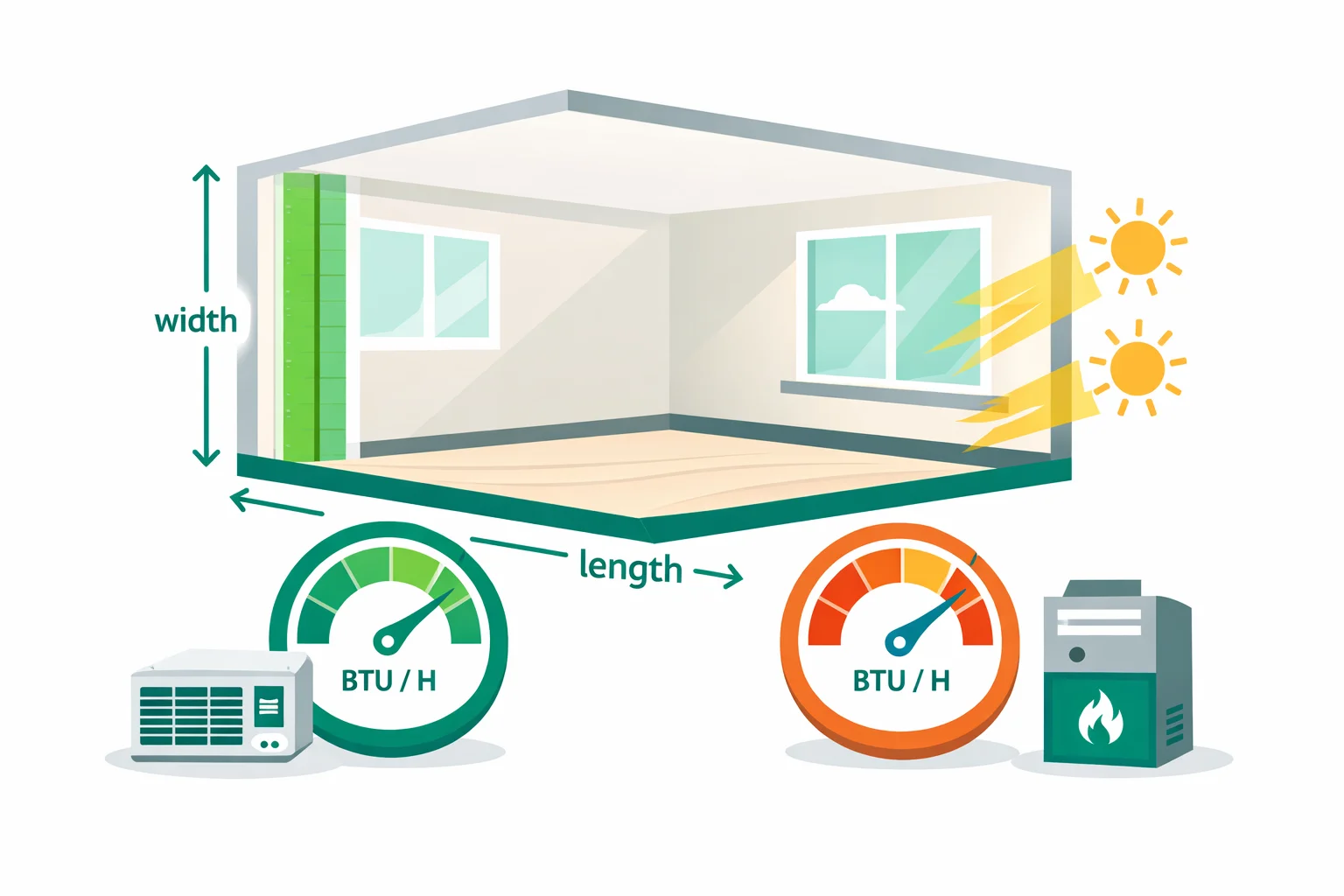
A BTU Is a Rate, Not a Total
BTU stands for British Thermal Unit — the energy it takes to raise one pound of water by one degree Fahrenheit. On its own that's trivia. What matters for sizing equipment is BTU per hour, a rate of heat moved. When a box store tags a window unit "12,000 BTU," it's shorthand for 12,000 BTU/hr — the heat that unit can pull out of a room every hour it runs.
You'll also see cooling rated in tons, and the conversion is fixed: 12,000 BTU/hr equals one ton. The name is a leftover from the ice era — one ton of ice melting over 24 hours absorbs about 12,000 BTU an hour, so early engineers rated chillers against blocks of ice. Divide any BTU figure by 12,000 and you have tons; a 36,000 BTU system is a 3-ton unit. Keep both units straight and the equipment aisle stops being a wall of random numbers.
Why a Bigger AC Cools Worse, Not Better
Here's the counterintuitive truth that most people get backwards: an oversized air conditioner cools worse than a right-sized one. Cooling has two jobs — dropping the temperature (sensible load) and pulling moisture out of the air (latent load). Temperature falls fast. Moisture comes out slowly, only while the compressor keeps running.
An AC that's 50% too big satisfies the thermostat on temperature in three to five minutes, then shuts off — long before it's removed much humidity. The room reads 72°F but feels like a basement, sitting at 60% relative humidity when comfortable is closer to 45-50%. Then it kicks back on a few minutes later. That's short cycling, and it's expensive: every startup draws a surge of current, the compressor wears from constant stop-start, and you never get the long, steady runtime that actually dries the air. A unit matched to the load runs 10 to 15 minute cycles, dehumidifies properly, and lasts longer. Sizing down slightly beats sizing up — the exact opposite of the instinct that says "get the big one to be safe."
The Cooling Load Formula, Step by Step
The core of the cooling calculation is one line, then a short list of adjustments:
Cooling BTU/hr = Floor area × 20 × (ceiling height ÷ 8), then adjust for insulation, sun, windows, occupants, and kitchen
Walk a real room through it. Say you've got a 400-square-foot living room — 20 by 20 — with standard 8-foot ceilings, average insulation, three windows, two people, and strong west-facing afternoon sun. Start with the base: 400 × 20 × 1.0 = 8,000 BTU. The sun is the "sunny" case, so add 10%: 8,000 × 0.10 = 800 BTU, bringing it to 8,800. One window past the standard two adds 1,000 BTU. Two occupants is the baseline, so no add there. The total lands at 9,800 BTU/hr, which rounds to a 10,000 BTU unit.
Notice how a single design choice moved the needle. Kill the afternoon sun with a shade tree or a west-facing overhang and that same room drops to roughly 8,900 BTU — close enough to buy the smaller, cheaper 8,000 BTU unit instead. The calculator above runs this exact arithmetic and shows each line in the breakdown, so you can see which factor is padding your number.
Room Size to AC Size: The Chart Pros Start From
Before you touch a single adjustment, it helps to know the baseline numbers installers keep in their heads. This is the room-air-conditioner sizing chart published by Energy Star, the closest thing to an official answer for "what size AC for X square feet."
| Room area (sq ft) | Cooling (BTU/hr) |
|---|---|
| 100 – 150 | 5,000 |
| 150 – 250 | 6,000 |
| 250 – 300 | 7,000 |
| 300 – 350 | 8,000 |
| 350 – 400 | 9,000 |
| 400 – 450 | 10,000 |
| 450 – 550 | 12,000 |
| 550 – 700 | 14,000 |
| 700 – 1,000 | 18,000 |
One quirk worth understanding: this chart already builds in a safety margin, so it lands a tier above the raw 20-BTU math. A 300-square-foot room computes to 6,000 BTU on the formula but shows 7,000 here. That's deliberate — the chart nudges up to cover hot days. Our calculator sizes to the raw load and rounds to the nearest sold unit, which keeps you out of the oversizing trap. Both approaches are defensible. The only real rule: never buy two sizes past your computed load.
Heating BTUs Depend on Where You Live
Cooling barely cares about your ZIP code; heating cares about almost nothing else. The heat a furnace has to replace depends on the gap between your indoor target and the coldest outdoor design temperature, and that gap is three times larger in Minnesota than in Miami. So heating is sized in BTU per square foot by climate zone.
| Climate zone | Heating BTU / sq ft |
|---|---|
| Zone 1 — Hot (S. Florida, S. Texas) | 30 – 35 |
| Zone 2 — Warm (Deep South, SoCal) | 35 – 40 |
| Zone 3 — Moderate (Carolinas, TN) | 40 – 45 |
| Zone 4 — Cool (lower Midwest, NY, PNW) | 45 – 50 |
| Zone 5 — Cold (N. Midwest, New England) | 50 – 60 |
The swing is huge. Heating a 1,000-square-foot home takes about 40,000 BTU/hr in moderate Zone 3, but 55,000 BTU/hr in frigid Zone 5 — a 15,000 BTU jump for the identical house, just moved north. Insulation stacks on top: poor insulation adds 20% while a tight, well-sealed envelope cuts 20% off. That's why a better-insulated home can drop a full furnace size, and why two identical floor plans in the same city can need very different equipment.
What Moves Your Number Up or Down
The square-footage base gets you in the ballpark. These five factors decide whether you land at the top or bottom of it, and each one carries a real BTU price:
- Ceiling height. The standard is 8 feet. A 10-foot ceiling means 25% more air volume to condition (10 ÷ 8 = 1.25), so a room that needed 8,000 BTU now needs 10,000. Cathedral ceilings punish you twice — more volume and rising heat.
- Windows. Glass is the weak point of any wall. A single-pane window admits and loses far more heat than the insulated wall it replaces, so each window past the first couple adds roughly 1,000 BTU of cooling load. Six windows in a sunroom can outweigh the floor area entirely.
- Sun exposure. A west-facing room baking in afternoon sun runs about 10% hotter than a shaded north-facing one — a 900 BTU difference on a 9,000 BTU room. Trees, awnings, and low-E glass all buy that capacity back.
- Insulation. This is the biggest lever on heating. Going from poor to good insulation is a 40% swing on the heating side (a 1.20 multiplier versus 0.80), which can mean the difference between a 60,000 and a 40,000 BTU furnace.
- Occupants and appliances.Every person past two adds about 600 BTU of body heat, and a kitchen's stove, oven, and fridge justify a flat 4,000 BTU bump. A crowded home office or a frequently-used kitchen genuinely needs more.
What Right-Sizing Does to the Power Bill
Sizing isn't only about comfort — it's money every month a unit runs. Cooling capacity translates to power draw through efficiency: a 10,000 BTU unit at a typical EER of 11 pulls about 910 watts, while a bloated 14,000 BTU unit in the same room draws closer to 1,270 watts for worse dehumidification. Multiply that gap across a summer of runtime and the oversized unit quietly costs more for a clammier room.
Want the dollar figure? Take the wattage the calculator shows, convert it to kilowatt-hours based on how many hours a day the unit runs, and price it out. Running a 910-watt AC eight hours a day for a 30-day month is about 218 kWh, or roughly $37 at the U.S. average rate. The electricity cost calculator ranks that against your fridge, dryer, and water heater so you can see exactly where cooling sits in the bill. That AC wattage matters again the moment the grid drops — if you want to keep cooling through an outage, feed the unit's running and starting watts into the generator sizing calculator to see what size backup unit clears the compressor's startup surge.
Tons, Window Units, and When to Size It Yourself
Once you have a BTU number, matching it to equipment follows a simple decision path. Loads under about 18,000 BTU are window or portable territory — pick the nearest sold size. Above that, you're into central air, sized in tons: divide by 12,000 and round to the nearest half-ton. A 30,000 BTU whole-home load is a 2.5-ton system. Furnaces add one twist: they're rated by input, not output, and lose some heat up the flue, so a 45,000 BTU heating need at 90% AFUE efficiency wants about a 50,000 BTU input furnace.
Know the limits of any square-footage estimate, including this one. It assumes a reasonably normal layout and doesn't model exact window orientation, ductwork losses, air infiltration rates, or the specific insulation R-values in each wall and the attic. For a whole-home central system, contractors run a Manual J load calculation that accounts for all of it — and a good one often lands 10-20% below the rule-of-thumb number, which is exactly why so many homes end up oversized. Use this calculator to size a window unit or space heater with confidence, to sanity-check a contractor's quote, and to see how insulation or window changes shift the load. For the equipment that heats and cools your entire house, treat the result as a strong starting estimate and have the Manual J run before you buy.