kWh Calculator: How to Convert Watts and Hours Into Kilowatt-Hours
A kWh calculator converts a device's wattage and run-time into kilowatt-hours — the exact unit your meter counts and your utility bills you for. One kilowatt-hour isn't an abstraction: it runs a 100-watt ceiling fan for 10 hours, a 10-watt LED bulb for 100 hours, or a 1,000-watt microwave for a solid hour. Get comfortable with that one unit and your entire electric bill stops being a mystery number and becomes something you can predict, device by device.
What One Kilowatt-Hour Actually Powers
Start with the unit itself, because most people never do. A kilowatt-hour is the energy of running one kilowatt — 1,000 watts — for one hour. That's the whole definition. Everything else is just scaling that up or down.
Made concrete, 1 kWh gets you a surprising amount. It'll toast around 20 rounds of bread, run a modern dishwasher through roughly two cycles, keep a 55-inch LED TV on for about 10 hours, or add 3 to 4 miles to an electric car. It'll also power a 60-watt ceiling fan for nearly 17 hours. The same 1 kWh that barely dents a fan's day disappears in 20 minutes under a 3,000-watt clothes dryer. Power rating is what decides how fast you burn through it.
Watts, Kilowatts, and Kilowatt-Hours Aren't the Same Thing
This trips up almost everyone, so it's worth 30 seconds. Watts and kilowatts measure power — how fast a device pulls energy at any instant. A kilowatt-hour measures energy — power multiplied by time. The difference matters because your bill charges for energy, not power.
Here's the payoff of that distinction: a high-wattage device used briefly can cost far less than a low-wattage one left on all day. A 1,500-watt hair dryer run 6 minutes uses 0.15 kWh. A 15-watt cable box left on 24 hours a day uses 0.36 kWh — more than twice as much, from a device rated 100 times weaker. When people ask why their bill is high "even though nothing big is running," this is usually the answer. Time is half the equation, and it's the half the sticker on the appliance never mentions.
The Watts-to-kWh Formula, Worked Two Ways
The conversion is one line, and there are no hidden factors:
kWh = (Watts ÷ 1,000) × Hours
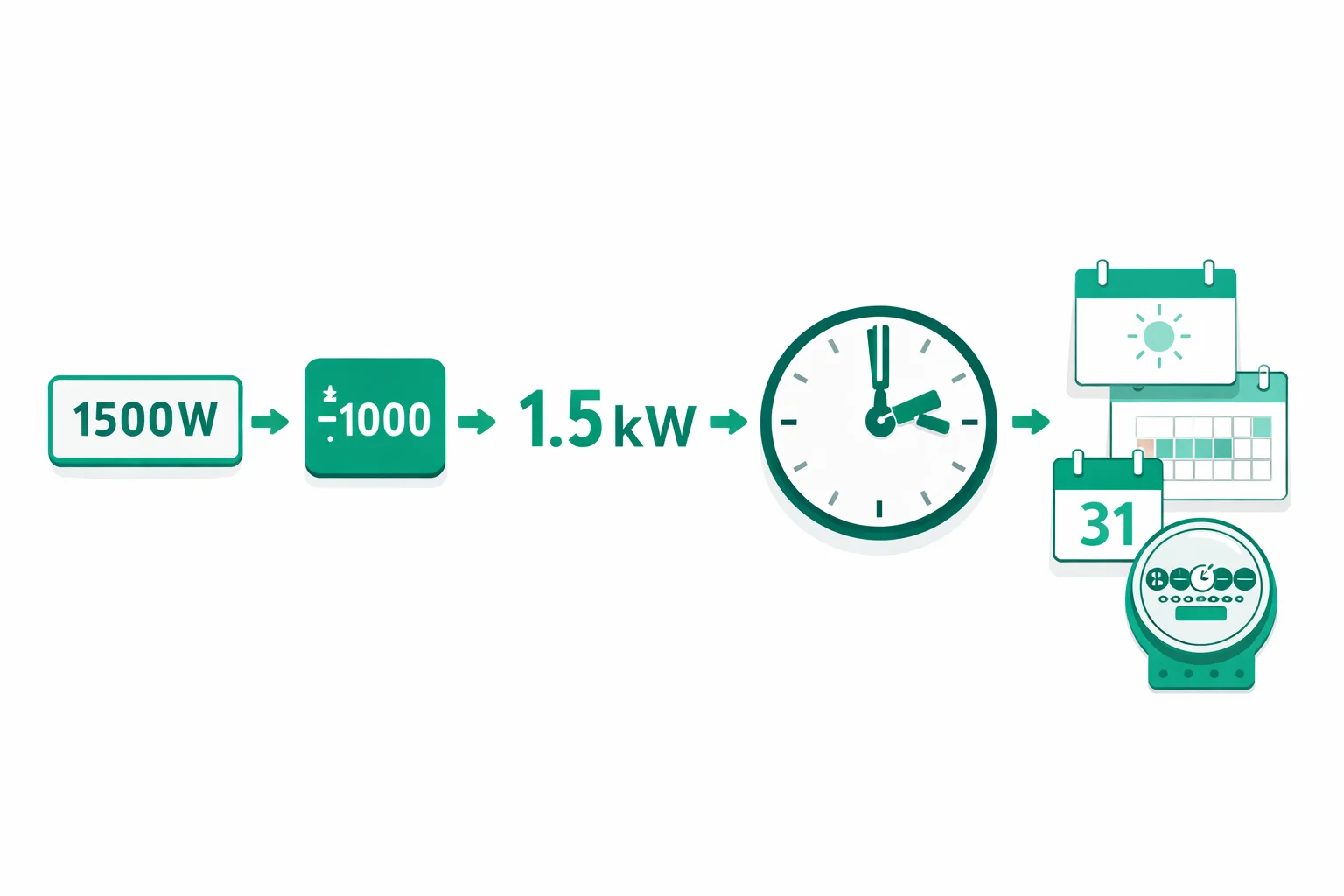
Divide watts by 1,000 to get kilowatts, then multiply by the hours the device runs. That's it. The 1,000 never changes, because a kilowatt is always 1,000 watts.
Worked from watts.A 1,500-watt space heater running 3 hours: 1,500 ÷ 1,000 = 1.5 kW, then 1.5 × 3 = 4.5 kWh in that day. Run it every day and a 30.4-day month is 4.5 × 30.4 = about 137 kWh. At the U.S. average of $0.17 per kWh, that's roughly $23 a month — from a heater that cost $40 to buy. A heater or AC that's mismatched to the room burns even more, which is why it's worth checking the BTU size the space actually needs before you plug one in.
Worked from kilowatts. Some devices already list kW, so you skip the division. A 7.2 kW Level 2 EV charger drawing for 3 hours a night is 7.2 × 3 = 21.6 kWh a night. Over a month that's about 657 kWh — more electricity than some small apartments use for everything combined. That's why the calculator above has a W/kW toggle: enter the number exactly as the label prints it and skip the mental math.
No Wattage Label? Get It From Amps and Volts
Plenty of tools, pumps, and older appliances list amps on the nameplate but not watts. You can still get there, because watts are just amps times volts:
Watts = Amps × Volts
A shop vac pulling 9 amps on a standard 120-volt outlet is 9 × 120 = 1,080 watts, or 1.08 kW. The voltage matters more than people expect. A device drawing 12.5 amps on 120 volts is 1,500 watts, but that same 12.5 amps on a 240-volt dryer or range circuit is 3,000 watts — double the power, double the kWh. So check the circuit: most household outlets are 120 volts, while electric dryers, ranges, water heaters, and EV chargers run on 240. Once you have watts, drop them into the formula above and finish the conversion. Those same wattage figures are exactly what a generator sizing calculator needs — add up the running watts of everything you'd keep on during an outage and you know what size backup unit to buy.
Watts to kWh: A Table You Can Bookmark
Here's the raw conversion at common wattages, no run-time assumptions baked in — just watts turned into kilowatt-hours over different stretches of time. Find your device's wattage on the left and read across.
| Power | 1 hour | 10 hours | 100 hours |
|---|---|---|---|
| 100 W | 0.1 kWh | 1 kWh | 10 kWh |
| 500 W | 0.5 kWh | 5 kWh | 50 kWh |
| 800 W | 0.8 kWh | 8 kWh | 80 kWh |
| 1,000 W (1 kW) | 1 kWh | 10 kWh | 100 kWh |
| 1,500 W | 1.5 kWh | 15 kWh | 150 kWh |
| 2,000 W | 2 kWh | 20 kWh | 200 kWh |
| 3,000 W | 3 kWh | 30 kWh | 300 kWh |
| 5,000 W | 5 kWh | 50 kWh | 500 kWh |
The pattern is clean because it's pure multiplication: every 10x jump in hours is a 10x jump in kWh. To get a real monthly figure, multiply the "1 hour" column by the hours a day you run the device, then by about 30. A 1,500-watt heater at 4 hours a day is 1.5 × 4 × 30 = 180 kWh a month. Once you turn those kilowatt-hours into dollars, the electricity cost calculator ranks your whole home's appliances so you can see which ones actually deserve attention.
How Many kWh Does a Normal Home Use?
A single device's kWh only means something next to a baseline. According to the U.S. Energy Information Administration, the average American home uses about 899 kWh a month — roughly 30 kWh a day. That number swings hard with home size, climate, and whether heating and hot water are electric.
| Home type | kWh / month | kWh / day |
|---|---|---|
| Small apartment (under 1,000 sq ft) | 400–500 | 13–16 |
| Average U.S. home | ~900 | ~30 |
| Large home (2,500–3,000 sq ft) | 1,200–1,500 | 40–50 |
| All-electric home with EV | 1,800–2,500 | 60–80 |
Use these as a sanity check. If you total up your devices and land near 900 kWh in an average-size home, your numbers are believable. Land at 300 or 3,000 and you've either missed a big load like heating and cooling or badly overestimated a run-time somewhere.
Reading Kilowatt-Hours Straight From Your Meter
Your meter is the ground truth, and it speaks in kWh. It shows a running total of every kilowatt-hour your home has ever pulled, so a single reading tells you nothing — the change between two readings is what counts. If the meter reads 45,320 kWh today and read 44,410 a month ago, you used 45,320 − 44,410 = 910 kWh.
Digital meters just display the number. Older dial meters have five small clocks that you read left to right, and here's the catch: adjacent dials spin in opposite directions, and when a pointer sits between two digits you always take the lower one. Want a device's real draw instead of an estimate? Note the meter reading, run only that device for an hour with as much else off as possible, and read again — the difference is its true kWh, duty cycles and all. That's the trick for pinning down the one appliance a nameplate never quite explains.
kWh or Dollars: Which Number to Track
Kilowatt-hours and dollars answer different questions, and knowing which one you need saves a lot of confusion.
- Track kWh when you're comparing hardware.A heat pump versus baseboard heat, an old fridge versus a new one, a gaming PC versus a laptop — kWh is the fair yardstick because it doesn't change when rates do. Two homes on different utilities can still compare kWh directly.
- Track dollars when you're budgeting. Your rate turns kWh into money, and it ranges from about $0.11 per kWh in Idaho to over $0.40 in Hawaii. The same 137 kWh space heater costs $15 in a cheap state and $55 in an expensive one. If you want the bill, not the physics, multiply by your rate.
- Track kWh when you're sizing solar or a battery. Panels are rated in kW and produce kWh, and batteries store kWh, so your annual kilowatt-hours are exactly what the solar calculator needs to size a system that actually covers your usage.
One last habit worth building: pull your effective rate off your own bill instead of trusting the national average. Divide the total dollar amount by the kWh used that month and you get the real price you pay, taxes and fees folded in. Feed that number into the calculator and your dollar estimates will land within a few cents of reality — which is the whole point of doing the math instead of guessing.