Recessed Lighting Layout: How to Space and Size Can Lights
Most people hang recessed lights by eye — one near the couch, one over the coffee table, maybe a third by the window — and end up with a ceiling full of bright pools and dim valleys. Even, glare-free light isn't luck. It comes from two numbers: how far apart the cans sit, and how many lumens each one throws. On a standard 8-foot ceiling that spacing is about 4 feet, center to center, and missing it by even a foot is the difference between a smooth wash of light and a row of spotlights on the floor.
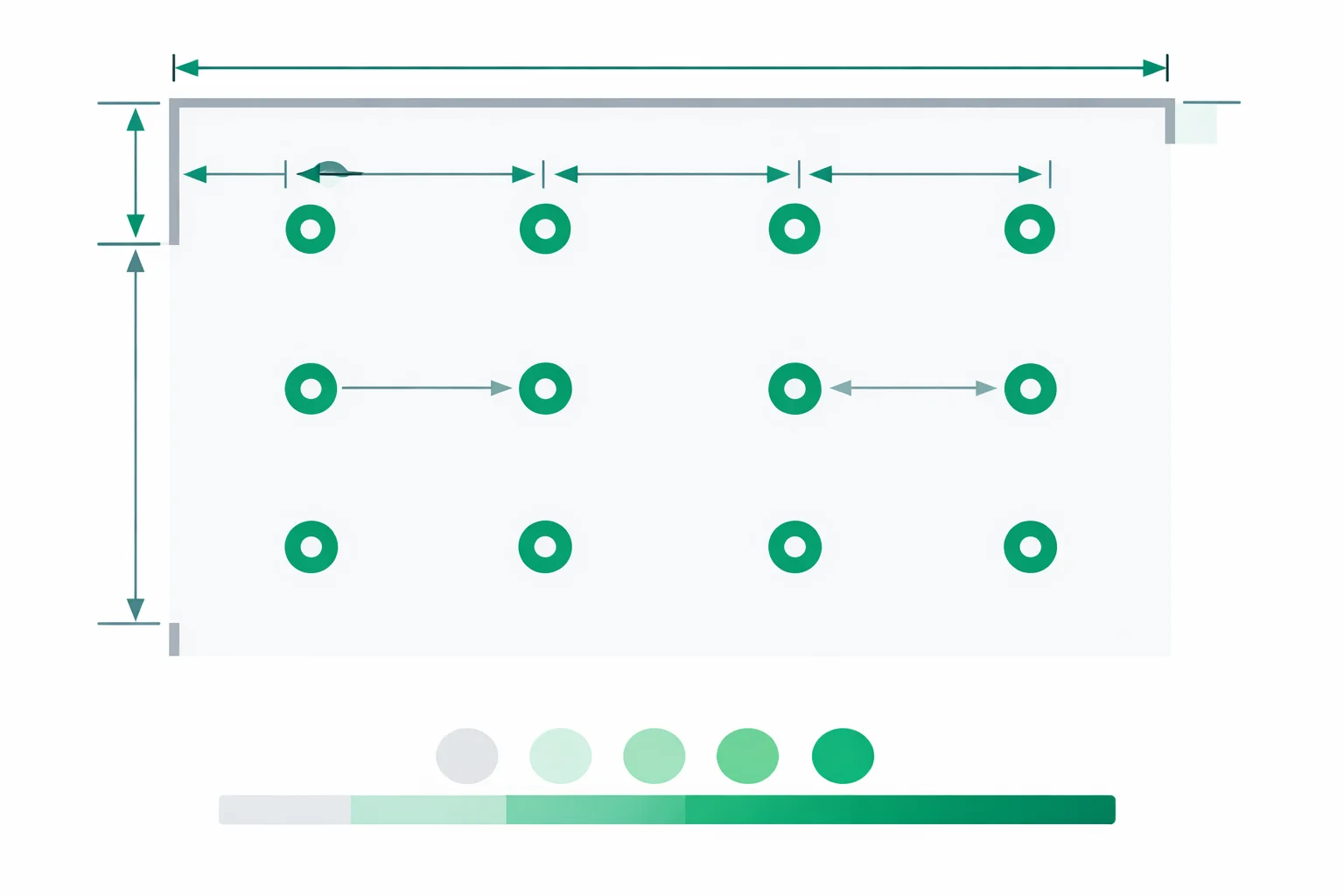
Two Numbers Decide Everything: Spacing and Lumens
A recessed lighting layout is really two separate calculations that people tend to mash together. The first is spacing, which controls evenness — whether the light is uniform across the room or splotchy. The second is lumens, which controls brightness — whether the room is dim, comfortable, or washed out. You can nail one and blow the other. A perfectly spaced grid of weak bulbs looks even and gloomy; three oversized cans crammed in a corner are bright and ugly.
Spacing comes from the ceiling. The working rule is maximum center-to-center spacing = ceiling height ÷ 2, and you keep the outer row about half that distance off the walls. Brightness comes from a separate equation: 1 foot-candle equals 1 lumen landing on 1 square foot, so total delivered lumens = room area × your foot-candle target. Get the grid from the first rule, then size the bulb lumens to hit the second. That order is how lighting designers actually work, and it's why this calculator reports both the layout and the light level instead of a single number.
The Ceiling-Height Rule for Spacing
Taller ceilings let each fixture spread its light over a wider area before it reaches the floor, so spacing grows with height. Here's the rule applied across common ceilings, plus a tighter figure for task-heavy rooms like kitchens where you want denser coverage:
| Ceiling height | General spacing | Off the wall | Task / kitchen |
|---|---|---|---|
| 8 ft | 4.0 ft | 2.0 ft | 3.5 ft |
| 9 ft | 4.5 ft | 2.25 ft | 4.0 ft |
| 10 ft | 5.0 ft | 2.5 ft | 4.5 ft |
| 12 ft | 6.0 ft | 3.0 ft | 5.0 ft |
The off-the-wall number matters more than people expect. Push that first row too far in and the perimeter — exactly where your art, shelving, and seating live — drops into shadow. Pull it too close and you get sharp scallops of light running down the wall. Half the fixture spacing is the sweet spot. If you're still working out the room area before placing anything, the square footage calculator handles odd-shaped and L-shaped rooms cleanly.
How Bright Should the Room Actually Be?
Brightness is measured in foot-candles, and the right target depends entirely on what you do in the room. A bedroom you relax in wants far less light than a kitchen where you're holding a knife. Here are practical residential targets and what they mean in real lumens for a 200-square-foot room:
| Room | Foot-candles | Delivered lumens (200 sq ft) |
|---|---|---|
| Hallway | 5–10 | ~1,000–2,000 |
| Bedroom | 10–20 | ~2,000–4,000 |
| Living / dining | 20–30 | ~4,000–6,000 |
| Kitchen (general) | 30–40 | ~6,000–8,000 |
| Office / kitchen task | 45–50+ | ~9,000–10,000+ |
One catch the table can't show: not every lumen a bulb produces reaches the work surface. Light bounces, scatters, and gets absorbed by dark paint. A room with white walls and ceiling might deliver 75% of the rated lumens to the work plane; a moody charcoal den closer to 55%. That's why two identical fixture counts can feel completely different — and why the calculator lets you drop the efficiency for dark rooms. The U.S. Department of Energy notes that LED downlights direct their light far more efficiently than old incandescent cans, so a 12-watt LED can replace a 65-watt incandescent and still come out ahead on delivered light. Across a full ceiling of cans running a few hours a night, that wattage gap is real money — convert each bulb's wattage into annual usage with the kWh calculator, or run both bulb types through the electricity cost calculator and a room of LED trims often costs a few dollars a year while the same count of incandescents runs into the dozens.
A Real 12 × 16 Living Room, Light by Light
Let's lay out a 12-by-16 living room with an 8-foot ceiling, targeting 20 foot-candles for comfortable general lighting. Every step:
- Area: 12 × 16 = 192 sq ft
- Spacing: 8 ft ceiling ÷ 2 ≈ 4 ft max, center to center
- Fixtures along the 16-ft length: 16 ÷ 4 = 4
- Fixtures along the 12-ft width: 12 ÷ 4 = 3
- Grid: 4 × 3 = 12 cans, each 4 ft apart, the outer row 2 ft off the walls
- Lumens needed: 192 sq ft × 20 fc = 3,840 delivered lumens
- After 70% room efficiency: 3,840 ÷ 0.70 ≈ 5,486 rated lumens total
- Per fixture: 5,486 ÷ 12 ≈ 457 lumens each to clear the minimum
Here's the useful surprise: a standard 700-lumen LED can blows past that 457-lumen floor. Run those, and 12 cans deliver about 12 × 700 × 0.70 ÷ 192 ≈ 31 foot-candles— brighter than the 20 you targeted. That's not a mistake, it's the goal. Put the whole grid on a dimmer and you can drop it to a soft glow for movie night or run it full for cleaning. Twelve cans on a dimmer beats six at full blast every time, because you can subtract light but never add it.
Worth saying plainly: 12 cans in a 192-square-foot room is on the generous side, and that's deliberate. If you want a softer, more architectural look, bump the spacing override to 5 feet and the grid drops to roughly 3 × 2 = 6 cans — then lean on higher-lumen trims plus lamps or sconces to fill in the corners.
Where Most Layouts Go Wrong
- Centering one big fixture.A single can in the middle of a 12 × 16 room lights a circle and leaves the corners dark. Even coverage needs a grid, not a centerpiece — that's the whole reason to choose recessed lighting over a flush mount.
- Counting cans but ignoring lumens. Eight 400-lumen bulbs in a kitchen that needs 35 foot-candles leaves you roughly 40% short. The ceiling looks busy and the counters are still dim. Brightness lives in the bulb, not the hole.
- Skipping insulation-rated housings in the attic. A non-IC-rated can buried in attic insulation is a documented fire hazard. IC-rated airtight housings cost only a few dollars more and also stop your conditioned air from leaking into the attic — a real energy penalty over a winter.
- Forgetting dimmer compatibility.Pairing LED trims with an old incandescent dimmer causes flicker and buzz. A proper LED-rated dimmer is $20–30; learning this after the drywall is closed up is an afternoon you don't get back.
- Lining cans up on the wrong axis.Run the rows parallel to the longest wall and the room reads calm; scatter them or cross the grain of a plank ceiling and it looks like an afterthought. Cost: nothing — but it's the difference between "designed" and "winged it."
Recessed vs. a Center Fixture: When Cans Win
Recessed lighting isn't automatically better than a flush-mount or a chandelier — it's better for specific jobs. The real split is coverage versus presence.
| Factor | Recessed grid | Center fixture |
|---|---|---|
| Even coverage | Excellent across the whole room | Bright center, dark edges |
| Cost (192 sq ft) | $240–480 in trims plus wiring | $60–300 for one fixture |
| Ceiling clearance | Needs 6–8 in of joist depth | Hangs below the ceiling |
| Visual statement | Disappears into the ceiling | A focal point |
Choose the recessed grid when you want clean, even light and a ceiling that gets out of the way — kitchens, hallways, basements, open-concept spaces. Choose a center fixture when the light itself should be part of the design, like a dining table or an entry. Plenty of rooms use both: a grid of cans for working light plus a pendant for character. If the ceiling needs patching or new board to take the housings, the drywall calculator sizes the board and mud for that side of the job.
Trim Size and Beam Spread: 4-Inch Isn't Just Smaller
Trim diameter changes more than looks. A 6-inch can throws a wide, soft pool — it covers more floor per fixture, which is why it's the default for general room lighting. A 4-inch can produces a tighter, more concentrated beam built for accent work: washing a stone fireplace, grazing a textured wall, or lighting a single reading chair.
Beam angle is the other lever. A narrow 25–35° beam is a spotlight for art and accents; a wide 60° beam is a floodlight for general coverage. Mixing them is how good lighting plans get depth — say, 6-inch 60° cans on the main grid plus a few 4-inch 30° adjustable trims aimed at the bookcase. Beam spread also feeds back into spacing: narrow beams need to sit closer together to avoid scalloping, so if you spec tight beams, tighten the grid to match. Painting the ceiling between the cans? The paint calculator covers that, and remember the ceiling color directly changes how much light bounces back into the room.
When the Even Grid Is the Wrong Answer
The ceiling-height grid is built for uniform general lighting, and that isn't always what you want. Over a kitchen island or a desk, you want concentrated task light directly on the surface — place those cans where the work happens, even if it breaks the pattern. For wall-washing artwork or cabinetry, pull the row in to 12–18 inches and use adjustable trims aimed at the wall, which deliberately violates the off-the-wall rule.
Sloped and vaulted ceilings change the geometry entirely — you need sloped-ceiling housings, and the spacing math shifts because mounting height varies across the room. Very high ceilings (14 feet and up) often do better with fewer, higher-output fixtures or a different fixture type altogether, because the half-height rule would scatter cans so far apart that the light gets weak before it lands. And in a room you only ever use for ambient mood lighting, a tight task-grade grid is just wasted fixtures and energy. Treat the calculator as the starting framework for general lighting, then layer task and accent light on top where the room asks for it. For a full remodel where lighting is one line among framing, drywall, and finishes, the construction calculator rolls it into the larger material takeoff. And for energy-saving fixture choices, ENERGY STAR lists certified LED downlights that actually hit their rated lumens and last as long as the box claims.