Drywall Calculator: Sizing Sheets, Mud, Tape, and Screws Together
A drywall calculator that only counts sheets is missing two-thirds of the job. Hanging the board is the fast part — a couple of people can board a bedroom in an afternoon. It's the taping, mudding, and sanding of every seam that eats the days, and the length of those seams is decided the moment you pick a sheet size. Two 4×12 panels on a 12-foot wall leave one joint to finish; three 4×8 panels leave two. Same wall, 50% more taping. That's the number this calculator is really built to surface, right alongside the sheets, mud, tape, and screws you'll carry to the register.
Why Sheet Size Decides How Long the Job Takes
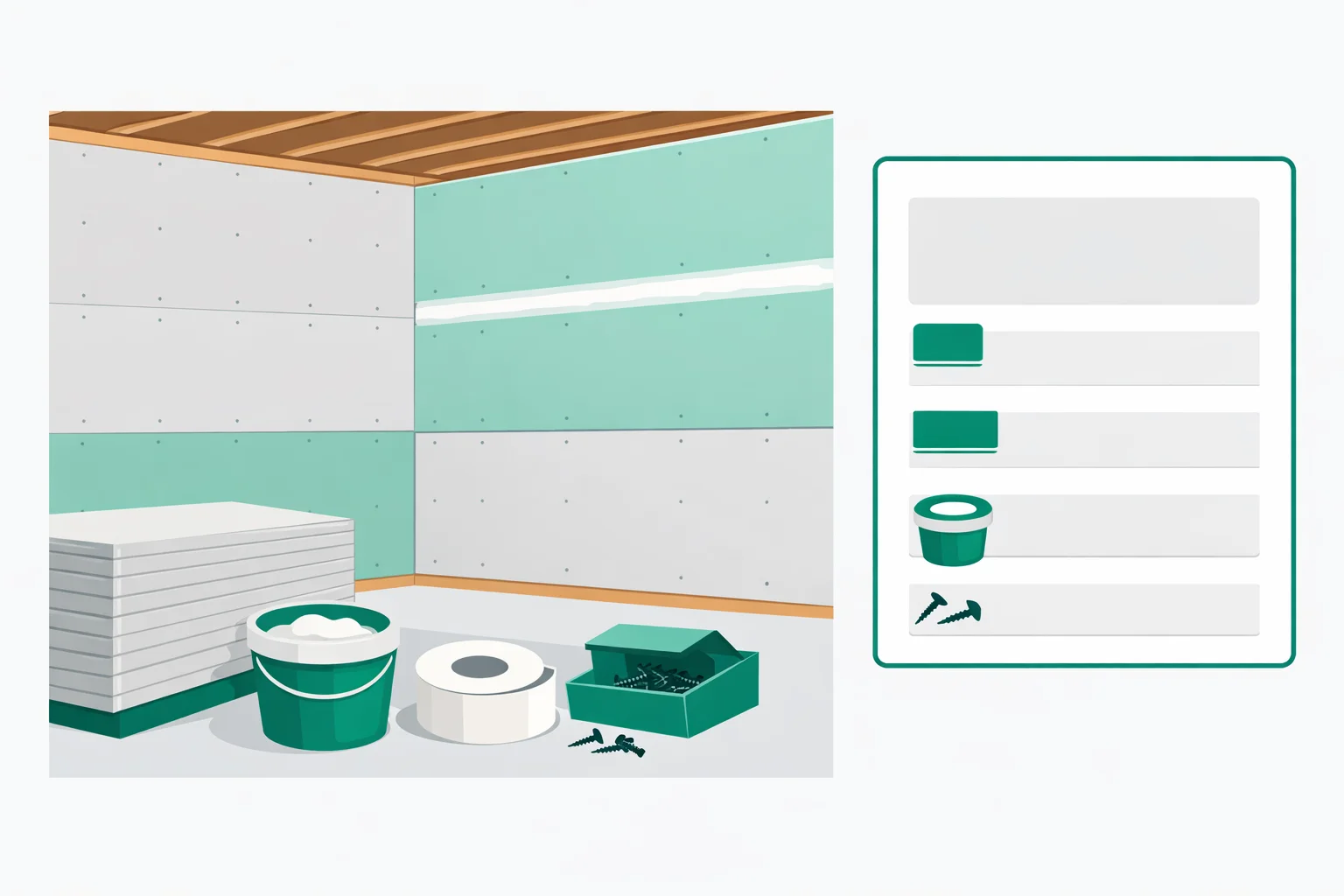
Drywall is sold by the square foot, but the finishing work happens by the linear foot of seam. Every joint gets tape, three coats of compound with dry time between each, and a sanding pass. A butt joint — where two panel ends meet without a tapered factory edge — is the worst of them, because you're feathering compound over a slight hump instead of into a recess.
Bigger sheets attack that problem directly. A 4×12 sheet spans a 12-foot wall in one piece, so the wall has zero vertical butt joints instead of one or two. Hang the panels horizontally and a standard 8-foot wall needs just two courses, leaving a single long horizontal seam at mid-wall. Switch to 4×8 sheets and you add a vertical joint every 8 feet. Across a whole room, moving from 4×8 to 4×12 panels routinely cuts butt-joint footage by 30 to 40 percent — and butt joints are exactly the ones that telegraph through paint when they're rushed.
The Formula: From Room Dimensions to Sheet Count
The math is short once you separate the walls from the ceiling. Walls wrap the perimeter; the ceiling is just the floor plan.
1. Wall area:perimeter × wall height. Perimeter is 2 × (length + width). A 14 × 12 room is 2 × (14 + 12) = 52 feet around, and at 8 feet tall that's 52 × 8 = 416 square feet of wall.
2. Subtract openings: a standard door is about 21 square feet (3 × 7), a window about 15 (3 × 5). One door and two windows trim 51 square feet, leaving 365.
3. Add the ceiling:length × width. Here that's 14 × 12 = 168 square feet, for 533 total.
4. Divide by sheet area, then add waste:a 4×8 sheet covers 32 square feet. 533 ÷ 32 ≈ 17 sheets, and a 10% cushion rounds you to about 19. If you'd rather pin down an irregular footprint first, our square footage calculator handles L-shapes and multi-room layouts before you ever pick a panel.
A Real 14x16 Bedroom, Hung and Finished
Let's board a 14 × 16 master bedroom with 9-foot ceilings — one door, two windows, ceiling included — in 1/2-inch 4×8 sheets. Here's the entire order, line by line:
- Perimeter: 2 × (14 + 16) = 60 ft
- Gross wall: 60 × 9 = 540 sq ft
- Less 1 door + 2 windows: 540 − 51 = 489 sq ft
- Ceiling: 14 × 16 = 224 sq ft
- Total surface: 713 sq ft
- Sheets (+10% waste): 713 × 1.10 ÷ 32 = 25 sheets
- Joint compound: 713 ÷ 100 ≈ 7.1 gal — two 4.5-gal boxes
- Tape: 713 × 0.4 ≈ 285 ft — two 250-ft rolls
- Screws: ~750 — a single 5-lb box covers it
- Sheets at $14: 25 × $14 = $350
- Finishing materials: ~$70 in mud, tape, and screws
- DIY material total: about $420, or roughly $0.59 per square foot
Now hire it out. At $2.25 per square foot to hang and finish to a smooth Level 4, that 713 square feet runs about $1,600 in labor — close to four times the material cost. That ratio is the whole reason drywall is such a common DIY job: the material is cheap, and you're really paying a pro for the finishing skill, not the gypsum.
Drywall Thickness: What Goes Where, and Why
Thickness isn't a preference — code and the substrate decide it. Grab the wrong board and you either waste money or fail an inspection.
| Thickness | Weight (4×8) | Where it goes |
|---|---|---|
| 1/4" | ~38 lb | Curved walls, skim over old plaster |
| 3/8" | ~44 lb | Remodels, double-layer repairs |
| 1/2" | ~51 lb | Standard walls, ceilings on 16" joists |
| 5/8" Type X | ~70 lb | Garages, fire walls, sag-free ceilings |
The 5/8-inch Type X board is the one people skip to save a few dollars and later regret. It's required by the International Residential Code on the garage side of any wall shared with living space, and its extra stiffness keeps ceilings from sagging between joists. On a ceiling, half-inch board on 24-inch centers can droop over time; bumping to 5/8-inch or using sag-resistant board fixes it for about $4 more per sheet.
Mud, Tape, and Screws: The Part That Isn't on the Pallet
The sheets are the obvious cost. The finishing supplies are the ones people forget, then drive back for. Here's how to size each straight from the board area:
- Joint compound:plan about 1 gallon per 100 square feet of drywall for tape plus three coats. A 4.5-gallon box finishes roughly 450 square feet, or fourteen 4×8 sheets. All-purpose mud handles every coat; lightweight setting-type ("hot mud") sets faster between coats but is harder to sand.
- Tape: roughly 40 feet per 100 square feet of board. Paper tape is stronger on butt joints and flat seams; mesh is easier for beginners but needs setting-type compound for the first coat. A 250-foot roll covers about 625 square feet.
- Screws: about 1 per square foot — every 16 inches in the field, 8 inches on the edges, and tighter on ceilings. Use 1-1/4-inch coarse screws for 1/2-inch board on wood studs, 1-5/8-inch for 5/8-inch board. A 5-pound box holds well over 1,000.
Underbuying mud is the classic miss. Compound is cheap and stores for months sealed, so round up — leaving a half-finished room while you wait for a coat to dry, then driving out for one more box, costs you a whole day.
4x8 vs. 4x12: The Seam-vs-Weight Tradeoff
The case for big sheets is fewer seams. The case against is the back of whoever's carrying them. Run the same 533-square-foot room through all three common lengths and the swap is plain:
| Sheet size | Sheets (+10%) | Weight each (1/2") | Seams to tape |
|---|---|---|---|
| 4 × 8 ft | 19 | ~51 lb | Most |
| 4 × 10 ft | 15 | ~64 lb | Fewer |
| 4 × 12 ft | 13 | ~77 lb | Fewest |
A 4×12 sheet of half-inch board weighs around 77 pounds, and 5/8-inch pushes past 100. That's a two-person lift, awkward on a ceiling and nearly impossible up a stairwell. The rule of thumb: use the longest sheet your access and your helpers can handle. Pros default to 4×12 on open walls because the finishing time saved dwarfs the handling hassle; a solo DIYer in a tight room is usually right to stay with 4×8. Behind that drywall, your stud spacing sets the fastening pattern — our framing calculator counts the studs and plates the sheets screw into.
Drywall Mistakes That Cost Real Money
- Ordering exact square footage. Zero waste on a room with a door, two windows, and four corners means you run short. Cost: a second trip and a stalled job. Always add 10%, more for cut-heavy rooms.
- Wrong board in the garage. Using standard 1/2-inch instead of 5/8-inch Type X on the house-side garage wall is a failed inspection and a tear-out. The fire-rated board costs about $4 more per sheet — far less than redoing the wall.
- Half-inch ceilings on 24-inch joists. Half-inch board sags between widely spaced joists within a year or two. Stepping up to 5/8-inch or sag-resistant board adds roughly $0.15 per square foot and prevents a wavy, re-screwed ceiling.
- Skimping on screws. Spacing fasteners too far apart lets the board flex, which cracks seams down the road. The fix is a $25 box of screws — cheap insurance against re-taping cracked joints.
- Underbuying compound, then sanding hot mud.Running out mid-coat, or trying to sand fast-setting compound smooth, wastes hours. Buy one extra box of all-purpose mud; it keeps, and it's forgiving.
Ceilings Aren't Just Walls Turned Sideways
Boarding a ceiling looks like more of the same, but three things change. First, gravity: every sheet has to be held up while you set screws, so a drywall lift or a second pair of hands is essentially required. Second, fastening — ceilings get screws every 12 inches instead of 16, and more of them, because the board is pulling away from the framing rather than resting against it.
Third, deflection. A ceiling that looks dead flat the day you screw it up can develop a slow sag, especially with half-inch board, high humidity, or blown-in insulation pressing from above. If you're adding that attic layer first, our attic insulation calculator sizes the bags and depth before the board goes up. That's why the standard move is 5/8-inch or sag-resistant board overhead. Once it's finished and primed, our paint calculator sizes the primer and topcoat for the same walls and ceiling you just boarded. If you're cutting can lights into that new ceiling, our recessed lighting calculator lays out how many fixtures you need and where to space them before you start cutting holes.
When This Estimate Won't Be the Whole Order
This tool sizes the board, mud, tape, and screws — the bulk of a standard room. It doesn't price a handful of real line items, so add them when they apply. Corner bead runs about $1 to $2 per linear foot on every outside corner; moisture- or mold-resistant board for bathrooms costs more than standard; and cement board behind tile is a different product entirely. A drywall lift rents for $40 to $60 a day if you're doing ceilings, and primer plus a Level 5 skim coat on high-gloss walls adds material the field count doesn't capture.
The compound and tape figures are planning numbers, too — real usage shifts with how heavy a hand you have and how many coats you choose. A first-timer burns more mud than a taper who's done it for years. Buy a little extra of the cheap stuff and skip the second store trip. For a remodel where drywall is one line among framing, insulation, and finishes, our construction calculator folds the board into the whole-project takeoff.