Biweekly vs Semi-Monthly: Why One Saves $87,000 and the Other Saves Nothing
Biweekly mortgage payments and semi-monthly payments sound like the same thing. They're not — and the gap between them is worth about $87,000. On a $300,000 loan at 6.5%, paying every two weeks knocks nearly six years off a 30-year mortgage and saves roughly $87,000 in interest. Paying twice a month, on the 1st and the 15th, saves you nothing at all. The biweekly mortgage calculator above runs the split on your own numbers; the difference always traces back to a single hidden payment a year.
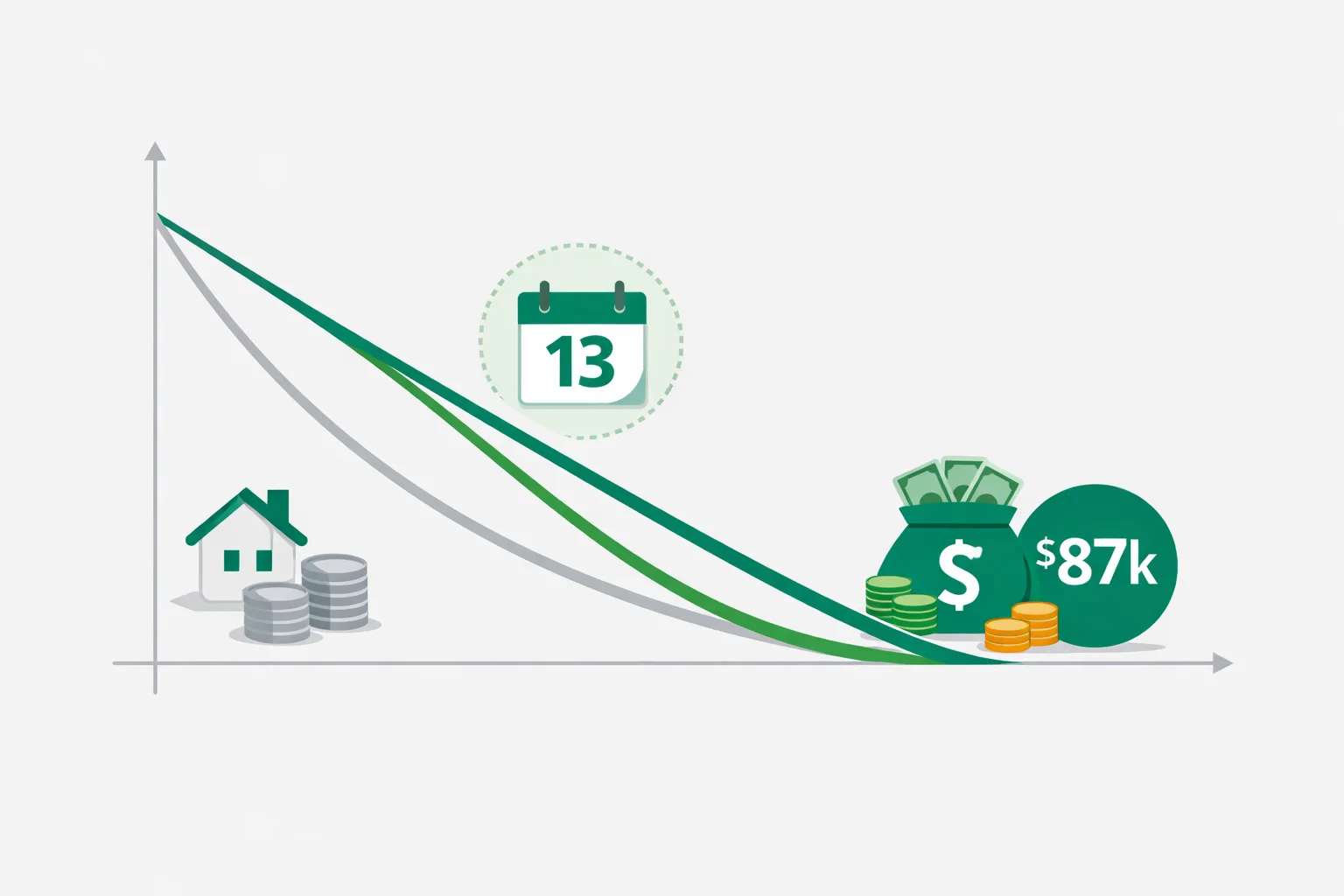
The Whole Trick Is a 13th Payment You Barely Feel
A year has 52 weeks. Split your mortgage into a half-payment every two weeks and you make 26 of them — which is 13 full payments, not 12. That extra payment is the entire mechanism. You never write a bigger check; you just end up sending one more full payment a year without it landing as a lump in any single month.
On our $300,000 loan at 6.5%, the monthly payment is $1,896. Half of that is $948, paid every two weeks. Over a year you pay $24,651 instead of $22,754 — an extra $1,896, or exactly one payment. All of it goes to principal, and principal is where the interest lives. Erase a dollar of principal in year one and you erase every future dollar of interest that balance would have generated over the next 29 years. That's why one extra payment a year turns into 5 years and 10 months off the loan.
Biweekly vs Semi-Monthly: The $87,000 Difference
Here's the confusion that costs people real money. "Biweekly" and "semi-monthly" both mean roughly two payments a period, so they get used interchangeably. They're mathematically different, and only one of them saves you a cent.
| Schedule | Payments/Year | Full Payments/Year | Interest Saved |
|---|---|---|---|
| Monthly | 12 | 12 | — |
| Semi-monthly (1st & 15th) | 24 | 12 | $0 |
| Biweekly (every 2 weeks) | 26 | 13 | ~$87,000 |
| Weekly | 52 | 13 | ~$88,000 |
Semi-monthly gives you 24 payments of $948, which totals $22,754 — the same $22,754 you'd pay in 12 monthly installments. Twelve full payments, no more. Biweekly gives you 26 payments of $948, totaling $24,651, which is 13 full payments. The word "semi-monthly" ties payments to the calendar month, so you can never get more than 24 a year. "Biweekly" ties them to the two-week cycle, which drifts past the month and delivers a 26th payment. If a lender or program offers you a "twice a month" plan and calls it accelerated, that number should be your first question.
How Half a Payment Every Two Weeks Adds Up
Start with the standard amortization formula that sets your payment: M = P × [ r(1 + r)ⁿ ] ÷ [ (1 + r)ⁿ − 1 ], where P is the balance, r is the monthly rate (annual rate ÷ 12), and n is the number of monthly payments. Plug in $300,000, 0.0054167, and 360 and you get $1,896.
Now watch the first month. Interest is $300,000 × 0.0054167 ≈ $1,625, so a normal payment drops the balance by only $271. With biweekly, you effectively add $158 of pure principal every month (one extra $1,896 payment ÷ 12). That month, principal falls by $429 instead of $271. Next month interest is charged on a slightly smaller balance, so a hair more of your regular payment goes to principal too — and the effect compounds. The payoff date moves from 360 payments to about 290, and total interest falls from roughly $383,000 to $295,000. To see the same effect play out row by row, the mortgage amortization calculator shows how a 13th payment reshuffles the entire schedule.
What You'll Save at Your Loan Size and Rate
Two things drive your savings: how big the loan is and how high the rate is. The payoff time barely moves with loan size — a $150,000 loan and a $500,000 loan at 6.5% both finish about 5.8 years early — but the dollars saved scale straight up with the balance.
| Loan (6.5%, 30 yr) | Biweekly Payment | Interest Saved | Years Saved |
|---|---|---|---|
| $150,000 | $474 | ~$43,600 | ~5.8 |
| $300,000 | $948 | ~$87,300 | ~5.8 |
| $400,000 | $1,264 | ~$116,300 | ~5.8 |
| $500,000 | $1,580 | ~$145,400 | ~5.8 |
Rate is the bigger multiplier. On the same $300,000 loan, biweekly saves about $33,000 and shaves 4 years at a 4% rate, but jumps to roughly $138,000 and 7 years at 8%. The higher your rate, the harder the extra payment works — because there's more interest for it to cancel. If you're carrying a high rate, that's also a signal to check what a refinance or a 15-year mortgage would do before committing to years of biweekly payments on the current loan.
You Can Do This for Free — Here's How
You don't need a program, an enrollment form, or a fee to pay biweekly. There are three free ways to capture the exact same 13th payment:
- Add one-twelfth to every monthly payment.Take your payment, divide by 12, and send that much extra as principal-only each month. On $1,896 that's about $158 more — the cleanest method, and it works even if your servicer won't accept biweekly drafts.
- Make one full extra payment a year. Drop a whole $1,896 payment whenever a bonus, tax refund, or third-paycheck month shows up, marked principal-only. Slightly less saved than spreading it out, but dead simple.
- Set up a real biweekly draft with your own bank.If you're paid every two weeks, schedule an automatic $948 transfer to the mortgage each payday. Two months a year you get three paychecks, which quietly funds the extra payment.
That last point is why biweekly clicks for so many households: it matches how the paycheck arrives. You're budgeting around a two-week rhythm anyway, so a two-week mortgage draft never feels like a stretch.
Are Paid Biweekly Programs Worth It?
Third-party biweekly companies pitch this as a service, and they charge for it. A typical program runs a $300–$400 setup fee plus $2.50 to $6.95 per draft. At $3.50 a draft across the roughly 628 biweekly payments it takes to retire a $300,000 loan, that's about $2,548 in fees on top of the setup — for a result you can produce with a free recurring transfer.
There's a subtler catch, too. Many of these services don't forward your money to the lender every two weeks. They hold each half-payment and only send a full payment monthly, banking the two extra half-payments to release one 13th payment near year-end. That still works, but you paid a fee for a schedule you could have set yourself. The only honest case for a paid program is discipline: if the fee is the thing that actually keeps you consistent, it may be worth it. For most people, an automatic principal-only transfer does the same job for free. The Consumer Financial Protection Bureau makes the same point: you can usually replicate these programs on your own at no cost.
Will the Extra Actually Reach Your Principal?
This is where good intentions quietly die. When you send extra money, plenty of servicers don't apply it to principal automatically — they park it toward your next scheduled payment, or hold a half-payment in a suspense account until the second half arrives. Either way, your balance doesn't drop and you save nothing.
Do two things. First, when you add money, mark it "apply to principal" — write it on the check memo or choose the principal-only option in your online portal. According to the CFPB, you generally have to instruct the servicer specifically to apply extra payments to the principal balance. Second, check next month's statement and confirm the balance fell by the full extra amount. A $158 monthly add-on that's silently credited to next month's bill for a year is $1,896 that bought you almost zero payoff progress. If you want to see exactly how much interest each principal dollar erases, run your loan through the mortgage interest calculator.
When Biweekly Isn't the Right Move
Accelerating a mortgage isn't automatically the smartest thing to do with a dollar. Before you lock into a biweekly plan, check whether one of these applies:
- You haven't captured your full 401(k) match. A 50–100% employer match is an instant guaranteed return no 6.5% payoff can touch. Grab every matched dollar first.
- You carry high-interest debt.A 22% credit card costs more than three times what your mortgage does. Clear that before overpaying the cheapest money you'll ever borrow.
- Your emergency fund is thin.Money sent to the mortgage is locked in the walls — you can't pull it back without a refinance or a HELOC. Keep 3–6 months of expenses liquid first.
- Your rate is very low.On a 3% loan, paying early earns a guaranteed 3% — often less than a high-yield savings account, and far less than the market's long-run average. The extra $158 may do more elsewhere.
Biweekly is a great default when those boxes are already checked and you simply want to be debt-free sooner without feeling the squeeze. If you'd rather see how biweekly stacks against a lump sum or a larger monthly add-on, the mortgage payoff calculator ranks every acceleration strategy side by side.
Biweekly Mistakes That Waste the Whole Benefit
- Signing up for semi-monthly by accident.A "twice a month" plan is 24 payments — 12 full payments a year — and saves $0. Confirm your schedule is 26 payments, not 24, or the whole exercise is pointless.
- Paying a fee for something free.A $350 setup plus per-draft charges can run past $2,500 over the loan. Unless the fee is what keeps you disciplined, that's pure waste next to a free bank transfer.
- Letting the servicer hold your money.If half-payments sit in suspense instead of hitting principal, you get 12 payments' worth of progress, not 13. Verify on your statement that the balance is actually dropping faster.
- Assuming your monthly bill goes down.Biweekly shortens the loan; it does not lower your required payment. Your payoff date moves up while the contractual payment stays the same — which is fine, just don't expect relief on the monthly number.
Keep it boring on purpose: confirm the plan is a true 26-payment schedule, set an automatic principal-only draft you won't miss, and check one statement to be sure the money landed. If your paycheck already comes every two weeks, this is the rare payoff strategy that fits your budget without asking you to find a single extra dollar.