The 30-Year Mortgage Isn't Expensive — It's the Flexible One
Run a 30-year mortgage calculator on a $340,000 loan at 6.5% and the payment lands at $2,149 a month. Run the same loan over 15 years and it jumps to $2,962 — $813 more, every month, for fifteen years straight. That $813 gap is the entire reason the 30-year term exists. Critics call it the expensive option because you hand the lender $433,651 in interest, more than the house itself. True. But that headline buries the real point: the 30-year isn't more expensive, it's more flexible. It only costs the full $433,651 if you actually take all 30 years — and nothing forces you to.
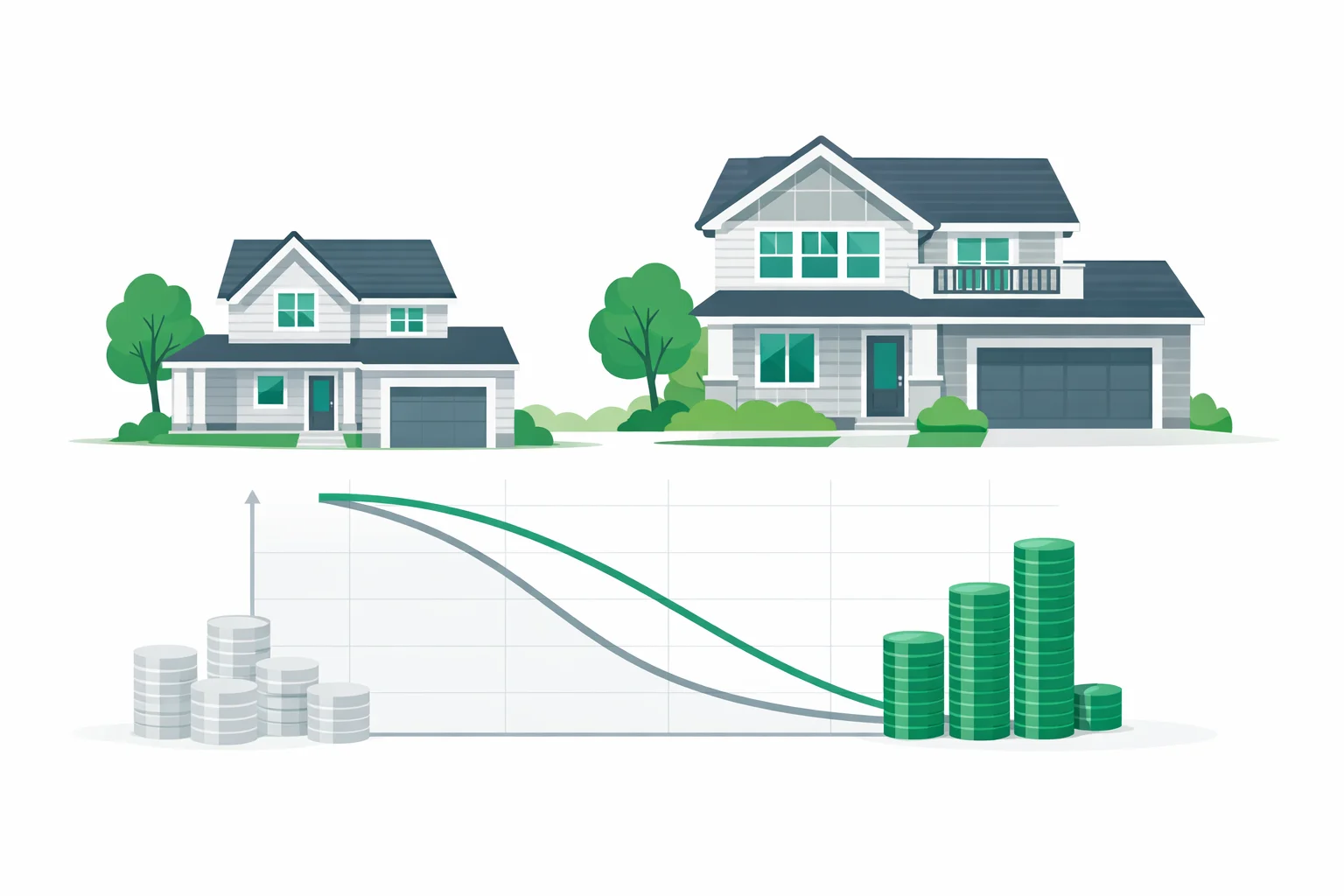
Why 9 in 10 Buyers Reach for the 30-Year
The 30-year fixed is the default American mortgage, and it's not because buyers can't do math. It's because the low payment does two jobs at once: it fits a monthly budget, and it leaves cash free for everything a house demands after closing — a dead furnace, a leaking roof, a retirement account that also needs feeding.
Lenders lean on it too. A 30-year loan is the most portable, most predictable product on the shelf, which is why the CFPB's loan-options guide treats it as the baseline every other term compares against. The catch is that "lowest payment" and "lowest cost" are not the same thing — and the 30-year wins the first while losing the second. Whether that trade is smart comes down to one question: what do you do with the $813 you keep each month?
The Same Payment Buys You 38% More House
Here's the angle rate-shopping tools never show you. Fix your payment instead of your loan, and the term turns into a lever on how much house you can buy. At $2,149 a month with 20% down, a 30-year term supports a $425,000 home. Hold that exact payment and switch to a 15-year, and you can only afford about $308,000 — roughly $117,000 less house for the identical monthly check.
That 38% swing is why the 30-year dominates high-cost markets. Run it across a range of budgets and the pattern holds (20% down, 6.5% on every term):
| Monthly P&I Budget | 30-Year Buys | 20-Year Buys | 15-Year Buys |
|---|---|---|---|
| $1,800 | $356,000 | $302,000 | $258,000 |
| $2,200 | $435,000 | $369,000 | $316,000 |
| $2,600 | $514,000 | $436,000 | $373,000 |
| $3,000 | $593,000 | $503,000 | $430,000 |
One honest caveat: this table uses the same rate for every term. In the real world 15-year rates run lower, which claws back a little of the 15-year's deficit — but never enough to close a 38% gap. The 30-year is, and will stay, the term that stretches a fixed budget furthest. If a bigger down payment is your other lever, the down payment calculator shows how that shrinks the loan behind all of these numbers.
What the Extra 15 Years Actually Cost You
The flexibility isn't free, so let's price it to the dollar. Take that $340,000 loan at 6.5% and hold it to full term:
- Total handed over: $2,149 × 360 payments = $773,651.
- Total interest: $773,651 − $340,000 = $433,651.
- Interest share: 56 cents of every dollar you pay is interest, not principal.
Now the 15-year version of the same loan: $2,962 a month, $533,118 total, and only $193,118 in interest. Choosing 30 years over 15 adds $240,533in lifetime interest. That's the sticker price of the low payment — a big enough number to stare at before you sign. To watch that interest pile up month by month, the mortgage interest calculator breaks it out across the full schedule.
The 30-Year Loan That Pays Off in 15
This is where the "expensive" label falls apart. A 30-year mortgage doesn't lock you into 30 years — it locks you into a maximumpayment and a minimum pace. You're free to go faster whenever you want, and the math is exact: add the $813 difference to your $2,149 payment, and the 30-year loan retires in precisely 15 years with total interest of $193,118 — the same $193,118 a real 15-year loan would cost.
So the 30-year hands you the 15-year's outcome plus an escape hatch. Lose your job in year 7 and the 15-year borrower still owes $2,962 every month with no legal way down. The 30-year borrower simply stops the extra $813 and falls back to $2,149 until things stabilize. You buy that insurance with a slightly higher rate — usually 0.5% to 0.75% above a 15-year — which is the only real cost of keeping the option open.
Even modest extra payments hit hard. An extra $200 a month on this loan trims about $107,000 in interest and pulls the payoff in by more than six years, because early principal kills all the future interest that dollar would otherwise generate.
Your Equity Crawls for a Decade, Then Runs
The 30-year amortization curve blindsides first-time owners. Your opening $2,149 payment splits $1,842 to interest and just $307 to principal. Interest is charged on the balance, the balance starts high, so the lender collects most of your money up front while your equity barely twitches.
On this loan, principal doesn't overtake interest inside a single payment until around year 20, and you don't cross the halfway-paid-off line until roughly year 21. Five years in, you've knocked barely $22,000 off a $340,000 balance. Then the curve flips: once principal takes the lead the balance drops fast, and the final decade retires debt at a sprint. The full mortgage amortization calculator maps every one of those 360 payments if you want the exact crossover for your numbers. This front-loading is also why a dollar paid in year 2 is worth far more than the same dollar in year 25.
Should You Take 30, 20, or 15 Years?
The 20-year is the forgotten middle option, and it's often the sweet spot. On the $340,000 loan it runs $2,535 a month — $386 more than the 30-year — but cuts total interest to $268,388, saving $165,263 against the 30-year while asking far less of your budget than the 15-year does. Use this framework:
- Take the 30-yearif the payment gap decides whether you can buy at all, your income is variable, or you have higher-return uses for the cash — a 401(k) match, an emergency fund that isn't built yet, or high-interest debt.
- Take the 20-yearif you can absorb a few hundred dollars more per month and want most of the interest savings without the 15-year's steep payment.
- Take the 15-year if the $2,962 payment still leaves you fully funding retirement and a 3–6 month reserve. The forced discipline and lower rate save the most.
If you're leaning short, price the exact payment on the dedicated 15-year mortgage calculator before you commit — that higher payment is a fifteen-year, real-life obligation, not a one-month experiment.
How Much a Half-Point Costs Across 30 Years
A 30-year term magnifies your rate more than any shorter loan, because interest compounds across 360 payments instead of 180. Watch what small rate moves do to the same $340,000 loan:
| Rate | Monthly P&I | Total Interest |
|---|---|---|
| 5.5% | $1,930 | $354,974 |
| 6.0% | $2,038 | $393,850 |
| 6.5% | $2,149 | $433,651 |
| 7.0% | $2,262 | $474,330 |
| 7.5% | $2,377 | $515,839 |
Every half-point costs roughly $40,000 in lifetime interest and about $110 a month. A full point from 6.0% to 7.0% is $80,480 in interest — real money for a number you can move with a stronger credit score or a well-timed lock. Rates shift constantly; Freddie Mac's weekly rate survey tracks where the 30-year fixed sits right now. Pull Loan Estimates from three lenders on the same day, since quotes from different days aren't comparable.
The 30-Year Mistakes That Cost the Most
- Serial refinancing back to 30 years.Ten years in, refinancing into a fresh 30-year term restarts the interest clock. Even at a lower rate, you can pay more total interest than if you'd left the old loan alone. Refinance into a 20-year, or keep making the old payment on the new lower rate.
- Buying the most house the 30-year allows.The buying-power table cuts both ways — just because a 30-year lets you afford $117,000 more house doesn't mean you should stretch to the ceiling. Taxes, insurance, and upkeep scale with the price too.
- Treating the low payment as the only payment. Never sending a dollar of extra principal is what makes the 30-year genuinely expensive. One extra payment a year — about $179 a month here — pays the loan off nearly six years early and saves close to $99,000.
- Comparing rate instead of APR. A 6.375% rate with $9,000 in points can cost more than a 6.5% rate with none. APR folds those fees in, so compare the APR line on your Loan Estimates, not the headline rate.
When the 30-Year Is the Wrong Call
The 30-year is the right default, not a universal answer. It works against you in a few specific spots:
- You're inside 15 years of a hard deadline. Buying at 55 and hoping to retire mortgage-free at 67? A 30-year term guarantees you carry the loan into retirement. A 15- or 20-year matches the payoff to the plan.
- You have the cash flow and no better use for it.If you already max retirement accounts, hold a full emergency fund, and carry no high-interest debt, the 30-year's extra $240,533 in interest is money spent on flexibility you don't need.
- You're selling in a few years.On a short hold you'll barely dent the principal either way, so the term matters less than the rate and closing costs — and a lower-rate 15-year makes little sense if you'll never reach its faster payoff.
One last move most borrowers miss: take the 30-year for the safety net, then set up an automatic extra principal payment the same day you close. You keep the low required payment for the months life goes sideways and a 15-year's payoff for the months it doesn't — the best of both terms, decided by you each month instead of by the contract.