Mortgage Amortization Calculator: How Each Payment Splits Between Principal and Interest
A mortgage amortization calculator shows the part of homeownership most lenders gloss over: on a $300,000 loan at 6.5%, your very first payment of $1,896 sends $1,625 to interest and just $271 to principal. You hand over nearly $1,900, and your balance drops by about the price of a decent dishwasher. That lopsided split isn't a glitch — it's how every fully amortizing loan is built, and understanding it changes how you think about extra payments, refinancing, and when you actually start owning your home.
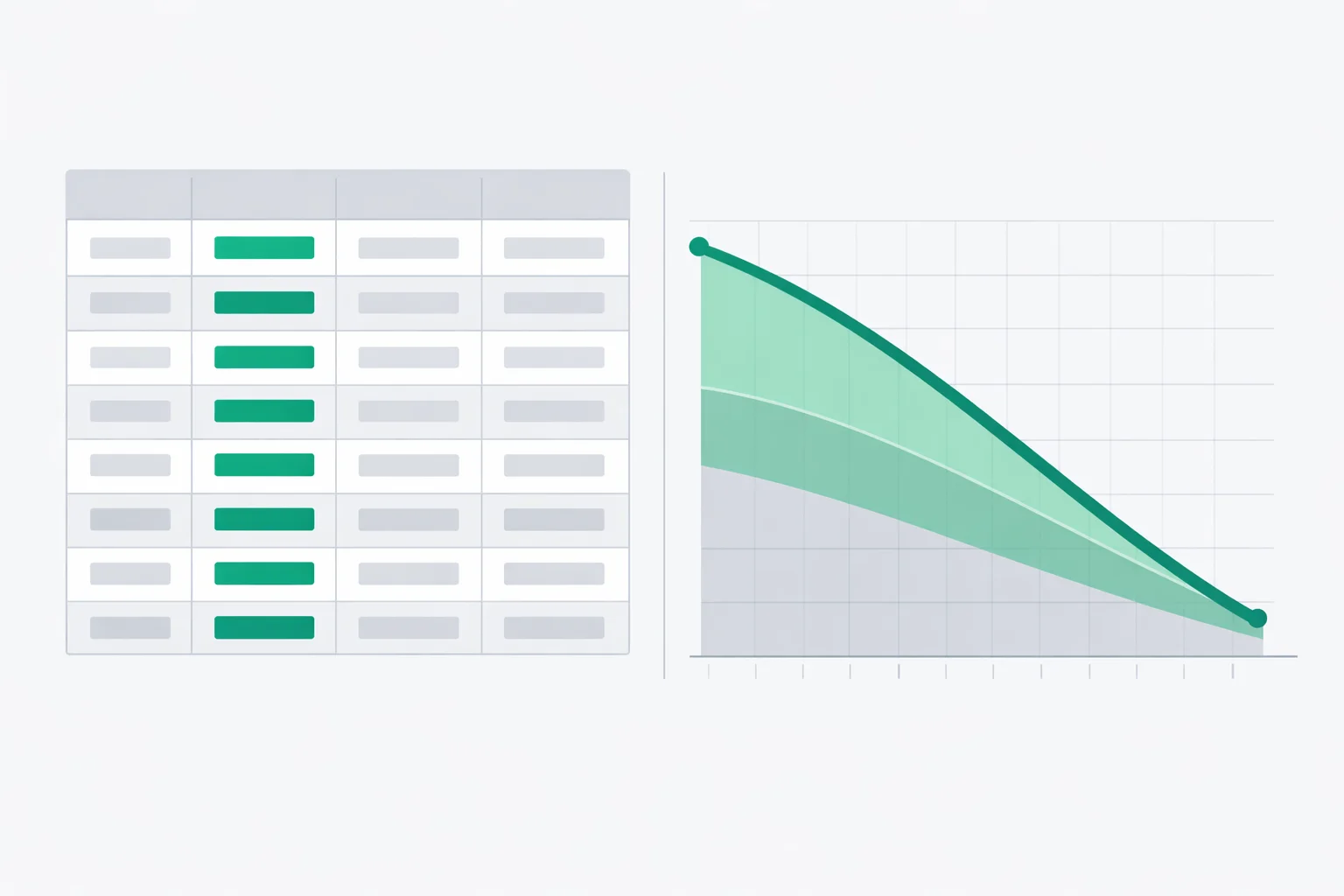
Where Your First Payment Actually Goes
Amortization is the process of paying off a loan with fixed payments where the principal-and-interest split shifts a little each month. The payment stays the same. What changes is the mix.
Interest is charged on whatever you still owe. At the start you owe almost the whole loan, so almost the whole payment is interest. Month one on that $300,000 loan: $1,625 interest, $271 principal. By month 360, the final payment is nearly all principal and just a few dollars of interest. The CFPB's definition of amortization describes this same shifting balance — it's the engine behind every figure in the schedule above.
The Amortization Formula, Step by Step
The fixed payment comes from one equation: M = P × [r(1+r)ⁿ] / [(1+r)ⁿ − 1]. Here P is the loan amount, r is the monthly rate (annual rate ÷ 12), and n is the number of payments (years × 12). For our example, P = 300,000, r = 0.065 ÷ 12 = 0.005417, and n = 360. Run those numbers and M = $1,896.20.
Then the schedule builds itself one row at a time. Each month is three steps:
- Interest this month = current balance × monthly rate. Month one: $300,000 × 0.005417 = $1,625.
- Principal this month = fixed payment − interest. Month one: $1,896.20 − $1,625 = $271.20.
- New balance = old balance − principal. Month one: $300,000 − $271.20 = $299,728.80.
Repeat 360 times and the balance lands on exactly zero. It's the same balance-based math that powers a savings account — our compound interest calculator runs it in your favor instead of the bank's. If you only need a single payment broken into its two parts without the full table, the principal and interest calculator handles just that step.
A $300,000 Loan, Decoded Year by Year
Here's the full 30-year loan at 6.5% compressed into a few milestone years. Watch the interest column shrink and the principal column grow — slowly at first, then faster.
| End of Year | Principal Paid That Year | Interest Paid That Year | Balance Remaining |
|---|---|---|---|
| Year 1 | $3,353 | $19,401 | $296,647 |
| Year 5 | $4,346 | $18,409 | $280,833 |
| Year 10 | $6,009 | $16,745 | $254,328 |
| Year 20 | $11,491 | $11,263 | $166,996 |
| Year 30 | $21,973 | $781 | $0 |
In year one you pay $19,401 in interest to retire $3,353 of debt — a 5.8-to-1 ratio. By year 30 it flips completely: $21,973 of principal against $781 of interest. Total interest over the full loan is $382,633, more than the $300,000 you borrowed in the first place.
Why Does Your Balance Barely Move for a Decade?
Ten years in, you've written 120 checks totaling $227,544. Your balance has dropped from $300,000 to $254,328 — a fall of just $45,672. The other $181,873 went to interest. Homeowners refinancing around the seven-to-ten-year mark are routinely stunned by how little equity their payments actually built — the mortgage refinance calculator shows whether a new loan is worth restarting that clock.
This front-loading is why selling or refinancing early costs more than it looks: you've been paying the bank's interest first and your own equity last. The flip side is that the equity you do build becomes borrowable later — the home equity calculator tracks how fast that cushion grows as the schedule advances.
The Month Principal Finally Beats Interest
On a 30-year loan at 6.5%, the crossover point — the first payment where more goes to principal than to interest — doesn't arrive until around month 233, roughly year 19. Not year 15, as many people assume. The calendar midpoint of the loan and the point where you're mainly paying yourself are years apart.
The balance midpoint lands even later. You don't owe half of the original $300,000 until about year 21 — a quirk baked into every 30-year mortgage. And the higher your rate, the later both milestones arrive, because more of every early payment is swallowed by interest before it can touch principal.
How Extra Payments Rewrite the Schedule
Because interest is always charged on the remaining balance, every extra dollar of principal you pay erases all the future interest that dollar would have generated. Add $200 a month to that $300,000 loan and the change is dramatic:
| Strategy | Payoff Time | Total Interest | Interest Saved |
|---|---|---|---|
| Standard $1,896/mo | 30 years | $382,633 | — |
| +$200/mo extra | ~23 years | $279,184 | $103,449 |
| 15-year term instead | 15 years | $170,398 | $212,235 |
An extra $200 a month — about $2,400 a year — cuts roughly seven years and $103,000 off the loan. Timing is everything: the same $200 saves far more applied in year 2 than in year 25, because early principal cuts dodge decades of compounding interest. To pit extra monthly payments, a lump sum, and a biweekly schedule against each other on your own balance, run the mortgage payoff calculator. A bigger down payment does the same job before the first payment even posts — the down payment calculator shows how each extra percent down shrinks the balance you amortize.
Here's How to Read Your Own Schedule
Every amortization schedule has the same four columns. Once you can read them, you can audit any loan statement your servicer sends.
- Payment: the fixed amount — it should match every month on a fixed loan.
- Interest: balance × monthly rate. This falls a little every single month.
- Principal: payment minus interest. This climbs every month.
- Balance: what you still owe after the payment posts.
One quick gut check: interest plus principal must always equal the scheduled payment. If your servicer's statement shows a principal figure that doesn't climb month to month, something is off — usually an escrow adjustment mislabeled as principal. Compare their numbers to the schedule here and to your base payment from the mortgage calculator to find the discrepancy.
Amortization Mistakes That Cost Real Money
- Assuming you're halfway done at year 15.You still owe roughly $217,000 on a $300,000 loan at the 15-year mark — about 72% of the balance. Plan a sale or refinance around that and you'll have far less equity than you expect.
- Refinancing and restarting the clock unnoticed. Refinancing a 7-year-old loan into a fresh 30-year term throws you back to the interest-heavy top of a brand-new schedule. The lower rate can still win, but only if you compare total interest, not just the monthly payment — the total mortgage interest calculator makes that lifetime comparison in one screen.
- Making extra payments without marking them "principal only."Some servicers apply unlabeled extra money to next month's payment instead of the balance, so you skip a due date but save zero interest. A misapplied $200 can quietly forfeit most of that $103,000 in potential savings.
- Ignoring PMI riding on top of the schedule.Private mortgage insurance isn't part of principal or interest, but it adds to the bill until you reach about 78-80% loan-to-value. The PMI calculator pinpoints the exact month it drops off based on your amortized balance.
When the Schedule Doesn't Tell the Whole Story
This calculator assumes a fixed rate for the entire term, so the schedule is exact for a fixed-rate mortgage and only an estimate for anything that adjusts. If you have an adjustable-rate loan, the schedule holds only through the fixed period. After the first reset, the lender re-amortizes the remaining balance at the new rate and the whole table changes.
It also shows principal and interest only. Your real monthly bill usually folds in property taxes and insurance escrow, which the amortization table never touches. According to Freddie Mac's rate survey, rates can swing more than a full point within a single year, so re-run your schedule whenever your rate, balance, or extra-payment plan changes. Here's the move once you see the interest pile up: open the schedule, pick an extra-payment amount you can actually sustain, and find the year your payoff date jumps to. That date — not the monthly payment — is the number worth chasing.