Principal and Interest Calculator: How the Split Shifts Over Your Loan
A principal and interest calculator shows you something your monthly statement hides: on a $300,000 loan at 6.5%, your first $1,896 payment sends just $271 to principal and a punishing $1,625 to interest. You paid almost two thousand dollars and the balance barely moved. That gap is the entire story of a mortgage, and it shifts a little every single month for thirty years.
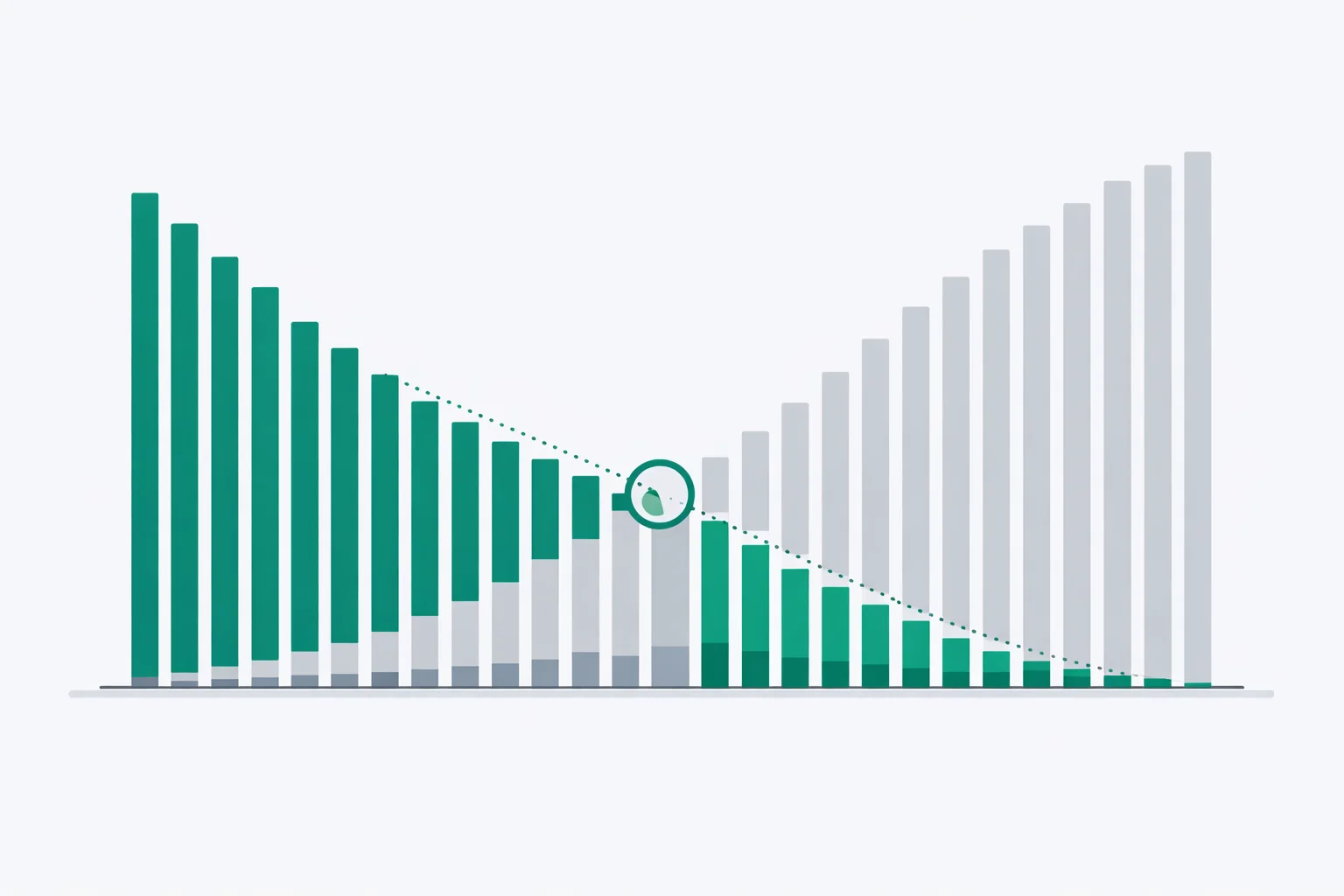
Most homeowners never see this split laid out. They know the payment number and assume the balance falls in a straight line. It doesn't. Understanding the curve — and the exact month it tips in your favor — is what separates people who pay their loan off early from people who hand the bank an extra $382,000 and call it normal.
Your First Payment Is Almost All Interest
Interest is charged on what you still owe. In month one you owe the full amount, so the interest charge sits at its absolute peak. The lender takes that slice first, and only the leftover touches your principal.
On the $300,000 example, the math is blunt: $300,000 × (6.5% ÷ 12) = $1,625 in interest. Subtract that from the $1,896 payment and $271 is all that's left to reduce the debt. So 86 cents of every dollar in payment one is rent on borrowed money. Next month you owe $271 less, the interest charge drops by about $1.47, and principal climbs by the same amount. Tiny. But it happens 360 times, and it accelerates.
The Formula Behind Every Payment
The fixed payment itself comes from the amortization formula. It looks heavy but it's just one equation:
Payment = L × [ r(1 + r)ⁿ ] ÷ [ (1 + r)ⁿ − 1 ]
Here L is the loan amount, r is the monthly rate (annual rate ÷ 12), and n is the total number of payments (years × 12). For our loan: L = 300,000, r = 0.0054167, n = 360. Run it and you get $1,896.20. That number never changes on a fixed-rate loan.
What changes is the inside. Every month: interest = balance × r, and principal = payment − interest. That's the engine behind the whole schedule. If you want the same logic applied to the full housing payment, the mortgage calculator stacks taxes and insurance on top of this P&I core.
A $300,000 Loan, Watched Up Close
Numbers in a formula are abstract. Watching them move is not. Here's the same 30-year loan at 6.5% at four checkpoints:
- Month 1: $271 principal, $1,625 interest. Balance: $299,729.
- End of year 1: about $3,350 of principal paid, $19,400 in interest. Balance has crawled to roughly $296,650 — a 1.1% dent after $22,750 in payments.
- Year 10: the monthly principal portion has grown to about $520, interest down to roughly $1,376. Balance near $253,000.
- Year 30: the final payment is almost pure principal — about $1,886 principal, $10 interest. Total interest over the loan: roughly $382,632, more than the house itself.
That last figure stops people cold. You borrowed $300,000 and handed the lender $682,632. The interest isn't a fee on the side — it's the larger half of the deal, which is exactly why the early split matters so much.
When Does Principal Finally Beat Interest?
There's a specific month where your payment finally sends more to principal than to interest. Call it the crossover. Before it, the bank wins each payment; after it, you do. Almost no calculator names this point, yet it's the most useful single number on the page.
The shortcut is elegant: crossover month = n − ln(2) ÷ ln(1 + r). For the 6.5% loan, that's 360 − 0.6931 ÷ 0.005402 ≈ month 232 — more than 19 years before you tip into winning territory. The higher your rate, the later it lands, because interest stays dominant longer:
| Rate (30-yr loan) | Crossover month | Roughly | % of payment 1 to principal |
|---|---|---|---|
| 3.0% | Month 82 | Year 7 | 30% |
| 4.0% | Month 152 | Year 13 | 23% |
| 5.0% | Month 193 | Year 16 | 19% |
| 6.0% | Month 221 | Year 18 | 15% |
| 6.5% | Month 232 | Year 19 | 14% |
| 7.0% | Month 241 | Year 20 | 13% |
| 8.0% | Month 256 | Year 21 | 11% |
Notice the cruelty of higher rates. Move from 3% to 7% and the crossover slides from year 7 to year 20 — 13 extra years where the lender takes the larger share, a direct consequence of the rate, not the loan size.
How the Loan Term Reshapes the Split
Rate sets the crossover; term sets how fast you climb toward it. Same $300,000 at 6.5%, three terms:
| Term | Payment | Payment 1 to principal | Crossover | Total interest |
|---|---|---|---|---|
| 15-year | $2,613 | $988 (38%) | Month 52 | $170,430 |
| 20-year | $2,237 | $612 (27%) | Month 112 | $236,880 |
| 30-year | $1,896 | $271 (14%) | Month 232 | $382,632 |
The 15-year payment is $717 higher each month, but look what it buys: your very first payment already puts 38% toward principal, you cross over in year 5, and you hand the bank $212,000 less in interest. The 30-year loan trades a lower payment for two extra decades of paying mostly interest. Neither is wrong — but the calculator makes the real price of that lower payment impossible to miss.
Where Borrowers Lose the Most Money
A few specific mistakes cost real dollars, and each one shows up in the split:
- Refinancing late, then restarting at 30 years.Twelve years into a loan you're finally building equity fast. Refinance into a fresh 30-year term and you reset to month one — back to 86% interest. Even at a lower rate, restarting the clock can add tens of thousands in total interest.
- Assuming appreciation equals equity.If your home value rises but you've only made early payments, your loan-side equity is tiny. That matters when canceling private mortgage insurance, which is tied to your balance, not the market value.
- Ignoring the rate's effect on the split.A 1% higher rate on $300,000 doesn't just raise the payment by about $190 — it pushes your crossover out by roughly two years and adds over $70,000 in lifetime interest.
One Extra Payment, Years Off the Clock
Here's the lever that flips amortization in your favor. Because interest is charged on the balance, every extra dollar of principal permanently kills the future interest that dollar would have generated — and early dollars kill the most.
On the $300,000 / 6.5% / 30-year loan, adding just $200 a month cuts total interest from about $382,632 to roughly $292,000 — a $90,000 saving — and retires the loan in about 23 years instead of 30. Make one extra full payment a year (spread monthly, that's about $158 extra) and you shave nearly five years off. To see every month rewritten side by side, run the numbers through the mortgage amortization calculator, which prints the full payment-by-payment schedule. It works so hard because early extra principal has the longest runway to compound against the lender. According to the Consumer Financial Protection Bureau, confirming that extra payments are applied to principal — not held as a prepaid future installment — is the step borrowers most often miss.
When This Calculator Won't Tell the Whole Story
This tool models a fixed-rate, fully amortizing loan. It's precise for the overwhelming majority of mortgages, but a few situations break the assumptions:
- Adjustable-rate mortgages. Once the rate adjusts, the payment and the entire split recalculate. The numbers here hold only through the fixed period.
- Interest-only loans. During the interest-only window there is no principal portion at all — the split is 100% interest. Model those separately with the interest-only mortgage calculator.
- The full housing payment.Principal and interest is only part of what you pay. Property taxes, homeowners insurance, and PMI ride alongside it and can add $300 to $700 a month — none of which is reflected in the P&I figure here.
One last move worth making: before you sign, find your crossover month and write it down. If it lands past year 18, that's your signal to run the extra-principal scenario above. Shaving even a little off the early balance is the cheapest equity you will ever buy, because it works against the largest balance you'll ever owe.