PMI Calculator: How Much PMI Costs and the Exact Month You Can Drop It
Most homeowners believe PMI disappears the moment they hit 20% equity. It doesn't — and that single misunderstanding keeps people paying private mortgage insurance months or years longer than they have to. A PMI calculator settles the question with numbers: on a $300,000 home with 10% down, you'll pay roughly $135 a month, and the premium only legally vanishes when your balance falls to 78% of the original price. That's around $14,000 of PMI if you wait for it — and a few thousand less if you act at the right moment.
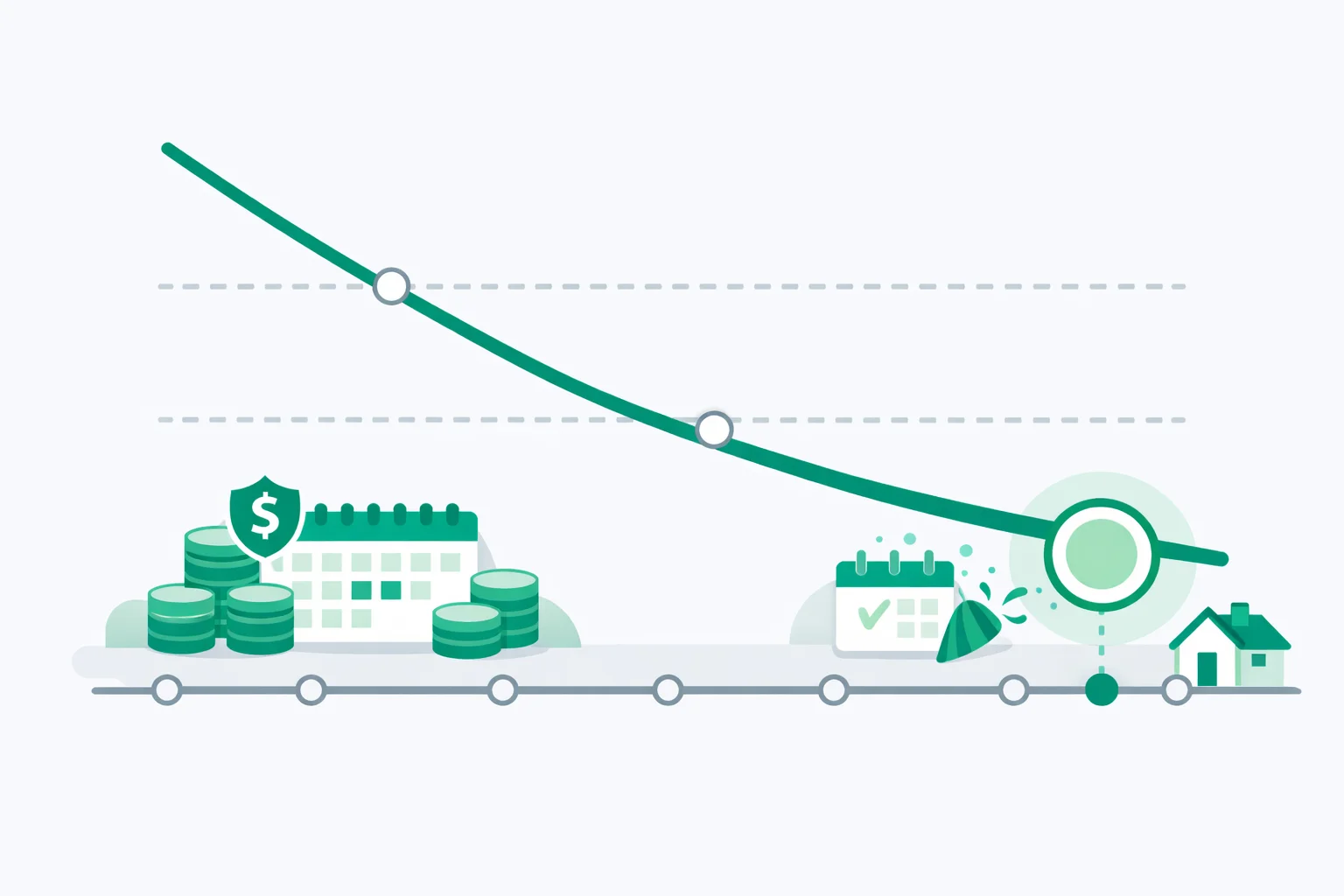
The 20% Equity Myth That Keeps People Paying
Here's the trap. People hear "PMI ends at 20% equity" and assume that includes equity from rising home values. It doesn't — at least not automatically. Private mortgage insurance on a conventional loan is governed by the federal Homeowners Protection Act, and that law works off your loan-to-value ratio against the original purchase price, on the original amortization schedule.
Two thresholds matter. At 80% LTV you can submit a written request to cancel. At 78% LTVthe servicer must cancel it for you, no request required. So if your home appreciates and you're technically at 25% equity by market value, the lender still won't auto-cancel until the scheduled balancehits 78% of what you paid. That's the reason someone can sit at 20%-plus equity on paper and still see PMI on the statement. The fix exists — you just have to know to ask for it.
How Lenders Price Your PMI
PMI is quoted as an annual percentage of your loan balance, then split into 12 monthly payments. Two inputs move that percentage more than anything else: how much you put down and your credit score.
- Down payment (LTV band): A 3% down loan sits at 97% LTV and carries the highest rate. Each step toward 20% drops you into a cheaper band — the difference between 5% down and 15% down can cut your rate roughly in half.
- Credit score: The second-biggest lever. On the same 90% loan, a 760+ borrower might pay 0.30% a year while a 660 borrower pays near 1.00% — more than triple for identical coverage.
- Loan term: 15-year loans usually carry slightly lower PMI rates than 30-year loans, and they reach 80% LTV far faster, so the premium lasts a fraction as long.
A quick reality check before you settle on a down payment: the down payment calculator shows how each percentage point reshapes your loan size and whether you cross the 20% line that eliminates PMI altogether. Because PMI cancels off your loan balance, it also helps to see how slowly that balance falls early on — the principal and interest calculator maps exactly when your equity starts building in earnest.
Worked Example: PMI on a $300K Home at 10% Down
Let's run an actual case — a 740 credit score, a 30-year loan at 6.5%, and 10% down. Walk the math one step at a time:
- Home price: $300,000 · Down payment (10%): $30,000
- Loan amount: $270,000 · Starting LTV: 90%
- PMI rate at 90% LTV, 740 score: 0.38% per year
- Annual PMI: $270,000 × 0.38% = $1,026
- Monthly PMI: $1,026 ÷ 12 ≈ $86/month
Now the part most calculators skip — when it ends. At 6.5% over 30 years, the $270,000 balance reaches 80% of the original $300,000 value (that's $240,000) at around month 102, just past the 8.5-year mark. Request cancellation then and you've paid roughly $8,800 in PMI. Do nothing, and it auto-terminates at 78% ($234,000) near month 121 — about $1,600 more out of pocket for the exact same loan. Same house, same payment; the only variable is whether you mail a one-page request.
The 80% / 78% Cancellation Timeline
The gap between 80% and 78% is where the real money hides, so it's worth being precise about how each trigger works.
| Trigger | LTV (vs. original value) | What happens | What you must do |
|---|---|---|---|
| Borrower request | 80% | Lender may cancel PMI | Submit a written request, be current, sometimes pay for an appraisal |
| Automatic termination | 78% | Lender must cancel PMI | Nothing — but you must be current on payments |
| Final termination | Loan midpoint | PMI ends regardless of LTV | Nothing — kicks in at year 15 of a 30-year loan |
The takeaway is simple: set a calendar reminder for the month you hit 80%. Waiting for the automatic 78% trigger is the default path, and it's the more expensive one. The Consumer Financial Protection Bureau spells out your exact cancellation rights in its guide to removing PMI — read it before you call your servicer.
PMI Rate Table by Credit Score and Down Payment
These are representative annual PMI rates for a 30-year fixed conventional loan. Actual numbers vary by insurer, but the shape holds: lower down payments and lower scores both push the rate up. Find your row and column to gut-check whatever a lender quotes you.
| Credit score | 3–5% down (95–97% LTV) | 10% down (90% LTV) | 15% down (85% LTV) |
|---|---|---|---|
| 760+ | 0.41% | 0.30% | 0.19% |
| 740–759 | 0.52% | 0.38% | 0.25% |
| 700–719 | 0.86% | 0.65% | 0.43% |
| 680–699 | 1.04% | 0.79% | 0.54% |
| 620–659 | 1.62% | 1.24% | 0.90% |
Read across the 10% down column: a 760 borrower pays 0.30% while a 640 borrower pays 1.24% — on a $270,000 loan that's $68 versus $279 a month for the same coverage. Read down instead, and you see why even a modest bump in your down payment changes the math. If you're weighing how much to put down against keeping cash on hand, the home affordability calculator fits PMI into your full monthly budget under the 28/36 rule.
Three Ways to Kill PMI Early
You don't have to wait nine years. There are three legitimate ways to end PMI ahead of schedule, each suited to a different situation.
- Pay down principal faster. An extra $200 a month on the $270,000 example pulls the 80% point in by roughly two years — and every month you skip is one fewer PMI premium. The extra-payment field above shows your exact new date.
- Request a value-based cancellation.If your home has appreciated, many lenders will drop PMI based on a fresh appraisal once you've held the loan two years (with 25% equity) or five years (with 20% equity). You pay $400–$600 for the appraisal, but it can end PMI long before the schedule would. Track your position with the home equity calculator.
- Refinance — but only if the rate also drops.Refinancing into a loan below 80% LTV erases PMI, yet closing costs only pencil out when you're also cutting your interest rate. Don't refinance solely to escape a $90 premium.
When This Estimate Will Be Off
This calculator models standard borrower-paid PMI on a conventional loan — to fold that premium into a full payment, the conventional loan calculator adds principal, interest, taxes, and PMI together. The estimate here will be wrong in a few specific cases worth naming up front:
- You have an FHA loan. FHA charges a mortgage insurance premium (MIP), not PMI. With under 10% down, MIP lasts the life of the loan — the only exit is refinancing into a conventional mortgage. The FHA loan calculator breaks down upfront plus annual MIP and shows the total over its full duration, and the mortgage insurance calculator puts PMI and MIP head-to-head on the same loan to show which costs less for your credit score.
- You chose lender-paid or single-premium PMI.Lender-paid PMI is baked into a higher interest rate and never "cancels." Single-premium PMI is paid upfront in a lump sum. This tool assumes the standard monthly borrower-paid structure.
- Your insurer prices differently. The rate table is representative, not a quote. Two PMI companies can price the same borrower a few basis points apart, and servicers sometimes pass through different schedules.
- You're behind on payments. Both the 80% request and the 78% automatic cancellation require you to be current. A 30-day late mark can push your termination date out.
- You have a VA loan.VA loans never carry monthly mortgage insurance at all — there's nothing to cancel. If you're a veteran, the VA loan calculator shows the no-PMI payment and the one-time funding fee that replaces it.
One last move that pays for itself: the day you close, calculate the month you expect to hit 80% LTV and put it on your calendar. PMI is the rare housing cost you can switch off with a single letter — but only if you know the date before your servicer reminds you. To see the premium folded into your whole payment, run the mortgage calculator with PMI — it projects the exact month the payment drops once PMI cancels, so PMI becomes the line you plan to delete, not the one you forget.