Compound Interest Explained: How Compounding Frequency Accelerates Your Money
A compound interest calculator is the single most important tool for understanding how your money grows over time. Unlike simple interest — which only pays you on your original deposit — compound interest earns interest on your interest, creating an exponential growth curve that Albert Einstein allegedly called "the eighth wonder of the world." Whether you're comparing savings accounts, planning retirement contributions, or evaluating an investment, knowing exactly how compounding works puts real dollar amounts behind your decisions.
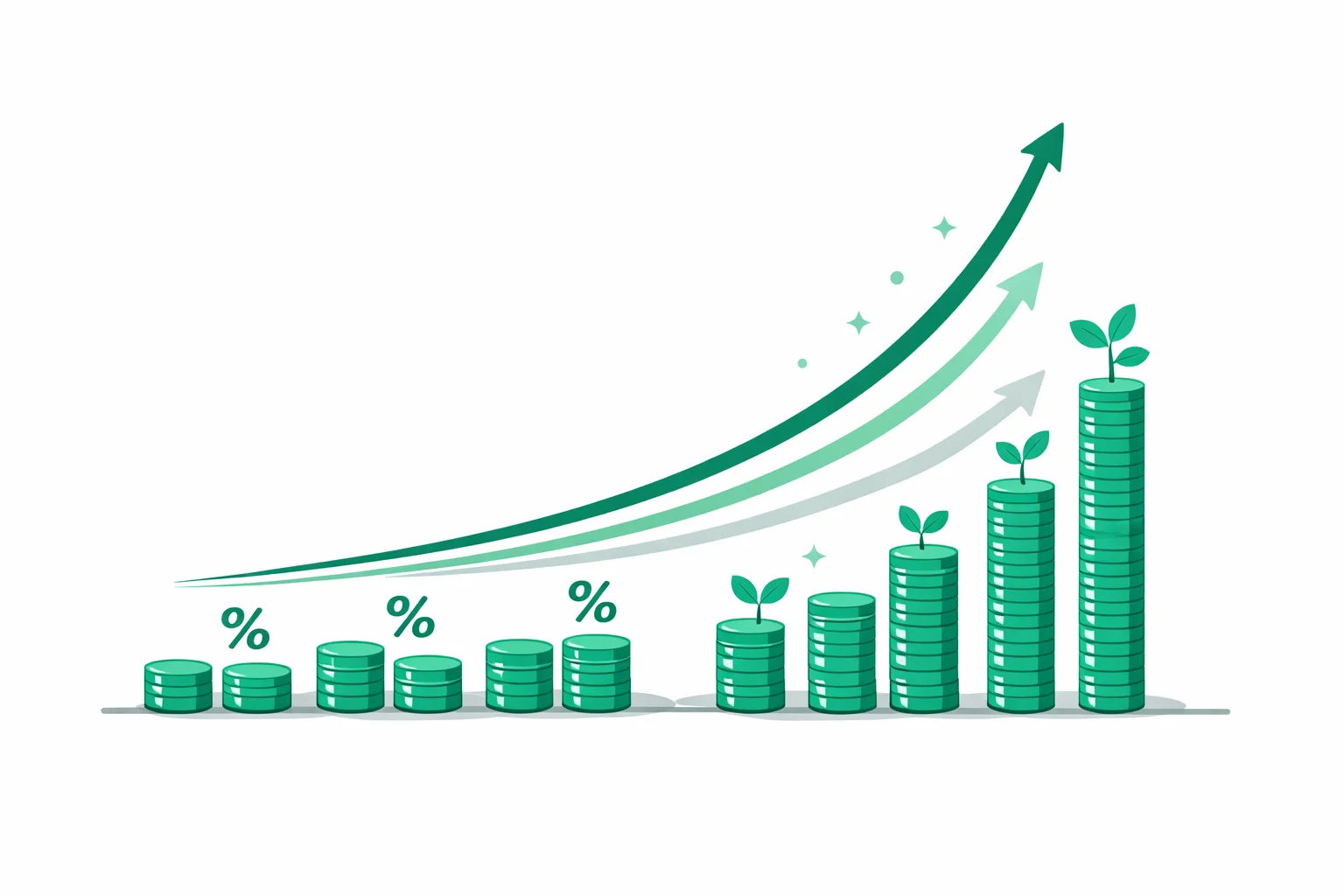
What Is Compound Interest?
Compound interest is interest calculated on both the initial principal and all accumulated interest from previous periods. When a bank pays you 5% interest compounded monthly, each month's interest payment gets added to your balance, and the next month's interest is calculated on that larger amount.
Here's a concrete example: deposit $10,000 at 5% compounded monthly. After month one, you earn $41.67 in interest (10,000 x 0.05/12). Month two, you earn interest on $10,041.67 — that's $41.84. The extra 17 cents may seem tiny, but over 30 years this snowball effect turns $10,000 into $44,677 — more than quadrupling your money without a single additional deposit.
The Compound Interest Formula Explained
The standard compound interest formula is: A = P(1 + r/n)^(nt), where:
- A = final amount (principal + interest)
- P = principal (initial deposit)
- r = annual interest rate (as a decimal — 5% = 0.05)
- n = number of compounding periods per year (12 for monthly, 365 for daily)
- t = time in years
Worked example: You invest $5,000 at 6% interest compounded quarterly for 10 years. Plugging in: A = 5,000(1 + 0.06/4)^(4 x 10) = 5,000(1.015)^40 = 5,000 x 1.8140 = $9,070.09. Your $5,000 earned $4,070.09 in interest — an 81.4% total return.
When you add regular monthly contributions, the formula expands to include the future value of an annuity. Our calculator handles this automatically. To plan your deposits alongside compound interest, try our savings calculator which includes goal tracking and contribution planning.
Why Compounding Frequency Matters
The more frequently interest compounds, the more you earn — but the difference between frequencies narrows as you move from annual to daily. Here's a comparison of $10,000 at 5% over 10 years with no additional contributions:
| Compounding | Periods/Year | 10-Year Balance | Interest Earned |
|---|---|---|---|
| Annually | 1 | $16,288.95 | $6,288.95 |
| Quarterly | 4 | $16,436.19 | $6,436.19 |
| Monthly | 12 | $16,470.09 | $6,470.09 |
| Daily | 365 | $16,486.65 | $6,486.65 |
The jump from annual to quarterly compounding gains you $147.24. Going from quarterly to daily adds only $50.46 more. For most savings accounts and CDs, the difference between daily and monthly compounding is negligible — roughly $16.56 on $10,000 over a decade. Focus on getting the highest interest rate rather than optimizing compounding frequency.
Compound Interest vs. Simple Interest
Simple interest pays a flat percentage of the original principal every year. At 5% simple interest, $10,000 earns exactly $500 per year — no more, no less — regardless of how long the money sits. Compound interest earns $500 in year one, then $525 in year two (5% of $10,500), then $551.25 in year three, and so on.
The gap accelerates dramatically over time:
- After 5 years: Simple = $12,500 vs. Compound = $12,763 (difference: $263)
- After 10 years: Simple = $15,000 vs. Compound = $16,289 (difference: $1,289)
- After 30 years: Simple = $25,000 vs. Compound = $43,219 (difference: $18,219)
At 30 years, compound interest delivers 73% more than simple interest on the same deposit. This is why starting early matters so much — the compounding effect needs time to build momentum.
The Rule of 72: How Fast Will Your Money Double?
The Rule of 72 is a quick mental shortcut: divide 72 by your annual interest rate to estimate how many years it takes your money to double. At 6% interest, your money doubles in approximately 12 years (72 / 6 = 12). At 8%, it doubles in about 9 years.
This rule works best for rates between 4% and 12%. Here are common benchmarks:
- 3% (savings bonds/CDs): doubles in ~24 years
- 5% (HYSA/conservative): doubles in ~14.4 years
- 7% (balanced portfolio): doubles in ~10.3 years
- 10% (S&P 500 historical average): doubles in ~7.2 years
At 10% returns, a single $10,000 investment becomes $20,000 in 7 years, $40,000 in 14 years, $80,000 in 21 years, and $160,000 in 28 years — four doublings with zero additional contributions.
Key Factors That Affect Compound Growth
Five variables control how fast your money grows. Understanding their relative impact helps you prioritize where to optimize:
- Interest rate (highest impact): Going from 4% to 6% on $10,000 over 20 years adds $8,400 in extra interest. Even a 0.5% rate increase is worth $1,600+ over two decades.
- Time horizon (second highest): $10,000 at 5% compounds to $16,289 in 10 years but $43,219 in 30 years. Each additional decade roughly triples the interest earned.
- Regular contributions: Adding just $100/month to that $10,000 at 5% turns a 10-year balance of $16,289 into $31,834 — nearly doubling the outcome.
- Compounding frequency: Moving from annual to daily compounding on $10,000 at 5% adds about $198 over 10 years. Helpful, but the smallest factor by far.
- Taxes and fees: A 1% annual fee on a $100,000 portfolio costs roughly $28,000 over 20 years at 7% returns. Always factor in account fees and tax drag.
Common Compound Interest Mistakes to Avoid
- Confusing APR with APY:A 5% APR compounded daily yields 5.127% APY. If you enter the APY into a compound interest calculator as the nominal rate, you'll overestimate your returns. Our calculator takes the nominal rate and shows you the true APY.
- Ignoring inflation:At 3% inflation, a 5% nominal return is really only 2% in purchasing power. Over 30 years, $43,219 in nominal terms is about $17,900 in today's dollars.
- Withdrawing interest: Taking out $500/year in interest from a $10,000 deposit at 5% means you never benefit from compounding at all — you earn $15,000 in simple interest over 30 years instead of $33,219 in compound interest. Leaving interest to compound costs you nothing and earns you $18,219 more.
- Starting late: A 25-year-old who invests $200/month at 7% until age 65 accumulates $525,000. Starting the same investment at 35 yields only $244,000 — less than half — because the final decade of compounding is where the most growth happens.
Real-World Applications of Compound Interest
Compound interest applies to far more than savings accounts. If you're planning a home purchase, the mortgage calculator shows the flip side — how compound interest works againstyou on a loan. A $300,000 mortgage at 7% over 30 years costs $418,527 in total interest. That's compounding working for the lender, not for you. Before you start house shopping, run your numbers through the home affordability calculator to see how your savings and income translate into a realistic price range. And if you're still building that down payment fund, the down payment calculator maps out exactly how long you need to save and what different down payment percentages mean for your monthly mortgage cost.
- Savings accounts & CDs: Most high-yield savings accounts compound daily. At 4.5% APY on $25,000, you earn about $1,148 per year.
- Retirement accounts (401k, IRA): Investment returns compound tax-deferred. Contributing $500/month at 7% for 30 years grows to $566,764.
- Debt (credit cards, loans): Credit card interest at 24% APR compounded daily means a $5,000 balance grows to $6,356 in one year if you make no payments. Always pay more than the minimum.
- Education (529 plans): Investing $250/month at 6% from birth gives your child about $97,000 by age 18. Starting at age 5 yields only $57,000 — a $40,000 penalty for waiting 5 years.
Tips for Maximizing Compound Interest
- Start immediately, even with small amounts.$50/month at 7% from age 22 to 65 grows to $174,000. Waiting until 32 to start the same $50/month yields only $81,000. The first decade of compounding is the cheapest — you're contributing when amounts are small.
- Reinvest all returns. Never withdraw interest or dividends unless you need the income. Every dollar withdrawn is a dollar that stops compounding forever.
- Use tax-advantaged accounts first. A Roth IRA at 7% grows 100% tax-free. In a taxable account at 25% tax bracket, that 7% effective return drops to roughly 5.25% after taxes — a significant drag over decades.
- Automate contributions. Set up automatic monthly transfers on payday. Consistent contributions matter more than timing the market. To plan your monthly savings contributions, use our savings calculator with goal tracking.
- Minimize fees ruthlessly. A 0.5% difference in annual fees (0.5% vs 1.0%) on $100,000 at 7% costs $25,400 over 20 years. Choose index funds and no-fee savings accounts.
When to Use This Calculator
- Comparing savings accounts: Enter rates from different banks and see which account earns the most over 1, 5, or 10 years with your specific deposit amount.
- Planning retirement contributions:Estimate how much $500/month at 7% grows over 25-30 years to see if you're on track for your retirement goal.
- Planning retirement withdrawals:After you've built your nest egg, use our savings withdrawal calculator to model how long your savings will last with monthly withdrawals, inflation adjustments, and Social Security income.
- Evaluating lump-sum investments: Got a $20,000 bonus or inheritance? See how different rates and time horizons affect the final value before deciding where to put it.
- Understanding the cost of waiting: Compare starting today versus waiting 5 years — the calculator shows exactly how much money you leave on the table by delaying.
- Teaching kids about money:Show children how $100 today becomes $761 in 40 years at 5% — making the abstract concept of "interest" concrete and motivating.