15 vs 30-Year Mortgage: What the Bigger Payment Actually Buys You
Run a 15-year mortgage calculator on a $320,000 loan and the first number that jumps out is the payment — around $635 a month higher than the 30-year version of the same loan. The second number takes longer to notice, and it's the one that actually decides things: ten years in, you'd own about 57%of your home free and clear. The borrower next door with the same house, the same purchase date, and a 30-year loan? They'd own about 15%. That gap — not the monthly payment — is the real story of the 15-year mortgage.
The Higher Payment Isn't an Expense — It's a Deposit
Here's the reframe most rate-shopping tools miss. That extra $635 a month isn't money leaving your life. Look at where it goes. On the 30-year loan, the first payment sends about $1,733 to the bank as interest and just $289 to principal. On the 15-year, the very first payment puts about $1,124 toward principal — nearly four times as much — with the rest as interest.
Interest is gone the second you pay it. Principal is yours; it sits in the house as equity you can borrow against, sell into, or simply own. So the 15-year's bigger check isn't a bigger bill — most of the difference is a forced transfer from "renting money from the bank" to "buying your house faster." You feel it as a tighter budget. Your net worth feels it as a much faster climb.
Run the Numbers: 15 vs 30 on the Same $400,000 House
Let's price it exactly. Take a $400,000 home with 20% down — an $80,000 down payment and a $320,000 loan. The monthly payment formula is the same for both terms:
M = P × [ r(1 + r)ⁿ ] ÷ [ (1 + r)ⁿ − 1 ], where P is the loan, r is the monthly rate, and n is the number of payments.
- 15-year at 5.75%: payment ≈ $2,658. Over 180 payments that's $478,368 total, so about $158,368 in interest.
- 30-year at 6.5%: payment ≈ $2,023. Over 360 payments that's $728,140 total, so about $408,140 in interest.
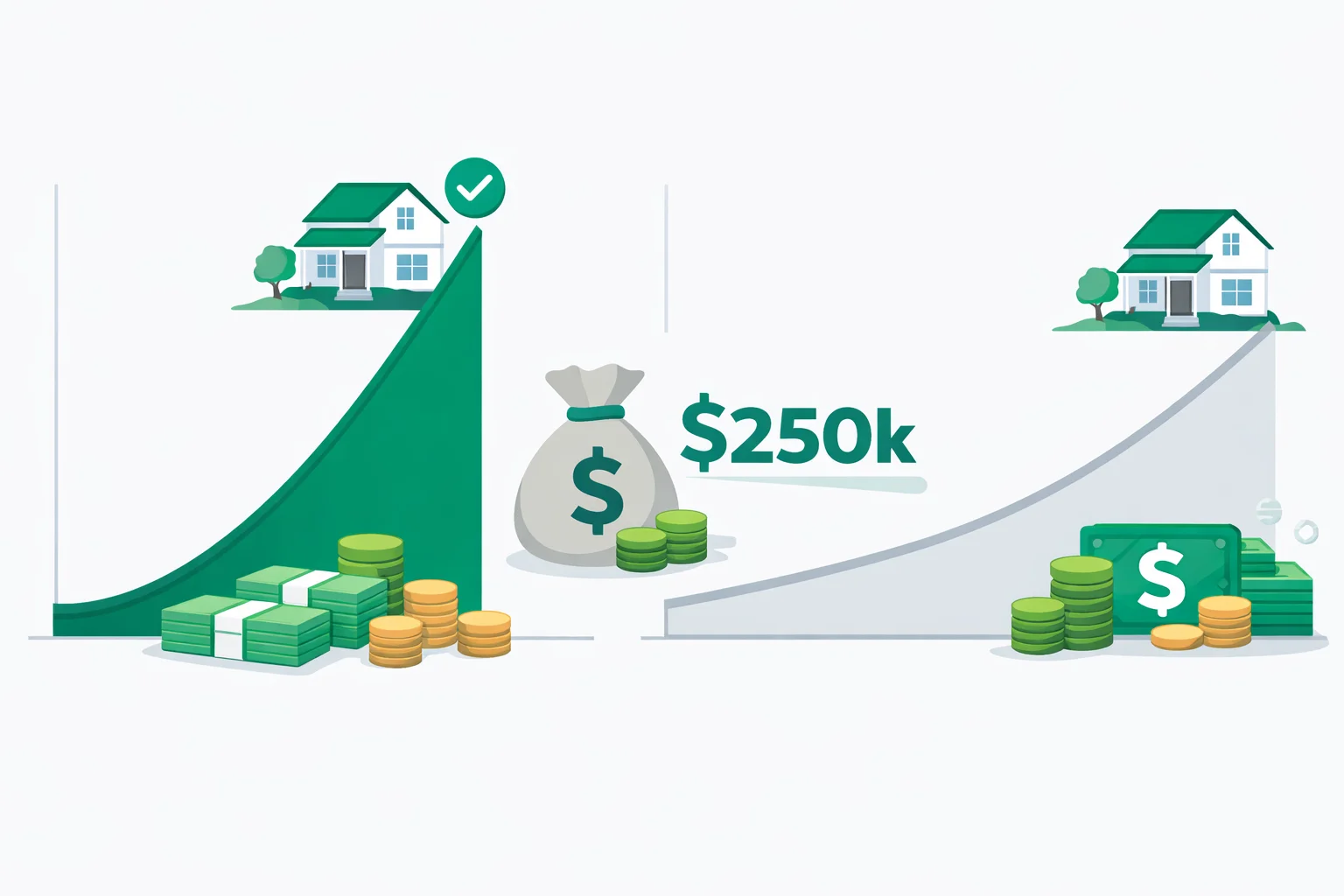
The 15-year costs $635 more each month but roughly $249,772 less in interest — call it a quarter of a million dollars. Put differently: you spend about $114,000 more in payments over 15 years (the $635 gap, banked monthly) to avoid $250,000 in interest and own the home outright fifteen years earlier. To see exactly how that interest stacks up over time, the mortgage interest calculator breaks it out payment by payment.
Why 15-Year Rates Run Lower — and What That's Worth
Notice the two rates above weren't the same. That wasn't a typo. Lenders price the 15-year roughly 0.5% to 0.75% below the 30-year, because their money is exposed to risk for half as long and pays down far faster. Most side-by-side calculators quietly use one rate for both terms, which understates what a 15-year really saves.
Split the savings to see it. At the same 6.5% rate, the 15-year on our $320,000 loan would cost about $181,758 in interest — already $226,000 less than the 30-year. Dropping the 15-year to its real 5.75% rate cuts interest to $158,368, adding roughly $23,400 more in savings. So of the ~$250,000 you save, about $23,000 is a pure gift for choosing the shorter term, and the rest is the term itself. Rates move weekly; Freddie Mac's rate survey publishes the current 15- and 30-year spread, so quote both terms on the same day before you decide.
Your Equity Doesn't Grow. It Sprints.
This is where the 15-year quietly wins. Because so much of each payment is principal, your ownership stake builds on a completely different curve. On the $320,000 loan:
| Milestone | 15-Year: Loan Paid Off | 30-Year: Loan Paid Off |
|---|---|---|
| Year 5 | ~24% | ~6% |
| Year 10 | ~57% | ~15% |
| Year 15 | 100% (paid off) | ~28% |
At the exact moment your 15-year loan hits zero, the 30-year borrower still owes about 72% of what they borrowed. That equity lead isn't just bragging rights. Reaching 20% equity lets you drop private mortgage insurance; more equity opens a bigger home equity line and a cleaner amortization curve, and it's a real cushion if home prices dip. The 15-year borrower simply gets to every one of those milestones years sooner.
What a 15-Year Costs Across Loan Sizes
Your loan won't be exactly $320,000, so here's the head-to-head across common loan amounts, using realistic split rates — 5.75% on the 15-year, 6.5% on the 30-year:
| Loan | 15-yr Payment | 30-yr Payment | 15-yr Interest | 30-yr Interest | Interest Saved |
|---|---|---|---|---|---|
| $200,000 | $1,661 | $1,264 | $98,980 | $255,088 | $156,108 |
| $300,000 | $2,492 | $1,896 | $148,470 | $382,632 | $234,162 |
| $400,000 | $3,322 | $2,528 | $197,960 | $510,176 | $312,216 |
| $500,000 | $4,153 | $3,160 | $247,450 | $637,720 | $390,270 |
The pattern is clean: the 15-year payment runs about 30% higher, and the interest saved lands near 60% of the original loan amount. On a half-million-dollar loan, the shorter term keeps nearly $390,000 in your pocket over the life of the mortgage.
Can You Actually Afford the Payment? Run the 28% Test
The 15-year's entire risk lives in that higher payment. The clean way to test it is the 28% front-end rule: your total housing cost — principal, interest, taxes, and insurance — should stay at or below 28% of gross monthly income. On our $320,000 loan, the 15-year principal and interest is about $2,658; add roughly $500 for taxes and insurance and you're near $3,158.
To keep that at 28%, you'd need about $11,280 a month, or roughly $135,000 a year. The same house on a 30-year needs closer to $108,000. The CFPB's debt-to-income guidance is worth reading before you stretch. My rule of thumb: only take the 15-year if the payment still leaves you funding retirement to at least your employer match, holding a 3–6 month emergency fund, and carrying no high-interest debt. That checklist is essentially the Baby Steps, and the stricter version of this test — a 15-year payment capped at 25% of take-home pay rather than 28% of gross — runs in the Dave Ramsey mortgage calculator. Miss any of those and the 30-year mortgage calculator shows the lower payment that keeps those priorities funded.
The Guaranteed Return Nobody Mentions
Every extra dollar of principal you pay on a 15-year does something quietly powerful: it earns a guaranteed return equal to your mortgage rate. Pay down a 5.75% loan and you've "earned" 5.75%, risk-free, with no market to watch and no tax on the gain. That's the honest math behind the shorter term.
The counterargument deserves a fair hearing, though. Take the 30-year instead and invest the $635 monthly difference. At an assumed 7% annual return, that stream could grow to roughly $200,000over 15 years — potentially more than the ~$158,000 in interest the 15-year would have cost you. So on paper, "invest the difference" can win. In practice it usually doesn't, for three reasons: most people don't actually invest the gap every single month, that 7% isn't guaranteed the way debt payoff is, and after 15 years the 30-year borrower still owes on the house for another decade and a half. The 15-year's forced discipline plus a certain return beats an uncertain one most borrowers never fully capture.
When the 30-Year Is the Smarter Play
A shorter term isn't automatically the right call. The 30-year wins outright in a few specific spots, and pretending otherwise is how people end up house-rich and cash-poor:
- Your income is variable or self-employed.The 15-year's payment is a legal obligation you can't dial down in a slow month. If your income swings, the 30-year's lower required payment is cheap insurance.
- You're not yet capturing your full 401(k) match. A 50–100% employer match is an instant return no 5.75% mortgage payoff can touch. Fund that first.
- You carry high-interest debt or no emergency fund.A 22% credit card balance dwarfs a 5.75% mortgage. Kill the expensive debt and build a cash cushion before accelerating the cheapest loan you'll ever have.
- You'll likely move within about five years.On a short hold you barely dent principal either way, so the 15-year's forced payment just ties up cash you may need for the next down payment.
In any of these cases, take the 30-year and send extra principal when you comfortably can — the mortgage payoff calculator shows how much a self-directed extra payment saves, and the biweekly mortgage calculator shows how just paying every two weeks shaves almost six years off a 30-year without a bigger check. You get most of the 15-year's payoff speed with a built-in escape hatch.
15-Year Mistakes That Quietly Cost You
- Stretching to the payment with no cushion. Signing up for the $2,658 payment when $3,158 all-in eats more than a third of your income leaves no room for a job loss or a new roof. A missed 15-year payment risks the same home the shorter term was supposed to secure faster.
- Accepting one rate for both terms.If a lender quotes you the same rate on the 15- and 30-year, they're leaving your money on the table — that automatic 0.5–0.75% discount is worth about $23,000 here. Always request both quotes explicitly.
- Refinancing a seasoned loan into a fresh 15-year without checking the alternative. Ten years into a 30-year, refinancing to a 15-year can help — but first compare it against simply making a 15-year-sized payment on your current loan, which costs $0 in closing fees.
- Ignoring the opportunity cost entirely. Draining your down payment or skipping retirement contributions to grab the 15-year can cost more than it saves. The math only works when the higher payment is truly spare.
The cleanest move is boring on purpose: get both quotes, size the 15-year payment against the 28% test using your real taxes and insurance, and take it only if your emergency fund and retirement stay funded. If it's close, take the 30-year and set an automatic extra payment the day you close — you keep the escape hatch and still capture most of the equity sprint, on your own terms instead of the contract's.