Mortgage Calculator with PMI: How Private Mortgage Insurance Reshapes Your Payment
A mortgage calculator with PMI exists for one reason: the payment it shows you is temporary. On a $400,000 home with 10% down, private mortgage insurance tacks roughly $150 a month onto your payment — but that surcharge has a hard expiration date. The moment your loan balance drops to 78% of the purchase price, federal law forces your lender to cancel it, and your payment falls. Most online calculators treat PMI as a permanent line item. It isn't, and that single fact changes how you should read your numbers.
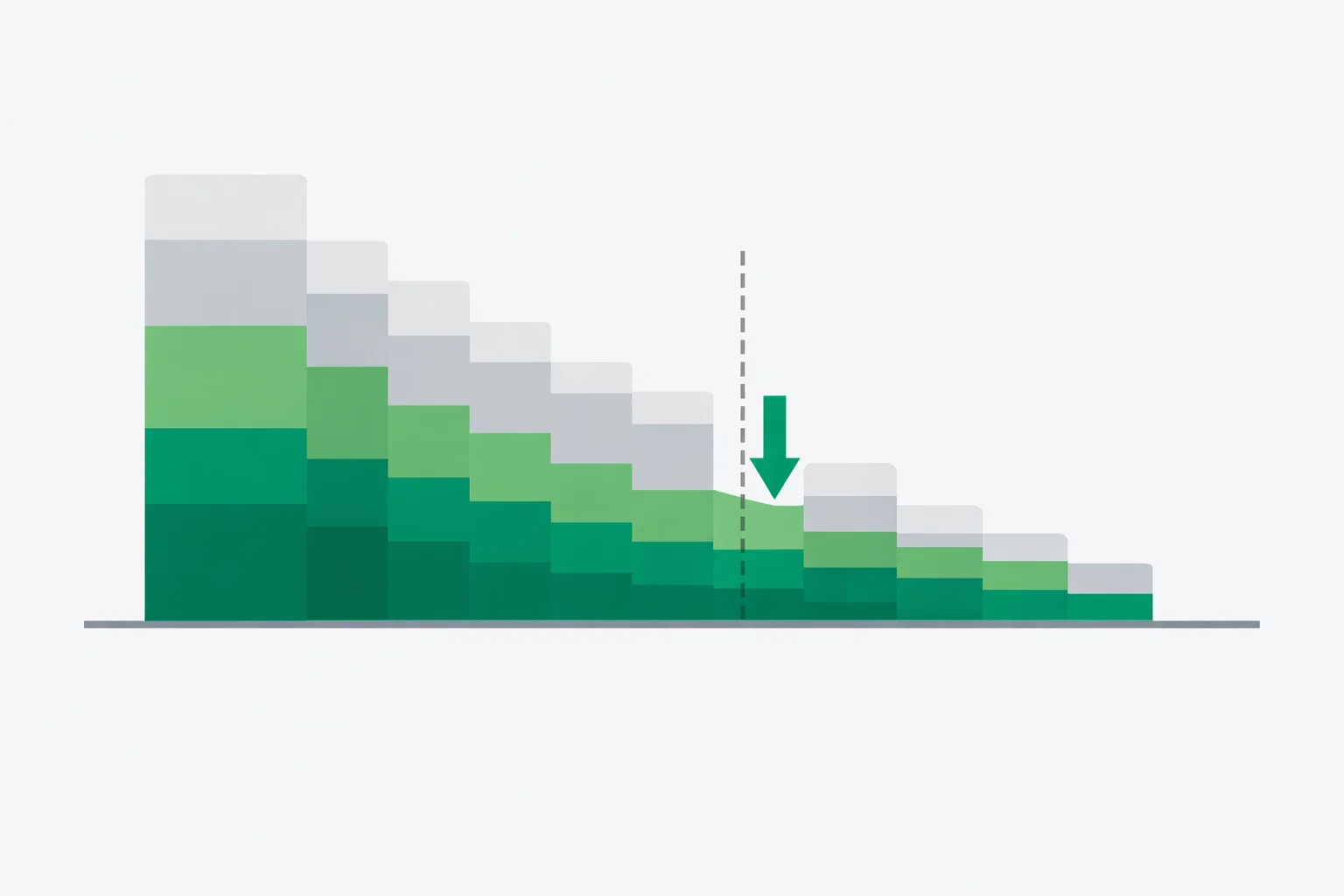
Your PMI Payment Has an Expiration Date
Think of your payment in two phases. Phase one runs from closing until your balance hits 78% of the original price — during these months you pay the full PITI plus PMI. Phase two begins the month PMI cancels, and your payment drops by the PMI amount and stays there. On that $400,000 home with 10% down at 6.5%, phase one costs about $2,942 a month. Phase two drops to roughly $2,792. Same loan, same house — $150 less, forever, starting around month 109.
This is the part the standard mortgage calculator can't show you, because it never models the down payment that triggers PMI in the first place. The premium isn't bonus interest and it builds you zero equity — it's pure insurance protecting the lender if you default. That's exactly why knowing its end date matters: every month you carry it past the cancellation point is money you didn't have to spend. Worse, many big-name payment tools skip PMI entirely — our Bankrate mortgage calculator alternative shows exactly how much those default assumptions hide.
What PMI Adds to a Real Payment
Let's build the full payment from scratch on a real scenario: a $400,000 home, 10% down ($40,000), leaving a $360,000 loan at 6.5% over 30 years.
- Principal & interest: the $360,000 loan amortizes to about $2,275/month.
- PMI:at 0.5% of the loan per year, that's $1,800 ÷ 12 = $150/month.
- Property tax: at 1.1% of value, $4,400 ÷ 12 = $367/month — estimate yours with the property tax calculator.
- Homeowners insurance: $1,800 ÷ 12 = $150/month.
Add them and the full payment is $2,942/month. PMI is only about 5% of that total, which is exactly why people underestimate it — $150 feels small next to a $2,942 payment. But run it forward: you'll carry that premium for roughly 109 months before automatic cancellation, for a total of about $16,350in insurance that does nothing to pay down your loan. That's real money, and the whole game is shortening that window. To see how the $150 premium alone is priced by credit tier, the dedicated PMI calculator breaks it down rate by rate.
The 78% vs. 80% Cancellation Cliff
There are two thresholds, and confusing them costs people money. At 80% LTV, you can request cancellation in writing. At 78% LTV, the lender mustcancel automatically. Both are measured against the home's original purchase price, using the original amortization schedule — not the current market value.
Here's the catch most homeowners miss. Automatic cancellation at 78% is hands-off but slow — on our example loan it lands around month 109. Requesting at 80% can happen a few months earlier, around month 95, saving you roughly 14 months of premiums — about $2,100 you'd otherwise keep paying. The trade-off: the lender can demand a current appraisal (often $400–$600) and a clean 12-month payment history before granting an early request. The CFPB's guidance on PMI cancellation spells out your rights under the Homeowners Protection Act, including the requirement that the lender cancel on schedule once you qualify.
A third path exists: if your home appreciates, you can reach 20–25% equity faster than the amortization schedule alone would predict. But this route always requires a new appraisal and your servicer's sign-off, because it's based on current value, not the original price. Watching your amortization schedule tells you the guaranteed automatic date; appreciation can only beat it, never delay it.
Down Payment Scenarios, Side by Side
The single biggest lever on your PMI bill is the down payment, because it sets both your starting LTV and how soon you cross 78%. Here's the same $400,000 home at 6.5% over 30 years, at four down payments:
| Down Payment | Loan Amount | Monthly PMI | Months to Cancel | Total PMI Paid |
|---|---|---|---|---|
| 5% ($20,000) | $380,000 | $158 | ~135 | ~$21,400 |
| 10% ($40,000) | $360,000 | $150 | ~109 | ~$16,350 |
| 15% ($60,000) | $340,000 | $142 | ~75 | ~$10,600 |
| 20% ($80,000) | $320,000 | $0 | None | $0 |
Notice the jump between 5% and 15% down: it's not just a smaller monthly premium, it's 60 fewer months of paying it. Moving from 5% to 15% down cuts your total PMI from about $21,400 to $10,600 — nearly $11,000 saved, on top of borrowing $40,000 less. That's the case for stretching your down payment even when you can't hit a full 20%. Our down payment calculator maps the savings goal against your timeline.
Pay PMI Now or Wait for 20% Down?
This is the decision PMI forces, and the right answer depends entirely on your local market. Run the two paths against each other:
- Buy now with PMIif home prices in your area are rising 3%+ a year. On a $400,000 home appreciating 4%, waiting two years to save the extra 10% means buying at roughly $432,000 — a $32,000 higher price that dwarfs the ~$3,600 of PMI you'd have paid in those two years. You also build equity during those two years instead of paying rent.
- Wait for 20%if prices are flat or falling, you're within 6–12 months of 20% anyway, or your PMI rate is punishing (1%+ because of a lower credit score). In a flat market, every dollar of avoided PMI is a clean dollar saved.
The deciding question isn't "is PMI bad?" — it's "what does waiting actually cost me?" In a hot market, PMI is often the cheapest ticket into building equity sooner. Before you commit either way, sanity-check the whole payment against your income with a home affordability calculator so the PMI-inclusive payment still fits the 28% housing rule.
PMI Versus the Alternatives
Conventional PMI isn't your only option for buying with less than 20% down. Each alternative swaps the PMI line for a different cost:
| Structure | How It Works | The Trade-off |
|---|---|---|
| Borrower-paid PMI | Separate monthly premium, cancels at 78% LTV | Temporary, but visible on every statement |
| Lender-paid PMI (LPMI) | Folded into a higher rate (often +0.25%) | Never "cancels" — the rate is permanent |
| Piggyback 80/10/10 | First loan 80%, second loan 10%, 10% cash | Second loan often at a higher rate |
| FHA loan (MIP) | Government insurance, low down payment | MIP often lasts the full loan term |
The math that trips people up: LPMI looks cheaper because there's no separate line, but a permanent +0.25% on a $360,000 loan is about $60/month for the entire 30 years — over $21,000 total. That's more than the $16,350 of cancellable PMI in our example. LPMI only wins if you're certain you'll never reach 20% equity, which is rare. And if you're a veteran, a VA loan skips mortgage insurance entirely, which beats every option on this list.
Costly PMI Mistakes
- Not requesting cancellation at 80%. If you wait for the automatic 78% trigger instead of requesting at 80%, you can pay roughly 14 extra months of premiums for no reason — over $2,000 on our example loan. Mark your calendar for the month your balance crosses 80%.
- Forgetting that extra principal payments move the date up. Adding $200/month to principal on our example loan pulls the 78% cancellation forward by almost three years — that's about $5,100 of PMI you never pay, on top of the interest you save.
- Assuming a home-value jump cancels PMI automatically. Automatic cancellation uses the original price. If your home doubles in value, you still pay PMI on the original schedule unless you proactively request removal and pay for a new appraisal.
- Choosing FHA without checking the MIP term. On most FHA loans with under 10% down, mortgage insurance never cancels. Over 30 years that can cost $50,000+ — far more than conventional PMI you could shed in under a decade.
Where This Estimate Falls Short
This calculator models conventional borrower-paid PMI with automatic cancellation, which fits most fixed-rate conventional loans. It's less accurate in a few specific cases. It assumes a single flat PMI rate, but some insurers tier the rate and it can shift if you refinance. It uses automatic cancellation at 78% of the original price, so it won't reflect an early removal you negotiate through appreciation. And it doesn't model FHA MIP, which follows entirely different rules — most FHA loans carry insurance for the full term and an upfront 1.75% premium at closing. To weigh conventional PMI against FHA MIP, USDA fees, and the VA funding fee on the same loan, the mortgage insurance calculator compares all four programs side by side.
One last thing the numbers can't capture: PMI is genuinely useful if it gets you into a home a year or two before you'd otherwise afford one in a rising market. Run your real purchase price and credit- appropriate PMI rate above, note the cancellation month, and set a reminder for when your balance crosses 80%. That one calendar entry is worth more than any rate-shopping trick — it's the difference between paying PMI exactly as long as you have to and paying it longer than you ever needed.