How Extra Payments Cut Years Off Your Mortgage — and Exactly What You Save
Most homeowners assume an extra $100 a month barely moves the needle on a mortgage. It moves it about four years. On a $300,000 loan at 6.5%, that $100 add-on — small next to a $1,896 payment — pays the loan off nearly four years early and saves roughly $61,000 in interest. Push it to $200 and you save about $103,000 and finish almost seven years sooner. A mortgage payoff calculator exists to show you those numbers before you commit a dollar, because the intuition is badly wrong: small extra payments aren't small at all.
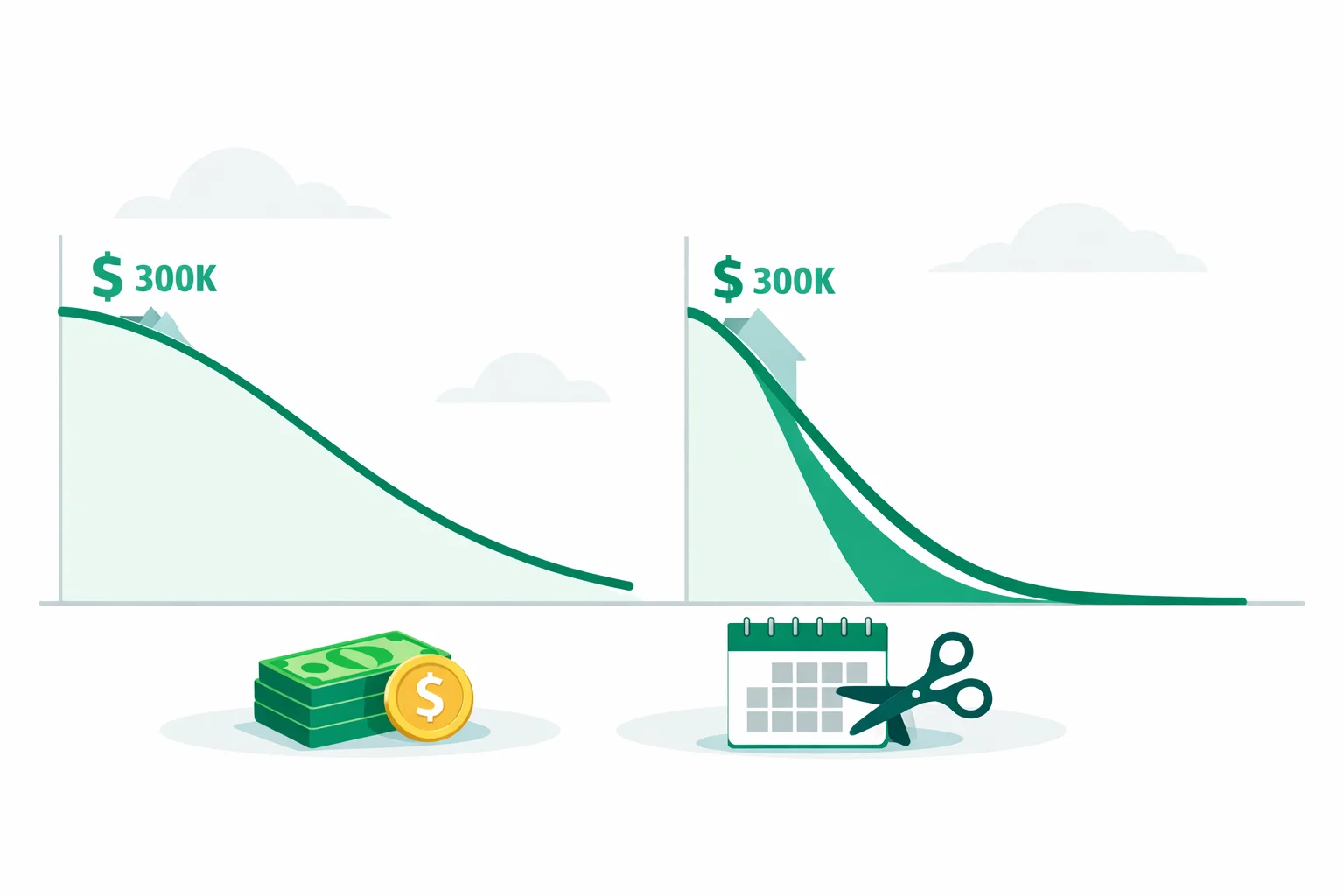
An Extra $100 a Month Buys You Four Years
The reason a modest extra payment hits so hard is that it skips the line. Your normal payment gets eaten mostly by interest in the early years — on that $300,000 loan, the first payment sends about $1,625 to the bank as interest and only $271 to principal. But an extra payment has no interest to cover. Every cent of it lands on principal, and it erases all the future interest that principal would have racked up over the remaining decades.
Here's the whole picture for a $300,000 loan at 6.5% with 30 years to go:
| Extra Per Month | Payoff Time | Years Saved | Interest Saved |
|---|---|---|---|
| $0 (minimum) | 30 years | — | — |
| +$100 | ~26 years | ~4 years | ~$61,000 |
| +$200 | ~23 years | ~7 years | ~$103,000 |
| +$300 | ~21 years | ~9 years | ~$135,000 |
| +$500 | ~17.5 years | ~12.5 years | ~$180,000 |
Notice the savings don't climb in a straight line. Doubling the extra from $100 to $200 doesn't double the payoff — it nearly doubles the interest saved and adds three more years off the term. That curve is the whole reason this calculator is worth running with your real numbers instead of guessing.
The Timing Trick That Triples Your Savings
Here's the part almost no lender explains: whenyou make an extra payment matters far more than most people think. The same dollar is worth a fortune early in the loan and almost nothing near the end, because early on it has 25 or 30 years of future interest to cancel — late in the loan, there's barely any interest left to erase.
Watch what a single $10,000 lump sum does to that $300,000 loan, depending on when you pay it:
| When You Pay $10,000 | Interest Saved |
|---|---|
| Year 1 | ~$53,600 |
| Year 5 | ~$40,100 |
| Year 10 | ~$26,900 |
| Year 15 | ~$17,100 |
| Year 20 | ~$9,800 |
| Year 25 | ~$4,400 |
Same $10,000 either way. Paid in year 1 it saves about $53,600; paid in year 25 it saves about $4,400 — roughly 12 times less. This is why a windfall you're sitting on today is worth far more thrown at the mortgage now than the identical amount applied a decade from now. Drop your loan into the calculator and slide the lump sum's year forward to watch the savings drain away. If you want to see the interest-cancelling effect payment by payment, the mortgage amortization calculator shows exactly how an early extra payment reshuffles the entire schedule.
Extra Monthly, Lump Sum, or Biweekly? Ranked by Power
There are three common ways to attack the balance, and they don't all pull the same weight. Run each one on our $300,000 loan and a clear ranking appears:
- A steady extra each month is the workhorse.$200 a month saves about $103,000 because the extra principal is compounding against future interest every single month for years. It's the most reliable lever because it's automatic.
- A lump sum is powerful but front-loaded. A one-time $20,000 paid today saves about $97,000 — nearly as much as the $200/month plan — but only if you pay it early. Wait ten years and that same $20,000 saves closer to $46,000.
- Biweekly is the "painless" option.Paying half your payment every two weeks sneaks in one extra full payment a year (26 half-payments = 13 full). On this loan that trims about five to six years and saves roughly $87,000 without you ever writing a bigger check — it's the same money you already pay, just resequenced. Our biweekly mortgage calculator breaks that strategy out on its own; toggle it on here to stack it with everything else.
You don't have to pick just one. Stack a $200 monthly add-on, a $20,000 lump today, and a biweekly schedule together and the same loan is gone in about 17 years, saving close to $196,000. The strategy table in the calculator ranks each move on your actual balance, so you can see which one is worth the effort.
How One Extra Dollar Erases Future Interest
The engine under every early-payoff strategy is the standard amortization formula. Your fixed monthly payment is:
M = P × [ r(1 + r)ⁿ ] ÷ [ (1 + r)ⁿ − 1 ] — where P is the balance, r is the monthly rate (annual rate ÷ 12), and n is the number of payments left.
Each month the lender charges interest on the current balance (balance × r), and whatever's left of your payment reduces principal. On a $300,000 balance at 6.5%, month one's interest is 300,000 × 0.005417 ≈ $1,625. Your $1,896 payment covers that and knocks $271 off the balance. Now add $200 extra: principal drops by $471 that month instead of $271. Next month, interest is charged on a smaller balance, so a hair more of your regular payment goes to principal too — and the effect snowballs. That's why the payoff date jumps years, not months, from a payment that only looks a little bigger. Every dollar of principal you retire early removes its entire stream of future interest from the loan; the mortgage interest calculator quantifies exactly how large that stream is.
Should You Just Round the Payment Up?
Rounding up is the easiest painless strategy going, and it works better than it sounds. Say your payment is $1,896 and you round it to $2,000 — a $104 add-on you'll barely feel. That's essentially the +$100 row from the table above: about four years off the loan and roughly $61,000 saved, for the cost of forgetting the payment isn't a round number.
Round all the way to $2,100 and you're at the +$200 tier, near $103,000 saved. The trick is to set it up as an automatic recurring payment so the extra goes out every month without a decision. In practice, the homeowners who succeed at early payoff almost never rely on willpower — they automate a slightly-too-big payment and never look at it again.
Tell Your Servicer to Apply It to Principal
This is the operational detail that quietly ruins good intentions. When you send extra money, many servicers don't automatically apply it to principal — they park it toward your next scheduled payment, which does almost nothing for your payoff date. According to the Consumer Financial Protection Bureau, you have to specifically instruct the servicer to apply extra payments to the principal balance.
So do two things. First, when you pay extra, mark it "apply to principal" — write it on the check memo or pick the principal-only option in your online portal. Second, check next month's statement and confirm the balance actually fell by the full extra amount. If it didn't, the money got misapplied and you're owed a correction. A $200 monthly extra that's silently credited to next month's payment for a year is $2,400 that bought you almost zero payoff progress.
When Keeping the Minimum Payment Wins
Accelerating a mortgage isn't always the smartest use of a dollar. Before you funnel cash into the house, run down this list — in several situations the minimum payment is the better call. It's the same ordering logic behind Baby Step 6, which the Dave Ramsey mortgage calculator gates behind a five-item checkpoint for exactly these reasons:
- You haven't maxed your employer 401(k) match. A 50–100% match is an instant, guaranteed return no 6.5% mortgage payoff can beat. Capture every matched dollar first.
- You carry high-interest debt.A 22% credit card balance costs more than three times what your mortgage does. Kill that first; the mortgage is the cheapest money you'll ever borrow.
- Your emergency fund is thin.Money sent to the mortgage is locked in the walls — you can't pull it back out without a refinance or a HELOC. Keep 3–6 months of expenses liquid before prepaying.
- Your rate is very low.If you're sitting on a 3% loan from a few years back, paying it down early earns you a guaranteed 3% — often less than a high-yield savings account, and far less than the market's long-run average.
If a lower rate is what's really on your mind, compare accelerating your current loan against a refinance before you commit — sometimes the cheaper path to debt-free is a new rate, not extra payments on the old one.
Payoff Mistakes That Quietly Waste Money
- Not checking for a prepayment penalty.Most conventional loans have none, but some charge a penalty — often around 2% of the balance — for paying off early in the first few years. On a $280,000 balance that's $5,600. Read the prepayment section of your note before dropping a big lump sum.
- Waiting to save up one big payment. Sitting on cash for two years to make a single $20,000 payment costs you two years of compounding. Paying about $830 a month over those same 24 months starts erasing interest immediately and usually saves more.
- Recasting confusion. A large principal payment lowers your balance but notyour required monthly payment unless you ask for a recast. Your payoff date moves up, but the monthly bill stays the same — which is fine, just don't expect a smaller payment.
- Draining every reserve to be debt-free.Being mortgage-free feels great until the water heater dies and you're reaching for a credit card at 22%. The payoff math only works when the extra money is genuinely spare.
The cleanest approach is boring on purpose: confirm there's no prepayment penalty, automate an extra amount you won't miss — even rounding up to the next $100 — and mark it principal-only. Then check one statement to be sure it landed right, and let the snowball do the rest. The earlier you start, the more each dollar is worth, so the best day to add $100 to the payment is the next one.