Concrete Slab Calculator: Getting the Right Pour for Patios, Driveways, and Foundations
A concrete slab calculator takes the guesswork out of ordering concrete for patios, driveways, garage floors, and foundations. Overorder by even half a yard and you're burning $75-$150 on material that hardens in the truck. Underorder and your finisher is racing the clock while you wait on a second delivery — and that cold joint where the two pours meet? It's a crack waiting to happen.
This calculator goes beyond a simple volume conversion. You'll get cubic yardage, gravel base tonnage, reinforcement quantities, and a line-item cost estimate — everything you need to hand a supplier a confident order.
What Is a Concrete Slab?
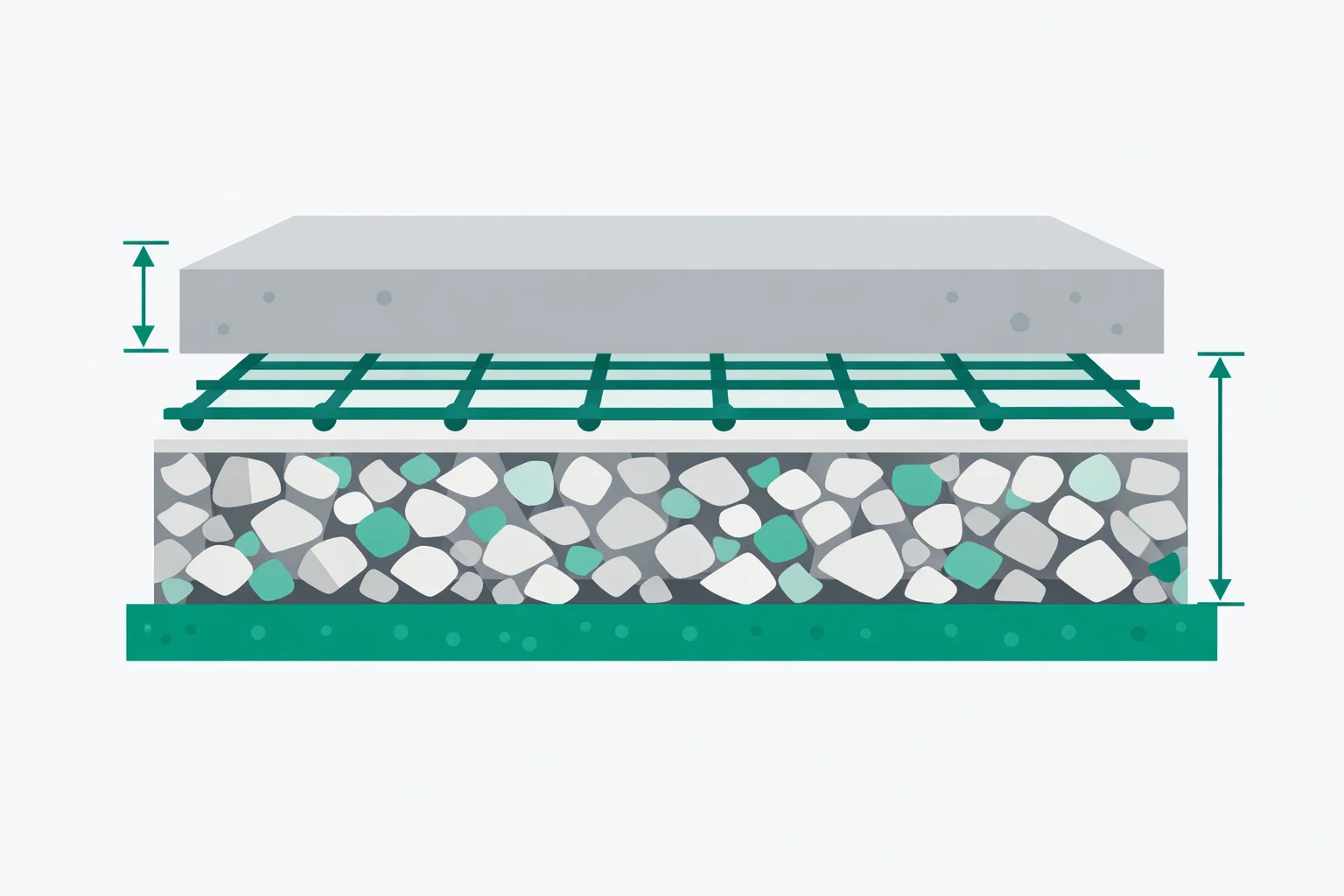
A concrete slab is a flat, horizontal pour of concrete that serves as a floor, foundation, or surface. Most residential slabs are between 4 and 6 inches thick, poured over a compacted gravel base, and reinforced with steel (wire mesh or rebar). The slab transfers loads evenly to the ground underneath — that's why the sub-base prep matters just as much as the concrete itself.
Slabs fall into two broad categories. On-grade slabs sit directly on the ground and work for patios, driveways, and garage floors. Monolithic foundation slabshave thickened edges (12-16 inches) that double as footings, supporting the weight of the structure above. The type you're pouring determines the thickness, reinforcement, and sub-base you'll need.
The Concrete Slab Formula
The volume formula for a rectangular slab is straightforward:
Volume (cubic yards) = Length (ft) × Width (ft) × Thickness (ft) ÷ 27
The ÷ 27 converts cubic feet to cubic yards, since one cubic yard equals 27 cubic feet. You'll want to work in feet for length and width, but thickness is usually measured in inches — so divide inches by 12 first. A 4-inch slab = 0.333 feet, a 6-inch slab = 0.5 feet.
Always add a waste factor. A 10% overage is standard for straightforward rectangular pours. Irregular shapes, sloped sites, or forms that aren't perfectly level can push waste to 12-15%. If you need help converting odd shapes to cubic yards, our cubic yard calculator handles cylinders, triangles, and custom dimensions.
Worked Example: 20×24 Driveway
Let's walk through a real project — a two-car driveway that's 20 feet wide and 24 feet long, poured at 5 inches thick.
- Step 1: Convert thickness — 5 inches ÷ 12 = 0.417 feet
- Step 2: Calculate volume — 20 × 24 × 0.417 = 200 cubic feet
- Step 3: Convert to yards — 200 ÷ 27 = 7.41 cubic yards
- Step 4: Add 10% waste — 7.41 × 1.10 = 8.15 cubic yards
You'd order 8.25 yards from the batch plant (they round to quarter-yard increments). At $150/yard for ready-mix, the concrete alone runs about $1,238. Add a 6-inch gravel base (roughly 2.7 cubic yards or 3.7 tons at $25/ton = $93), rebar at $0.55/sq ft ($264), and labor at $3.50/sq ft ($1,680), and the full project lands around $3,275 — or about $6.82 per square foot.
Compare that to a thinner 4-inch slab: you'd save about $100 on concrete, but a 5-inch driveway lasts 25-30 years under daily vehicle traffic while a 4-inch slab often cracks within 8-10 years. That extra inch is the cheapest insurance you'll buy.
Slab Thickness Guide by Project Type
Thickness isn't a guess — it depends on what the slab has to carry. Here's what contractors typically pour for each application:
| Project Type | Thickness | Gravel Base | Reinforcement |
|---|---|---|---|
| Sidewalk / Garden Path | 4" | 4" | Wire mesh or fiber |
| Patio | 4" | 4" | Wire mesh |
| Driveway (passenger cars) | 5" | 6" | #4 rebar @ 18" |
| Driveway (trucks/RVs) | 6" | 6-8" | #4 rebar @ 12" |
| Garage Floor | 6" | 6" | #4 rebar @ 18" |
| House Foundation (monolithic) | 6" field / 12-16" edges | 8" | #4 or #5 rebar @ 12" |
| Workshop / Heavy Equipment | 6-8" | 8" | #5 rebar @ 12" |
These are industry-standard minimums. Always check with your local building department — some jurisdictions require thicker slabs, especially in frost-prone areas where IRC building codes mandate frost-protected shallow foundations.
Rebar vs. Wire Mesh: Picking the Right Reinforcement
Steel reinforcement doesn't prevent cracks — concrete willcrack. What reinforcement does is hold those cracks tight so they don't widen into structural problems.
Welded wire mesh (6×6 W1.4/W1.4)works for slabs that only carry foot traffic: patios, sidewalks, pool decks. It comes in 5×10 foot sheets, costs about $0.35/sq ft installed, and is quick to lay down. For a 12×12 patio (144 sq ft), you'd need 4 sheets with overlap — roughly $50 in mesh.
#4 rebar on 18-inch centers is the go-to for driveways and garage floors. It handles the point loads from vehicle tires far better than wire mesh. For that same 20×24 driveway, you'd need about 680 linear feet of rebar — that's 34 standard 20-foot sticks at around $264 total. Use our rebar calculator to get exact piece counts, weight, and cost for any slab, footing, or wall layout.
#4 rebar on 12-inch centers(or #5 rebar) is required for foundation slabs and any slab expected to support structural loads. Closer spacing means more steel and higher cost — about $0.75/sq ft — but it's not optional when you're building on top of the slab.
Why the Gravel Sub-Base Matters
Skip the gravel base and your slab will crack. It's that simple. The gravel serves three purposes: it creates a uniform bearing surface so the concrete doesn't settle unevenly, it drains water away from the slab bottom (trapped water freezes and heaves), and it provides a capillary break that prevents ground moisture from wicking up through the concrete.
Crushed limestone or clean ¾-inch angular gravel compacts best. Round river rock doesn't lock together and shifts under load. Compact the gravel in 2-inch lifts with a plate compactor — this step alone prevents more cracking than any reinforcement will. For a 20×24 driveway with a 6-inch base, you'll need about 3.7 tons of gravel, which usually means one dump truck delivery at $90-$100.
If you're pouring a larger project and want to verify the total material volumes, our concrete calculator handles multi-section projects with footings, columns, and stairs alongside your slab pour.
Concrete Slab Cost Breakdown
Knowing where the money goes helps you make trade-offs. Here's what a typical 480 sq ft driveway slab (20×24, 5 inches, rebar, 6-inch base) costs in 2026:
| Cost Component | Unit Cost | Quantity | Total |
|---|---|---|---|
| Ready-mix concrete (3,500 PSI) | $150/yd³ | 8.15 yd³ | $1,223 |
| Gravel sub-base (¾" crushed) | $25/ton | 3.7 tons | $93 |
| #4 rebar (18" centers) | $0.55/sq ft | 480 sq ft | $264 |
| Forms, stakes, expansion joints | — | — | $120 |
| Labor (excavation, forming, pour, finish) | $3.50/sq ft | 480 sq ft | $1,680 |
| Total | $3,380 |
That's about $7.04/sq ft all-in. Patios run cheaper ($5-$7/sq ft) because they're thinner and use wire mesh instead of rebar. Foundation slabs cost more ($8-$12/sq ft) because of thickened edges, deeper excavation, and closer rebar spacing. Stamped or colored finishes add $3-$6/sq ft on top.
5 Slab Mistakes That Cost Real Money
After enough projects, you see the same errors again and again. Each one is avoidable:
- Ordering to the exact calculated volume. Concrete is sold by the quarter-yard, and forms are never perfectly level. A 20×24 slab calculated at 7.41 yards can easily swallow 8+ yards in practice. Always add 10% waste — the $100-$150 for an extra half yard is nothing compared to a $300+ short-load delivery fee.
- Skipping compaction on the gravel base. Dumping gravel and raking it flat isn't compacting it. Uncompacted fill settles unevenly, creating voids under the slab that lead to cracks within the first year. Rent a plate compactor for $60/day — it pays for itself immediately.
- Setting rebar on the ground. Rebar that sits at the bottom of the slab does nothing. It needs to be elevated to mid-slab depth using rebar chairs (about $0.10 each). For a 5-inch slab, set chairs at 2-2.5 inches off the sub-base.
- Pouring in extreme heat without wind breaks. Air temperatures above 90°F cause surface water to evaporate faster than the concrete can hydrate, leading to plastic shrinkage cracks — ugly spiderweb patterns that appear within hours. Schedule hot-weather pours for early morning.
- Forgetting control joints. Concrete will crack no matter what. Control joints (saw-cut or tooled lines at ¼ the slab depth) tell the concrete where to crack so the lines are straight and hidden. Cut every 8-10 feet in each direction for a 4-inch slab, or every 10-12 feet for 5-6 inches.
Bagged Concrete vs. Ready-Mix Truck
The break-even point is smaller than most people think. A single 80-lb bag of premix yields about 0.6 cubic feet and costs $5-$7 at a home center. One cubic yard = 27 cubic feet = 45 bags = $225-$315 in materials alone, plus the labor of mixing each one by hand. A ready-mix truck delivers that same yard already mixed for $140-$180.
For projects under 1 cubic yard — a 10×10 patio at 4 inches thick, for example — mixing bags yourself makes sense. You control the pace, you don't pay a delivery fee, and cleanup is minimal. Our Quikrete calculator tells you exactly how many 40, 60, or 80 lb bags to buy for smaller pours. Above 2-3 cubic yards, a truck is almost always better. Mixing 90+ bags by hand is exhausting, and the pour takes so long that the first batch starts setting before you finish the last one.
If you're weighing material quantities for a full home build that goes beyond the slab, the construction calculator estimates lumber, drywall, and roofing alongside your concrete needs.
When to Use This Calculator
This calculator is built for flat, rectangular slab pours — the most common residential concrete project. Pull it up when you're:
- Getting quotes from concrete contractors — knowing the volume before they show up keeps you from overpaying on inflated estimates. A contractor who quotes 12 yards for a 10-yard job is either padding or measuring wrong.
- Ordering from a batch plant yourself — ready-mix plants quote by the cubic yard. Hand them the number from this calculator and they'll have your truck scheduled in minutes.
- Comparing DIY vs. hiring out — the cost breakdown shows exactly where the money goes, so you can decide which parts to do yourself (excavation, gravel base) and which to leave to a crew (forming and finishing).
- Sizing up your gravel and reinforcement order — most concrete calculators stop at cubic yards. This one also tells you how many tons of gravel, sheets of wire mesh, or sticks of rebar you need, so you can call one supplier and order everything at once.
For non-rectangular shapes, stepped footings, round columns, or multi-section projects, the general-purpose ACI concrete calculator from the American Concrete Institute handles more complex geometry.