Concrete Block Calculator: How to Estimate CMU Blocks, Mortar, and Rebar for Any Wall
A concrete block calculator takes your wall dimensions and tells you exactly how many CMU blocks, bags of mortar, and lengths of rebar you'll need — before you make a single trip to the supply yard. Ordering too few blocks stalls your project; ordering too many wastes money and leaves you with a pallet of 33-pound dead weight in the driveway. Whether you're framing a garage foundation, building a retaining wall, or enclosing a basement, getting the material count right on the first try saves real dollars and real headaches.
What Is a CMU (Concrete Masonry Unit)?
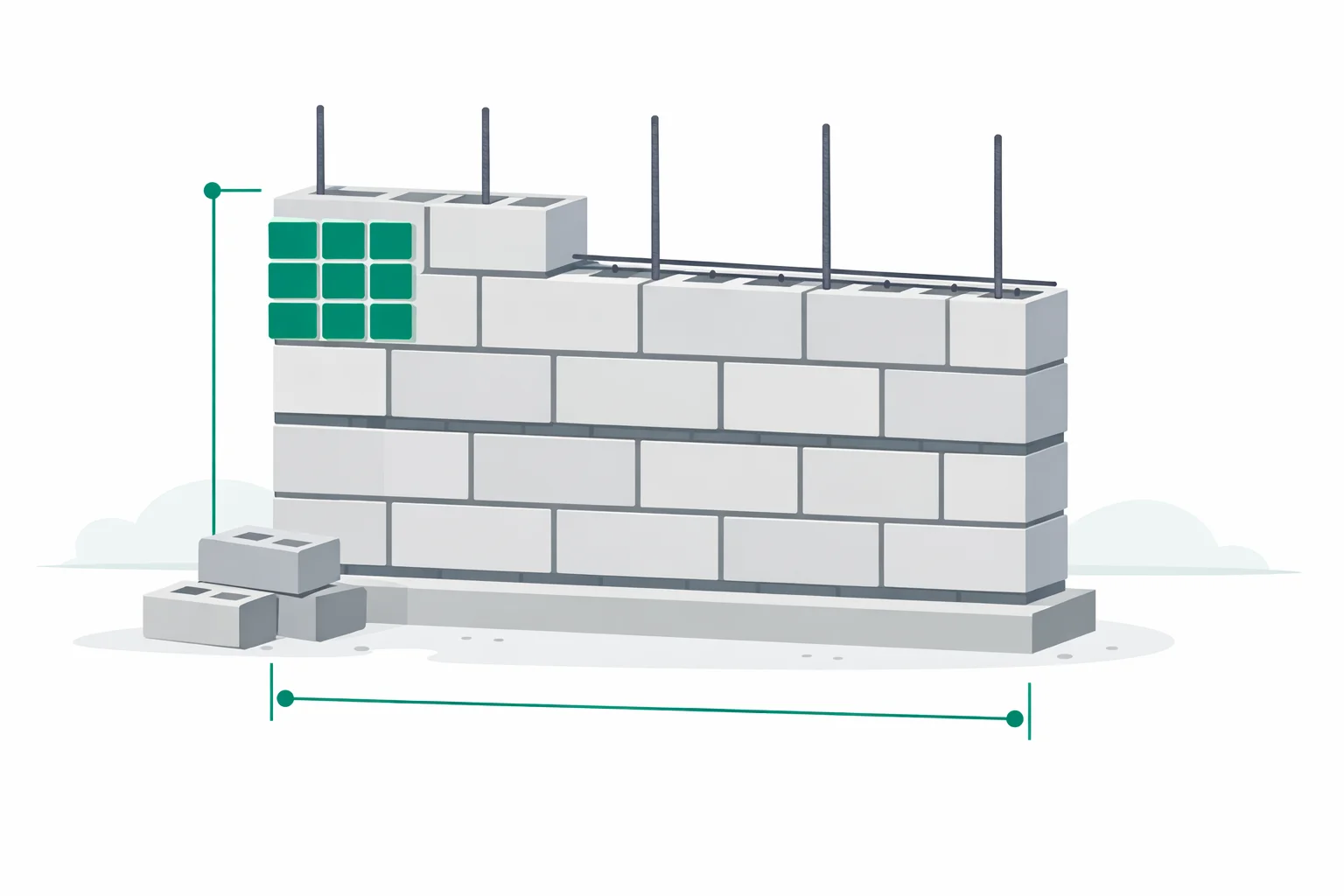
CMU stands for Concrete Masonry Unit — the industry term for what most people call a concrete block or cinder block. A standard CMU measures 7-5/8 inches tall by 15-5/8 inches long by 7-5/8 inches wide (the "8x8x16" nominal size accounts for the 3/8-inch mortar joint on all sides). They're hollow, with two or three open cells that can be filled with grout and rebar for structural reinforcement.
Standard-weight blocks use Portland cement, sand, and gravel aggregate and weigh around 33 pounds each. Lightweight CMUs swap in expanded shale or pumice aggregate, dropping weight to about 25 pounds — easier to handle but roughly 20% more expensive. For most residential walls, standard-weight blocks are the better value.
The Block Calculation Formula
The math behind block estimation is straightforward. Each standard 8x8x16 block, including its mortar joint, covers a face area of exactly 0.889 square feet (8 inches × 16 inches = 128 square inches = 0.889 sq ft). Here's the formula:
Blocks needed = Wall Area (sq ft) ÷ 0.889
Wall area is simply length × height. A 40-foot-long, 8-foot-tall wall has 320 square feet of face area, requiring 360 blocks before waste. Add your waste factor (typically 5-10% for straight runs, 10-15% for walls with many openings or corners), and you get your order quantity.
The formula adjusts the same way for other block sizes. A 12x8x16 block has the same face dimensions (8×16 = 0.889 sq ft) — only the width changes. So the block count stays identical regardless of width. What changes is the weight, cost per block, and the amount of grout needed to fill cores.
Worked Example: 24×32 Garage Foundation
Say you're building a detached garage with exterior dimensions of 24 feet by 32 feet, and the block wall sits 4 feet above grade (the below-grade portion is poured concrete footing). Here's the step-by-step:
- Calculate perimeter: 24 + 32 + 24 + 32 = 112 linear feet
- Calculate wall area:112 ft × 4 ft = 448 sq ft
- Subtract openings:One 16′ garage door (16 × 4 = 64 sq ft) + one 3′ service door (3 × 4 = 12 sq ft) = 76 sq ft. Net wall area: 448 − 76 = 372 sq ft
- Divide by block face area:372 ÷ 0.889 = 418 blocks
- Add 10% waste:418 × 1.10 = 460 blocks
At $2.15 per standard 8x8x16 block, that's about $989 in blocks alone. You'll also need roughly 14 bags of mortar and, if the wall is reinforced, approximately 15 vertical rebar bars plus 3 horizontal runs — around 140 linear feet of #4 rebar total.
Need to figure out the footing volume underneath those blocks? Our concrete calculator handles cubic yard estimates for footings, slabs, and poured walls.
Block Size Reference Table
Not every wall calls for the same block. Here's a quick reference for the five standard CMU widths, with weight and typical pricing:
| Nominal Size | Actual Width | Weight (each) | Cost (each) | Common Use |
|---|---|---|---|---|
| 4×8×16 | 3-5/8" | 22 lbs | $1.50 | Veneer, partition walls, garden walls |
| 6×8×16 | 5-5/8" | 28 lbs | $1.85 | Interior partitions, short retaining walls |
| 8×8×16 | 7-5/8" | 33 lbs | $2.15 | Standard exterior walls, foundations, retaining walls |
| 10×8×16 | 9-5/8" | 40 lbs | $2.75 | Tall retaining walls, load-bearing basement walls |
| 12×8×16 | 11-5/8" | 48 lbs | $3.25 | Heavy load-bearing, commercial foundations, deep basements |
Prices vary by region. The Southeast US tends to be cheapest; the Northeast and West Coast run 15-25% higher. Always call your local block supplier for exact pricing — bulk orders (500+ blocks) often qualify for a 5-10% volume discount.
How to Estimate Mortar and Grout
Mortar and grout are different products that serve different jobs. Mortar bonds the blocks together at the joints. Grout fills the hollow cores to encase rebar and add mass. Don't confuse them at the supply store — mortar is sandier and stays workable longer; grout is more fluid so it flows into block cells without voids.
Mortar: Budget 3 bags of 80-lb pre-mixed Type S mortar per 100 blocks. That accounts for standard 3/8-inch bed and head joints in a running bond pattern. A 460-block garage project needs about 14 bags. At $8-9 per bag, mortar adds roughly $120 to the job.
Grout:Only needed when you're filling cells for structural reinforcement. Each filled 8-inch block cell holds about 0.25 cubic feet of grout. If you're filling every fourth cell (standard residential rebar spacing), calculate the number of filled cells × 0.25 to get total cubic feet, then convert to bags. One 80-lb bag of grout fills about 0.5 cubic feet. For precise fill volumes, our cubic yard calculator can help with bulk material conversions.
Rebar Reinforcement: When and How Much
Not every block wall needs rebar — but any wall that carries a load, retains earth, or stands taller than 4 feet almost certainly does. The International Residential Code (IRC) sets minimum reinforcement requirements for residential masonry walls.
Standard residential practice for a reinforced block wall:
- Vertical rebar:#4 bars every 48 inches on center, placed in the block cores and grouted solid. For a 40-foot wall, that's 11 vertical bars.
- Horizontal rebar: Typically placed every other course (every 16 inches vertically) using bond beam blocks or joint reinforcement wire. An 8-foot wall has 6 horizontal courses of rebar.
Tighter spacing increases strength significantly. Going from 48-inch to 24-inch vertical spacing doubles your rebar count and grout fill but produces a wall that resists lateral pressure far better — crucial for retaining walls holding back 4+ feet of earth. Your structural engineer or local code will dictate exact spacing.
Common Block Estimation Mistakes
After years of seeing block orders come in short or wildly over, these are the mistakes that cost the most:
- Forgetting the mortar joint in block dimensions. People calculate using 8×16 face area (0.89 sq ft) — correct. But some use the actual block dimension (7.625×15.625 = 0.827 sq ft), which over-orders by about 7%. Always use nominal dimensions that include the joint.
- Not accounting for bond beam and cap blocks. The top course usually needs bond beam blocks (U-shaped) for the horizontal rebar. These cost $0.50-1.00 more per block. A 40-foot wall needs 30 bond beam blocks for the top course alone.
- Skipping the waste factor entirely. Blocks break during delivery and handling. Corners and openings require cuts that waste partial blocks. A 5% minimum waste factor is realistic even for a perfectly straight wall; 10% is safer for walls with windows and doors.
- Underestimating delivery costs. A pallet holds about 72 standard blocks and weighs around 2,400 pounds. Moving 7 pallets for a 500-block order requires a forklift and solid ground access. Factor in $75-150 for delivery plus any equipment rental for placement.
Block Wall Cost Breakdown
Here's what a typical 8-foot-tall, 40-foot-long block wall costs in materials when built with standard 8x8x16 blocks and rebar reinforcement:
| Material | Quantity | Unit Cost | Total |
|---|---|---|---|
| 8x8x16 CMU Blocks | 396 (incl. 10% waste) | $2.15 | $851 |
| Type S Mortar (80 lb bags) | 12 | $8.50 | $102 |
| #4 Rebar | 148 linear ft | $0.75/ft | $111 |
| Grout Mix (80 lb bags) | 30 | $5.00 | $150 |
| Bond Beam Blocks (top course) | 30 | $2.75 | $83 |
| Materials Total | $1,297 |
That works out to about $4.05 per square foot in materials. Professional mason labor adds $10-15 per square foot, bringing the installed cost to $14-19 per square foot. A DIYer with a helper can realistically lay 60-80 blocks per day — so that 40-foot wall is roughly a 5-day project.
Tips for Ordering Concrete Blocks
- Order by the pallet, not the piece. Most suppliers sell in full pallets of 72 blocks. Partial pallet charges add $20-40, so round up to the nearest pallet to avoid the surcharge and have extra blocks on hand.
- Inspect on delivery. Check for cracks and chips before the truck leaves. Cracked blocks waste mortar when you try to fill the gaps and compromise structural integrity. Reject any pallet with more than 5% damaged blocks.
- Buy specialty blocks upfront. Bond beam blocks, half blocks, corner blocks, and cap blocks should be part of your original order. Running out of bond beams mid-project means waiting for a special order while your wall sits partially grouted.
- Store blocks off the ground and covered. Wet blocks shrink as they dry, which can crack mortar joints weeks after the wall is finished. Stack pallets on gravel or lumber and cover with a tarp.
- Use the right mortar type. Type S mortar is standard for structural and below-grade walls. Type N works for non-structural above-grade partitions. Using Type N where S is required is a code violation and a structural risk.
If your block wall is part of a larger project, our construction calculator estimates materials across all phases — foundation, framing, drywall, roofing, and flooring — so you can budget the full build in one place.
When to Use This Calculator
- Garage or shop foundation walls— size the block order for 3-5 course above-grade walls sitting on poured footings
- Retaining walls— estimate blocks, rebar, and grout for earth-retention projects up to code-allowed heights
- Basement walls— calculate 8" or 12" block quantities for full-height below-grade enclosures
- Garden and landscape walls— quick estimates for decorative or functional walls under 4 feet
- Material budgets and contractor quotes— verify a contractor's material estimate before signing, or build a purchase list for a DIY project
Run the numbers, print the materials list, and head to the block yard with confidence. A 10-minute calculation today saves a wasted trip and a stalled project tomorrow.