Mortgage Points Calculator: When Does Buying Down Your Rate Pay Off?
You need a mortgage points calculator at exactly one moment: when your lender slides two versions of the same loan across the table. Say it's 6.75% with zero points, or 6.5% if you hand over $3,500 at closing. That $3,500 is one discount point on a $350,000 loan, and whether it's a smart buy or wasted cash comes down to a single number your loan officer probably didn't mention: month 61.
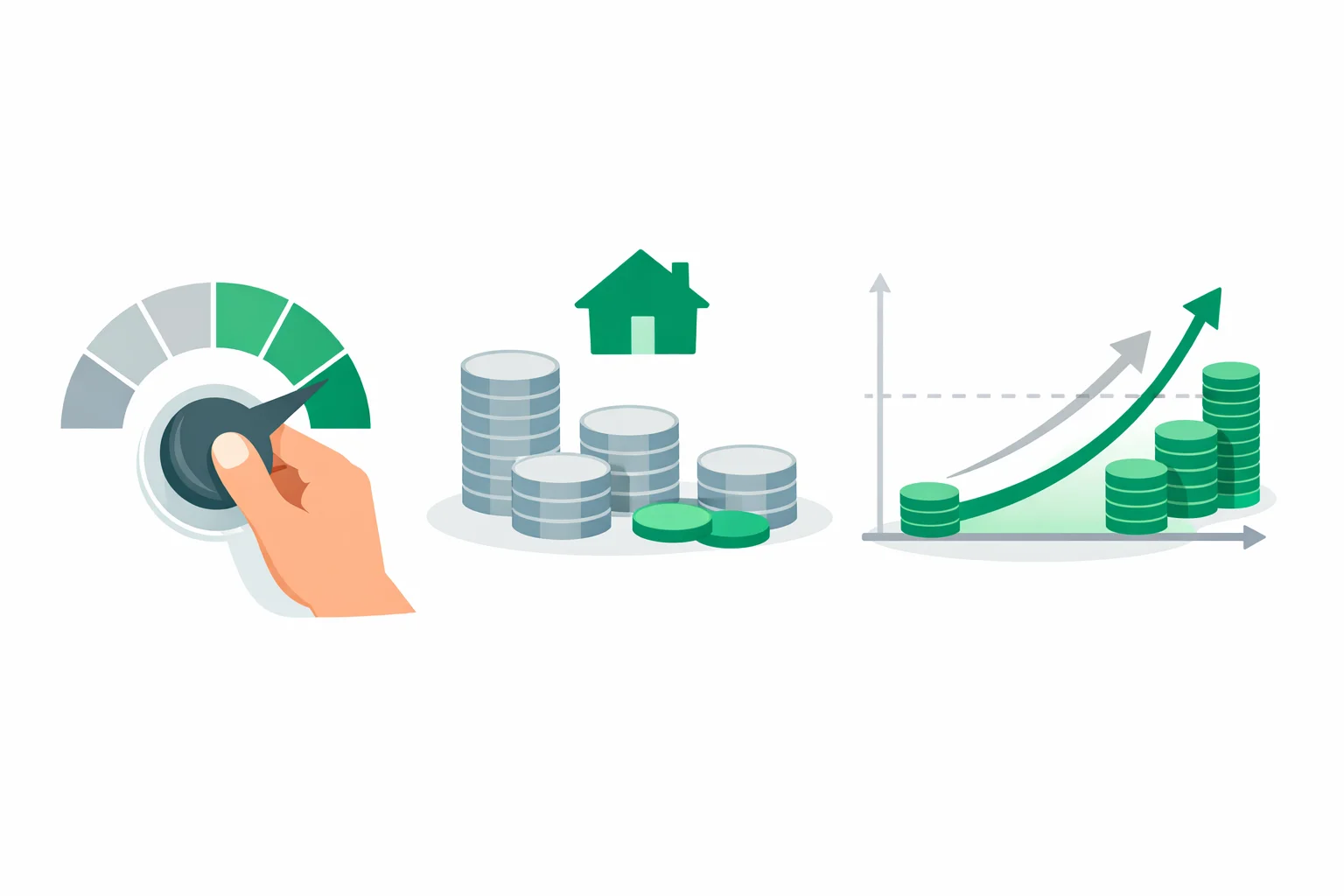
One Loan, Two Prices: What a Discount Point Actually Buys
A discount point is prepaid interest. You pay 1% of the loan amount at closing, and in exchange the lender permanently lowers your rate — typically by 0.25%, though the real figure on any given day ranges from 0.125% to 0.375% depending on the lender and the bond market.
Back to the quote above. One point on $350,000 costs $3,500. Dropping the rate from 6.75% to 6.5% cuts the monthly principal-and-interest payment from $2,270 to $2,212 on a 30-year term — $58 a month. You can verify both payments in our mortgage calculator if you want the full picture with taxes and insurance layered on. So the real question isn't "is a lower rate better?" Of course it is. The question is whether $58 a month is worth $3,500 today.
Break-Even Is the Only Number That Matters
The formula is short: break-even months = point cost ÷ monthly savings. Here, $3,500 ÷ $58 = 60.3 — call it month 61. For your first 61 payments, the points are a hole you're climbing out of. From month 62 on, every payment puts $58 in your pocket.
Three exits from the same loan, three completely different outcomes:
- Sell at year 3: you collected 36 payments × $58 = $2,088 in savings but paid $3,500. Net result: −$1,412. The points lost money.
- Sell or refinance at year 7: 84 × $58 = $4,872 saved, minus $3,500. Net: +$1,372. Modest win.
- Keep the loan all 30 years: 360 × $58 = $20,880, minus $3,500. Net: +$17,380. This is the number lenders like to advertise — and the least likely scenario to actually happen.
Notice how the same $3,500 decision swings by nearly $19,000 based on nothing but how long you keep the loan. That's why the holding-period slider in the calculator above matters more than any other input.
Points Pricing on a $350,000 Loan: Reference Table
Here's the full menu on a $350,000, 30-year loan with a 6.75% base rate, assuming the standard 0.25% cut per point:
| Points | Upfront Cost | Rate | Monthly P&I | Monthly Savings | Break-Even | Net If Kept 30 Yrs |
|---|---|---|---|---|---|---|
| 0 | $0 | 6.75% | $2,270 | — | — | — |
| 0.5 | $1,750 | 6.625% | $2,241 | $29 | ~61 months | +$8,690 |
| 1 | $3,500 | 6.50% | $2,212 | $58 | ~61 months | +$17,380 |
| 2 | $7,000 | 6.25% | $2,155 | $115 | ~61 months | +$34,400 |
| 3 | $10,500 | 6.00% | $2,098 | $172 | ~61 months | +$51,420 |
Spot the pattern? When pricing is linear, the break-even lands at the same month — about 61 here — no matter how many points you buy. Buying more points doesn't make the bet smarter; it makes the bet bigger. Two points doubles both your potential loss (exit early) and your potential gain (stay long).
One warning before you extrapolate from this table: real rate sheets aren't linear. The first point might buy 0.25%, the second 0.19%, the third just 0.125%. Ask your lender to print the full sheet and run each rung through the calculator — the sweet spot is usually somewhere in the first 1 to 1.5 points.
How Long Will You Actually Keep This Loan?
Buyers answer this question about the house. The math only cares about the loan — and loans die young. Most 30-year mortgages are retired well before year 10, ended by a move, a divorce, a cash-out, or a refinance the day rates drop far enough.
The refinance risk deserves special attention right now. If you buy two points at 6.25% today and rates fall to 5.5% in two years, refinancing is clearly the right move — but it vaporizes the roughly $4,200 of unrecovered point value you haven't earned back yet. Points are a bet that rates stay flat or rise. Before you buy them, run our refinance break-even calculator with a plausible future rate and see how easily a refi would tempt you. If the answer is "very easily," skip the points.
A practical rule from years of running these numbers with clients: don't count the years you hope to stay. Count the years since your last move, and assume the next gap will be similar. People are remarkably consistent about this.
Should That $3,500 Buy Points or Boost Your Down Payment?
Same $3,500, two destinations. As one point, it saves $58 a month. Added to the down payment instead, it shrinks the loan to $346,500 and saves about $23 a month at 6.75%. Points win on monthly cash flow by more than double — but the comparison isn't that clean.
Down payment money stays yours. It becomes equity you get back when you sell, whether that happens at year 3 or year 30. Point money is spent the moment you close. That asymmetry means the down payment is the safer play whenever your timeline is uncertain.
And there's one situation where the down payment wins outright: when the extra cash pushes you to 20% down and eliminates PMI. On a loan this size, PMI runs roughly $100–$150 a month — nearly triple what the point saves. Check where you stand with our mortgage calculator with PMI before you spend a dollar on points. Buying points while still paying PMI is almost always the wrong order of operations.
Buy Points If… Skip Them If…
Buy points if all of these are true:
- You realistically expect to keep this exact loan past the break-even month — typically 5+ years — with no refinance on the horizon
- You're already at 20% down (no PMI to kill first) and still have 3–6 months of expenses in reserve after paying for the points
- Rates are flat or rising, so a tempting refinance is unlikely to appear
- The rate sheet shows a genuine sweet spot — say, a full 0.375% cut for the first point
Skip them if any of these apply:
- There's a real chance you move or refinance within 5 years
- Paying for points would drain your post-closing cash below one month of expenses
- You'd still be paying PMI — redirect the cash to the down payment instead
- Rates are widely expected to fall — you'd be prepaying for a discount the market may hand you for free
Negative Points: When the Lender Pays You
The points machine runs in reverse, too. Accept a rate 0.25% higher and the lender hands you a credit worth about 1% of the loan toward closing costs — the CFPB calls these lender credits. On our $350,000 example, taking 6.5% instead of 6.25% frees up roughly $3,500 in cash at closing in exchange for $58 more per month.
The break-even logic flips with it: with credits, you're aheadfor the first 61 months and behind after. That makes lender credits the mathematically correct choice for the same short-timeline buyer who should refuse discount points. Cash-poor first-time buyers who'll likely refinance within five years are often better served by credits than by the "lowest rate" instinct.
Don't confuse either of these with a temporary 2-1 buydown, where a lump sum (often seller-paid) subsidizes a rate that's 2% lower in year one and 1% lower in year two, then snaps back. Discount points are permanent; a 2-1 buydown is a two-year coupon. They price completely differently and shouldn't be compared point-for-point.
Where the Points Math Breaks Down
A few situations where the clean break-even calculation above will mislead you:
- Adjustable-rate mortgages.Points on an ARM only discount the fixed period. Buying two points on a 5/1 ARM with a 61-month break-even means the discount expires almost exactly when you'd finally profit from it.
- The tax wrinkle. Points on a home purchase are generally deductible in the year paid — IRS Topic 504 covers the tests — but only if you itemize. Most filers take the standard deduction, so for them the "points are tax deductible" sales pitch is worth exactly $0. Refinance points are worse: they must be amortized over the loan's life, a deduction of roughly $117 a year on our $3,500 example.
- Opportunity cost. $3,500 earning 4% in a high-yield savings account produces about $140 a year risk-free. The true break-even, counting what your cash could have earned elsewhere, lands several months later than the simple formula shows.
- Stale quotes. Points pricing reprices daily with mortgage bond yields. A rate sheet from last week is trivia, not data.
The move that ties all of this together: when you request quotes, ask each lender for the same loan at 0, 1, and 2 points on the same day, then run every option through the calculator above with an honest holding period. Lenders quote the rate; the break-even month is the price tag they leave off.