PMI vs MIP: Which Mortgage Insurance Costs Less on Your Loan?
A mortgage insurance calculator is really settling an argument between loan programs, because "mortgage insurance" isn't one price. The same $350,000 house with 5% down costs about $180 a month to insure on a conventional loan with a 700 credit score, $141 a month plus $5,819 upfront through FHA, and $0 a month with a one-time $4,988 fee on a VA loan. Most buyers never run that comparison — they get quoted one program and assume the insurance line is just what insurance costs. It isn't. The spread between the cheapest and most expensive option on that loan is over $34,000.
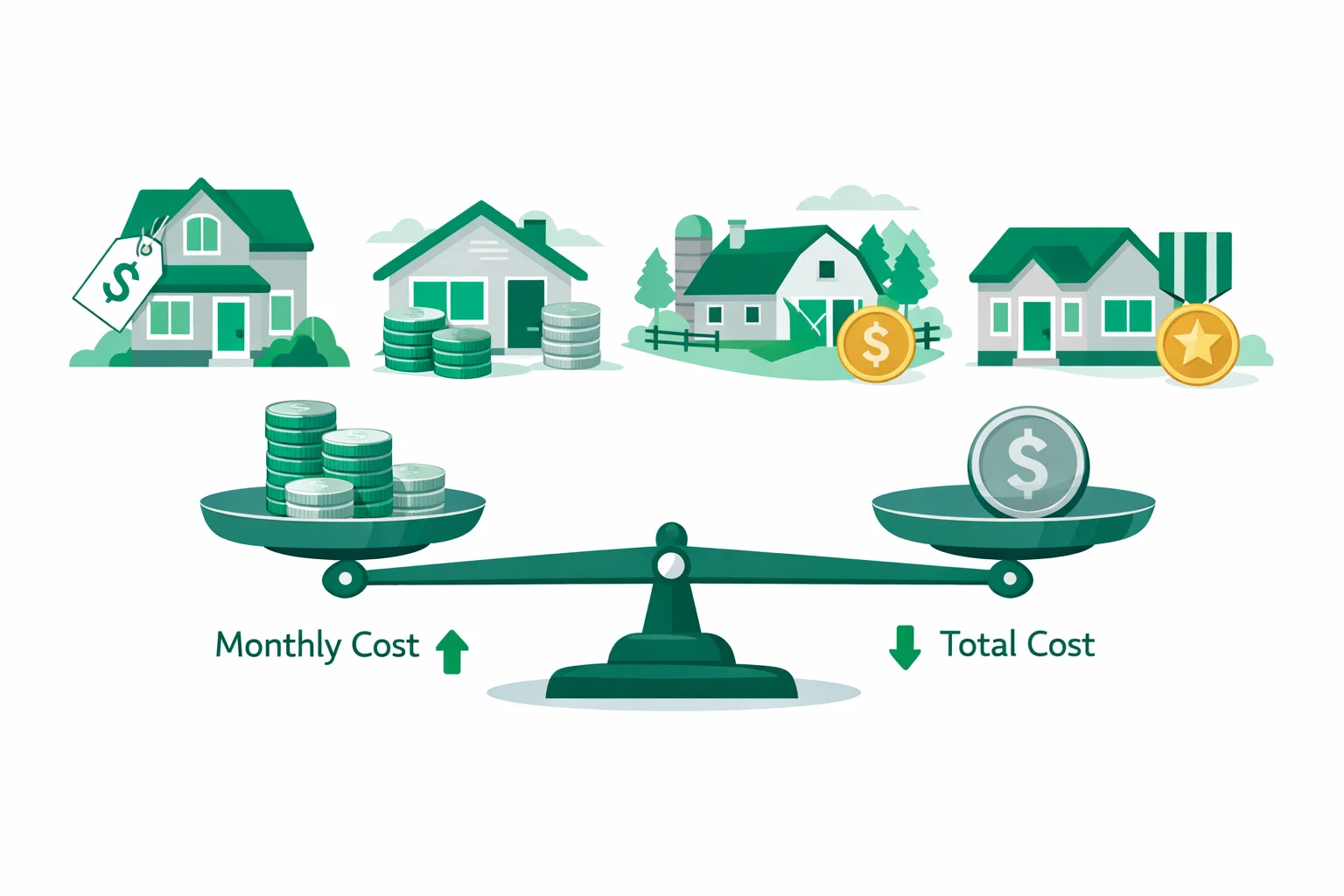
Mortgage Insurance Isn't One Product — It's Four
Each major loan program insures low-down-payment loans differently, and the structures barely resemble each other. Conventional loans use PMI — private insurance priced by your credit score and loan-to-value ratio, with no upfront charge, that cancels once you build equity. FHA uses MIP — a government premium with a 1.75% upfront charge plus a flat annual rate that ignores your credit score entirely and, at less than 10% down, never cancels. USDA charges a 1% upfront guarantee fee plus 0.35% annually for the life of the loan. VA charges a single funding fee of 1.25% to 2.15% and nothing monthly, ever.
Four products, four price structures, four cancellation rules. That's why a single "what does mortgage insurance cost" number is meaningless without naming the program first.
Your Credit Score Picks the Winner
Here's the asymmetry that decides most PMI-vs-MIP matchups: FHA charges every borrower the same 0.50-0.55% annual MIP whether their score is 580 or 800, while PMI rates swing almost 4x across credit tiers. On a $332,500 loan at 95% LTV, monthly PMI runs about $83 with a 760+ score, $136 at 720-739, $219 at 680-699, and $344 at 620-659. FHA's MIP sits at $141 for all of them.
So the monthly crossover lands right around a 720 score at this LTV. Above it, conventional wins the monthly comparison. Below it, FHA looks cheaper every month — which is exactly how buyers with 650 scores end up in FHA loans. But the monthly number is only half the story, and the other half usually flips the result. Our PMI calculator breaks down the full conventional rate grid by credit tier and down payment if you want to see where your exact profile lands.
The Math, Worked Out on the Same $350,000 Loan
Both premiums are simple percentages — the differences are in what they're charged on and for how long. Take a $350,000 house, 5% down ($17,500), leaving a $332,500 loan at 6.5% over 30 years, with a 700-719 credit score.
Conventional PMI:at 95% LTV and that credit tier, the annual rate is about 0.65% of the loan. That's $332,500 × 0.0065 = $2,161 a year, or $180.10 a month, added to your payment with nothing due at closing. The premium stays fixed until cancellation.
FHA MIP: two charges. Upfront, 1.75% of the base loan — $332,500 × 0.0175 = $5,819— which almost everyone finances, bringing the real loan to $338,319. Then the annual premium: 0.50% of the outstanding balance at 95% LTV, recalculated as the balance falls. Year one that's $338,319 × 0.005 ÷ 12 = $140.97 a month, drifting slowly downward each year. The FHA loan calculator folds both charges into the full monthly payment if you're pricing the whole loan, not just the insurance.
Monthly verdict: FHA by $39. Now watch what the duration rules do to that lead.
The Cancellation Gap Nobody Prices In
PMI dies. MIP, at less than 10% down, doesn't. Under the federal Homeowners Protection Act — the CFPB summarizes the rules here — you can request PMI cancellation at 80% LTV and your lender must terminate it automatically at 78%, based on the original amortization schedule. On our example loan, the balance hits 78% of $350,000 at month 135 — about 11 years in. Total PMI paid: $180.10 × 135 = $24,314.
The FHA loan keeps charging MIP for all 360 payments. Add up the declining annual premium plus the $5,819 upfront charge and total MIP comes to about $39,012 — roughly $14,700 more than the PMI that looked $39 a month cheaper. And that 11-year PMI figure is the worst case: it ignores appreciation. If the home gains value, you can order a new appraisal ($400-600) and request cancellation years earlier, cutting the PMI total further. MIP has no such lever — the standard escape is refinancing into a conventional loan at 20% equity, which is worth checking with the mortgage refinance calculator once rates and equity line up.
Choose Conventional If… Choose FHA If…
Run your own numbers in the calculator above, but the pattern at 3-5% down is consistent enough to state as rules:
- Choose conventional if your score is 720 or higher.PMI is cheaper monthly ($136 vs $141 at 720-739 on our example) AND it cancels. There's no case for FHA insurance here.
- Choose conventional if your score is 660-719 and you plan to stay 8+ years. You'll pay $40-80 more per month than FHA early on, but PMI's cancellation saves $10,000-15,000 in total. The longer you hold, the more the cancellation matters.
- Consider FHA if your score is under 660 and cash flow is tight now.At 620-659, PMI costs $344 a month against FHA's $141 — a $203 monthly gap that's hard to ignore, even though lifetime totals land close ($46,384 PMI vs $39,012 MIP). Plan the conventional refinance for the moment you hit 20% equity or your score recovers.
- Choose FHA if conventional approval isn't on the table.Below a 620 score conventional financing generally isn't available, and FHA accepts scores down to 580 at 3.5% down. Then the comparison isn't PMI vs MIP — it's MIP vs renting.
- Put down 10% on FHA if you're anywhere close.That single move converts MIP from life-of-loan to an 11-year cutoff — on our example loan it's worth roughly $19,000 in avoided premiums.
Does Waiting for 20% Down Beat Paying Insurance?
Usually not, and the gap is bigger than most people expect. Going from 5% to 20% down on a $350,000 house means saving an extra $52,500. A household putting away $1,000 a month needs more than four years to get there. Meanwhile, at a modest 4% annual appreciation, that house costs about $14,000 more each year you wait — so three years of saving to dodge roughly $6,500 in PMI premiums can cost $40,000+ in purchase price, plus three years of rent. The insurance you were avoiding was the cheapest item in the equation.
The honest exception: if you're only a few thousand dollars from a threshold — 10% down for the FHA 11-year rule, or 15% down where PMI rates drop to the 0.19-0.62% band — a short delay can pay off. Test the thresholds with the down payment calculator before deciding the target is worth the wait.
USDA and VA: The Two Programs That Break the Pattern
USDA loans look like FHA at first glance but price out very differently. The upfront guarantee fee is 1% (vs FHA's 1.75%) and the annual fee is 0.35% (vs 0.50-0.55%) — on our $332,500 loan that's $3,325 upfront and about $98 a month, roughly $26,400 total over 30 years against FHA's $39,000. It runs for the life of the loan, but at nearly half FHA's annual rate and with zero down payment required, USDA is the cheapest monthly insurance of any low-down-payment program — if the property sits in an eligible rural area and your household income clears the limits.
VA loans skip monthly insurance entirely. The one-time funding fee — 2.15% first use with less than 5% down, 1.5% at 5-9.99%, 1.25% at 10%+ — is $4,988on our example at 5% down. Compare that with $24,314 of PMI or $39,012 of MIP and it's not close; the VA guarantee is the single most valuable mortgage benefit in the market. Veterans with a service-connected disability rating pay no funding fee at all, per VA's funding fee schedule.
When This Calculator's Numbers Will Be Off
The PMI grid here models standard borrower-paid monthly PMI on a 30-year fixed. Real quotes move with factors the grid can't see: debt-to-income ratio above 45%, a second home, a condo, more than one borrower, or a 15-year term (which prices lower). Lender-paid PMI and single-premium PMI restructure the cost entirely — LPMI buries the premium in a rate roughly 0.25% higher, which you can't cancel, ever, making it a bad deal if you'll hold past year 6-7.
On the FHA side, the 0.50-0.55% rates assume a loan at or under the base conforming limit; loans above it add 0.20-0.25%, and 15-year FHA terms drop to 0.15-0.40%. One more thing worth knowing: none of these premiums protect you. Mortgage insurance pays the lender if you default — your protection is the equity you're building, which is the strongest argument for treating any of these premiums as a temporary toll, not a permanent line item. Set a calendar reminder for the month your balance crosses 80% LTV; lenders are required to cancel PMI when asked, but they're not required to remind you.