FHA Loan Calculator: How MIP, the 3.5% Rule, and the 11-Year Cliff Shape Your Payment
$30,000. That's roughly what an FHA loan calculator won't show you unless you read the fine print — the total annual mortgage insurance you'll pay over 30 years on a typical $300,000 home with the minimum 3.5% down. FHA loans open the door to homeownership with a low down payment and forgiving credit rules, but that access comes wrapped in a mortgage insurance premium (MIP) that behaves nothing like the PMI on a conventional loan. Getting the structure right is the difference between a smart FHA purchase and an expensive one.
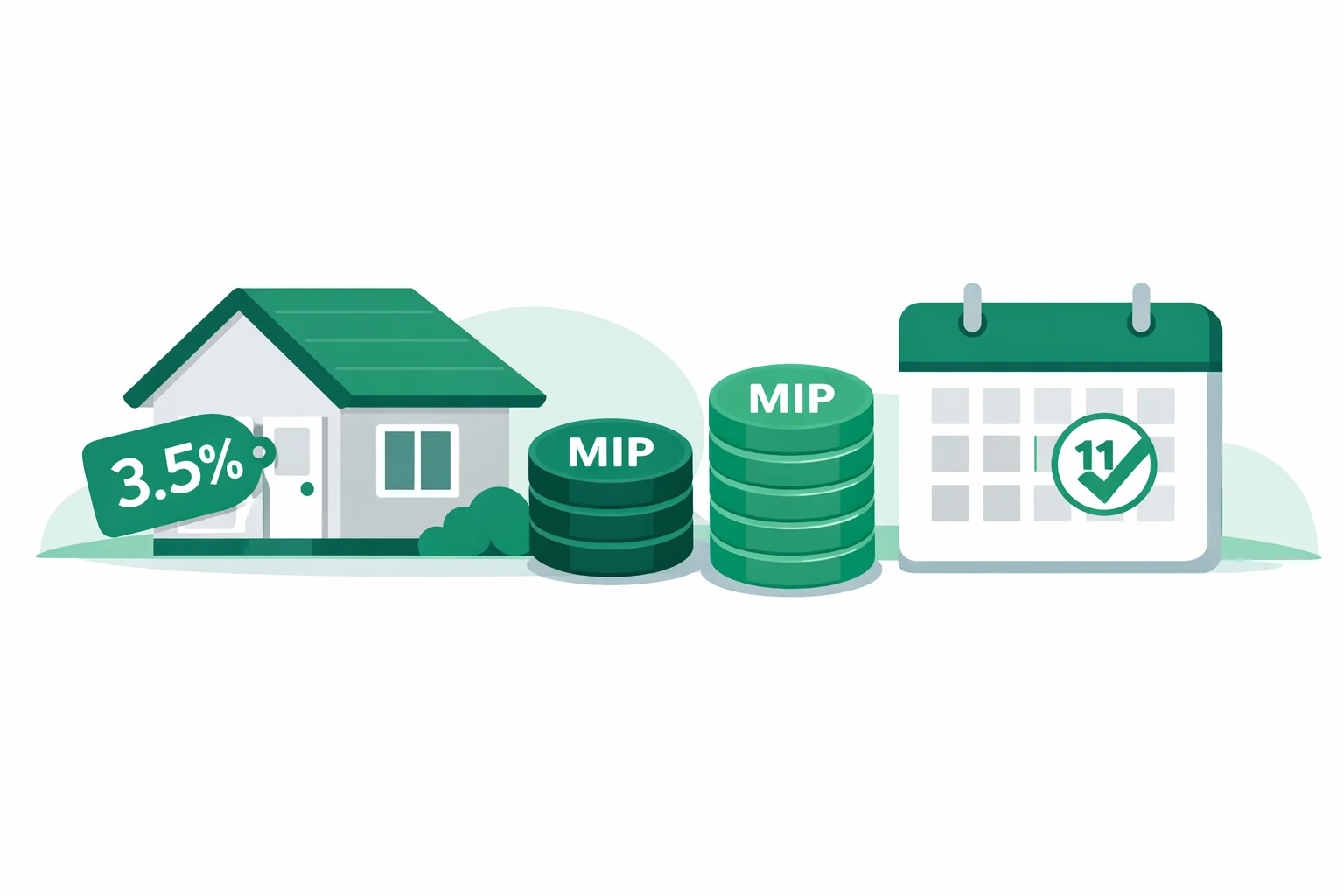
FHA Charges Two Mortgage Insurance Premiums, Not One
Most buyers know FHA loans carry mortgage insurance. What surprises them is that there are two separate premiums, and they work in completely different ways.
The first is the upfront mortgage insurance premium (UFMIP)— a flat 1.75% of your base loan amount, charged once. Almost nobody pays it in cash. It's rolled into the loan balance instead, so on a $289,500 base loan that's $5,066 added to what you borrow, and you pay interest on the premium for the life of the loan.
The second is the annual MIP, billed monthly. For a standard 30-year loan with the minimum down, it runs 0.55% of the balance per year — about $135 a month on that $294,566 loan. This is the premium that can haunt you, because how long you pay it comes down to a single number: your down payment.
The 11-Year Cliff: Why 10% Down Changes Everything
Here's the rule almost no one explains clearly. Put less than 10% down and annual MIP stays for the entire life of the loan. It never cancels on its own — not at 20% equity, not at 22%, never. Put 10% or more down and MIP automatically drops off after 11 years.
That single threshold is worth real money. Take our $300,000 home. At 3.5% down you pay roughly $135 a month in MIP for 30 years — call it $30,000 in total once you count the declining balance plus the $5,066 upfront premium. Bump the down payment to 10% ($30,000) and MIP stops at year 11, closer to $13,000 in annual MIP instead of $25,000. Crossing from 9% to 10% down doesn't just shrink your loan — it deletes 19 years of premiums. The down payment calculator shows exactly where your cash lands relative to that 10% line.
Current FHA MIP and Down Payment Reference Table
FHA's rates depend on your loan term, loan size, and down payment. These are the figures for the most common case — a 30-year loan at or below the standard county limit. Confirm current numbers on HUD's single-family insurance page before you lock, since premiums are adjusted periodically.
| Down Payment | Annual MIP Rate | How Long You Pay It |
|---|---|---|
| 3.5% (minimum, 580+ score) | 0.55% | Life of the loan |
| 5% to 9.99% | 0.50% | Life of the loan |
| 10% or more | 0.50% | 11 years |
Notice the upfront 1.75% premium applies in every row — it doesn't move with your down payment. And here's a detail the table can't capture: a credit score below 580 forces a 10% minimum down anyway, which pushes lower-credit buyers onto the 11-year track by default. It's a strange silver lining of a weak score.
Worked Example: $300,000 Home With 3.5% Down
Let's run a realistic FHA purchase from start to finish. Home price $300,000, 3.5% down, 6.5% rate, 30-year term, 660 credit score.
- Down payment: $300,000 × 3.5% = $10,500
- Base loan: $300,000 − $10,500 = $289,500
- Upfront MIP: $289,500 × 1.75% = $5,066 (financed)
- Total loan: $289,500 + $5,066 = $294,566
- Principal & interest: about $1,862/month
- Annual MIP: $294,566 × 0.55% ÷ 12 ≈ $135/month
- Taxes + insurance: ($3,600 + $1,700) ÷ 12 ≈ $442/month
- Full payment: roughly $2,439/month
The line that should stop you is the MIP. At 3.5% down, that $135/month runs the full 30 years — about $30,000 in mortgage insurance, none of which builds equity. Run the same payment math for a standard loan with the mortgage calculator and the FHA premium is the gap you'll see between the two payments.
FHA vs. Conventional: Where Each One Wins
Most FHA borrowers are really choosing between FHA and a conventional loan. The honest answer is that it hinges on your credit score and your cash — not on which program is "better" in the abstract.
| Factor | FHA | Conventional |
|---|---|---|
| Minimum credit score | 580 (3.5% down) | 620, best pricing 740+ |
| Minimum down payment | 3.5% | 3% to 5% |
| Mortgage insurance | 0.55%/yr, often for life | 0.3%–1.5%/yr, cancelable |
| Insurance cancellation | Refinance or 11-yr rule | Automatic at 22% equity |
The crossover sits around a 680 score. Below it, FHA usually offers a lower interest rate and easier approval, so it wins on monthly cost. Above it, conventional pricing improves and its PMI both costs less and cancels — so conventional pulls ahead over time. If your score is strong, run the same purchase through the conventional loan calculator and weigh the cancelable premium on the PMI calculator against FHA's lifetime MIP before you commit. Veterans have a third option worth a look — the VA loan calculator shows a zero-down structure with no monthly mortgage insurance at all. And if you're buying in a small town or the open country, the USDA loan calculator checks a zero-down rural program whose 0.35% annual fee undercuts FHA's MIP. All of these assume a fixed rate — if you're weighing an adjustable loan to shave the start rate, the adjustable rate mortgage calculator maps out the best, expected, and worst-case payments once it adjusts.
The Refinance Exit Most FHA Buyers Plan From Day One
Because annual MIP usually never cancels at the minimum down payment, savvy FHA buyers treat the loan as a stepping stone. The plan: buy now with 3.5% down, let the home appreciate and the balance shrink, then refinance into a conventional loan once you hit 20% equity to shed MIP for good.
In practice, most buyers reach that 20% mark within three to seven years, especially where home values climb 3–5% a year. On our $300,000 example, dropping $135 a month in MIP after a refinance saves $1,620 a year. The catch: refinancing only pays off if rates haven't risen sharply since you bought. If your new conventional rate would be a full point higher, the MIP savings can get swallowed by the higher interest. Time the move — don't assume it's always on the table.
Mistakes That Cost FHA Buyers Thousands
- Stopping at 3% or 7% down.If you have cash near the 10% line, landing just below it keeps you on lifetime MIP. Pushing to a full 10% switches you to the 11-year cutoff — on a $300,000 home that's worth roughly $12,000 in avoided premiums.
- Forgetting the upfront premium is financed. Buyers budget for a $289,500 loan and then see $294,566 on the closing disclosure. That $5,066 also accrues interest — about $6,400 over 30 years at 6.5%.
- Assuming MIP cancels like PMI. Conventional PMI auto-cancels at 22% equity; FHA MIP at the minimum down does not. Buyers who expect it to vanish at 20% equity keep paying for years longer than they planned.
- Skipping the conventional comparison. With a 700+ score and 5% down, a conventional loan can beat FHA on total cost. Always run both before signing — the home affordability calculator helps frame the price range each program supports.
When an FHA Loan Is the Wrong Choice
FHA is a genuine on-ramp to homeownership, but it isn't the cheapest path for everyone. Its higher debt-to-income ceiling — up to 50% versus roughly 45% on a conventional loan — is what earns approval for many buyers, so if your DTI is the sticking point, check both limits on the mortgage approval calculator before you decide. Lean conventional — or at least compare hard — when:
- Your credit score is 700 or higher.You'll likely qualify for conventional with lower, cancelable PMI, which beats FHA's lifetime MIP over the years you own the home.
- You can put 20% down. A conventional loan then has zero mortgage insurance and no upfront premium, making FHA the more expensive option by a wide margin.
- You're buying a higher-priced home near the FHA limit. FHA caps how much it insures by county, and the larger your loan, the more that 0.55% lifetime MIP stings in absolute dollars.
One last move before you choose: ask your lender to quote an FHA and a conventional loan side by side, and specifically ask when each one's mortgage insurance ends — the mortgage insurance calculator runs that exact comparison, MIP against PMI, on your numbers. The monthly payments often look similar at the start. The real difference shows up in year 12 — when one borrower's insurance is gone and the other is still paying it. That's the comparison the headline payment hides.