USDA Loan Calculator: Zero-Down Rural Mortgages, the Two Eligibility Gates, and Real Monthly Costs
A USDA loan calculator only tells you half the story unless it answers one question first: do you even qualify? Roughly 97% of U.S. land area is eligible for USDA financing, yet most buyers never check — they assume "rural" means a farm an hour from the nearest stoplight. It doesn't. The bigger surprise is the price of admission: zero down, no monthly PMI, and a guarantee fee of just 0.35% a year — less than half of what FHA charges. Two gates stand between you and that deal, and both are easy to check before you fall for a house.
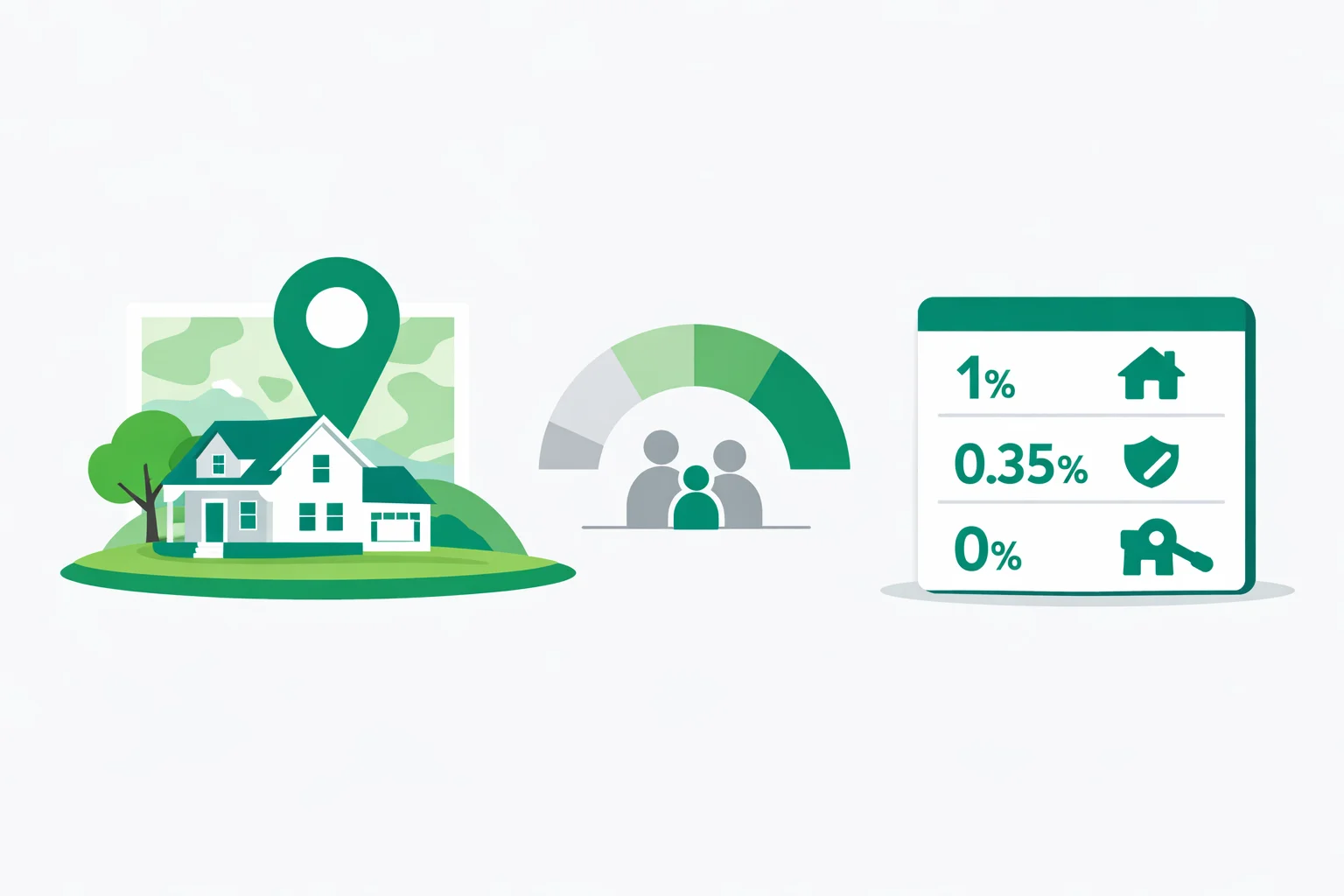
"Rural" Covers Far More Ground Than You Think
Here's what trips people up. The USDA Rural Development program defines eligible areas by population and location, not by how the place feels. Most towns under about 35,000 people qualify, and so does the open country wrapped around nearly every mid-size city. Plenty of subdivisions that look like ordinary suburbs sit inside the eligible map — sometimes one side of a street qualifies and the other doesn't.
The only way to know for certain is to type the exact address into the USDA property eligibility map. Don't eyeball it. A home a half-mile outside a shaded zone is ineligible no matter how rural the surrounding land looks, and the boundaries get redrawn after each census. Check the property, not the neighborhood.
Two Eligibility Gates Decide Everything
Every USDA approval clears two separate hurdles, and missing either one ends the conversation no matter how strong your credit is. Gate one is the property: it has to sit in an eligible area and be a modest primary residence — no working farms, no investment rentals, no second homes. Gate two is income.
This is where USDA flips the usual logic. Most loan programs ask whether you earn enough. USDA asks whether you earn too much. Your total household income — counting every adult living in the home, not just the borrowers — generally can't top 115% of the area median income. Earn a dollar over the limit and you're out, even with a 780 credit score and a 20% down payment you don't need. The calculator above flags both gates at once so you don't discover the problem three weeks into underwriting.
USDA Income Limits by Household Size
USDA sets income limits county by county, but most areas use a standard figure that steps up with household size. These are the common 2024-2025 standard limits for the Guaranteed Loan program — high-cost counties run higher, so confirm yours on the USDA income and property eligibility site.
| Household Size | Standard Income Limit (most areas) |
|---|---|
| 1 to 4 people | $112,450 |
| 5 to 8 people | $148,450 |
The jump from a 4-person to a 5-person household raises the cap by $36,000 — a real difference for a multigenerational family or one with several kids. One nuance the table can't show: USDA lets you deduct certain amounts, like $480 per dependent child and documented childcare costs, before comparing your income to the limit. So a family slightly over the headline number can sometimes still squeak under after adjustments.
How the 1% + 0.35% Guarantee Fee Works
USDA has no PMI, but it isn't free. The program runs on two guarantee fees that replace mortgage insurance. The upfront fee is 1% of the loan, charged once and almost always rolled into the balance. The annual fee is 0.35% of the remaining balance, split into 12 and added to each monthly payment for the life of the loan.
The formula is straightforward: total loan = home price × 1.01when you finance the upfront fee with zero down. On a $250,000 home that's a $2,500 upfront fee and a $252,500 loan. The annual fee starts at $252,500 × 0.35% ÷ 12 ≈ $74 a month and shrinks slowly as you pay down principal. Compare that to FHA's 0.55% annual MIP with the FHA loan calculator and the gap is obvious — USDA's monthly fee is roughly a third lower on the same price.
Worked Example: $250,000 Home, Zero Down
Let's run a complete USDA purchase. Home price $250,000, zero down, 6.5% rate, 30-year term, a 4-person household earning $85,000 in an eligible area.
- Base loan: $250,000 (100% financed)
- Upfront fee: $250,000 × 1% = $2,500 (financed)
- Total loan: $250,000 + $2,500 = $252,500
- Principal & interest: about $1,596/month
- Annual fee: $252,500 × 0.35% ÷ 12 ≈ $74/month
- Taxes + insurance: ($3,000 + $1,500) ÷ 12 ≈ $375/month
- Full payment: roughly $2,045/month — with $0 down
On the income side, $85,000 against a $112,450 limit lands at 76% of the cap — comfortably eligible with room for a raise. Over 30 years that $252,500 balance carries about $322,000 in interest, and the annual fee adds roughly $15,000 across the life of the loan. To benchmark the same payment against a standard 20%-down loan, run it through the mortgage calculator — the USDA version trades a higher balance for keeping every dollar of your savings.
USDA vs. FHA: Which Is Cheaper When You Qualify?
For buyers who clear both USDA gates, the real competition is FHA — the other low-barrier option. When you genuinely qualify for USDA, it almost always wins on cost. Here's a $250,000 home at 6.5% over 30 years under each program's standard terms:
| Program | Cash Down | Monthly Mortgage Ins. | Est. Monthly Payment |
|---|---|---|---|
| USDA (0% down) | $0 | ~$74 | ~$2,045 |
| FHA (3.5% down) | $8,750 | ~$110 | ~$1,985 |
| Conventional (5% down) | $12,500 | ~$99 | ~$1,960 |
The monthly payments land within about $90 of each other, but the cash-down column is the whole story. FHA wants $8,750 at closing and conventional wants $12,500 — USDA wants nothing. That's thousands of dollars you keep for reserves, repairs, or simply not draining your savings to move in. The catch is that USDA's annual fee never cancels, while conventional PMI drops off around 20% equity. If you'll hold the home a decade or more and can cover a down payment, weigh that cancelable PMI on the PMI calculator before assuming USDA is the cheapest over the full term.
Mistakes That Sink USDA Applications
- Counting only the borrowers' income. USDA counts every adult in the household, including a working teenager or a parent living with you. Buyers who forget this sail past the 115% limit and get denied late in the process.
- Trusting how a neighborhood "feels." A home that looks rural can sit just outside the eligible map. Always verify the exact address — being one block off the boundary kills the loan entirely.
- Forgetting the upfront fee is financed. Buyers budget for a $250,000 loan and then see $252,500 on the closing disclosure. That $2,500 also accrues interest — about $3,200 over 30 years at 6.5%.
- Skipping the income deductions.If you're a hair over the limit, missing the $480-per-child and childcare deductions can cost you an approval you actually qualified for. Have your lender run the adjusted number, and frame your price range with the home affordability calculator so you're shopping in the right band.
When a USDA Loan Won't Work for You
USDA is the cheapest path to a rural home for buyers who qualify — but the qualifications are narrow on purpose. Look elsewhere when:
- Your household income tops 115% of the area median.There's no override. A conventional or FHA loan is your route, even if everything else fits.
- The home isn't in an eligible area.If the address falls outside the USDA map, the program simply isn't available — no exceptions for "close enough."
- You're buying a rental or second home.USDA requires you to occupy the property as your primary residence, so it can't fund investment purchases.
- You have 20% to put down and plan to stay long-term.A conventional loan then carries no mortgage insurance at all, and its PMI-free payment can beat USDA's never-cancelling annual fee over 15-plus years.
One move worth making before you commit: ask your lender to confirm both your adjusted household income and the property's map status in writing on day one. USDA denials almost always trace back to one of those two gates, and both are knowable up front. Clear them early and the rest of the loan — zero down, low fees, competitive rates — is the easiest money in the mortgage market.