How an ARM Payment Moves: Caps, Scenarios, and the Worst Case You Should Plan For
Your rate is 5.5% for five years. Then, in the right conditions, it can climb to 10.5% — and your $2,271 payment becomes roughly $3,350. That swing is what an adjustable rate mortgage calculator exists to expose. An ARM trades a lower starting rate today for the risk that your rate floats upward once the fixed period ends. Whether that's a smart trade or a costly one depends entirely on three numbers most borrowers never check: the margin, the caps, and the worst-case payment.
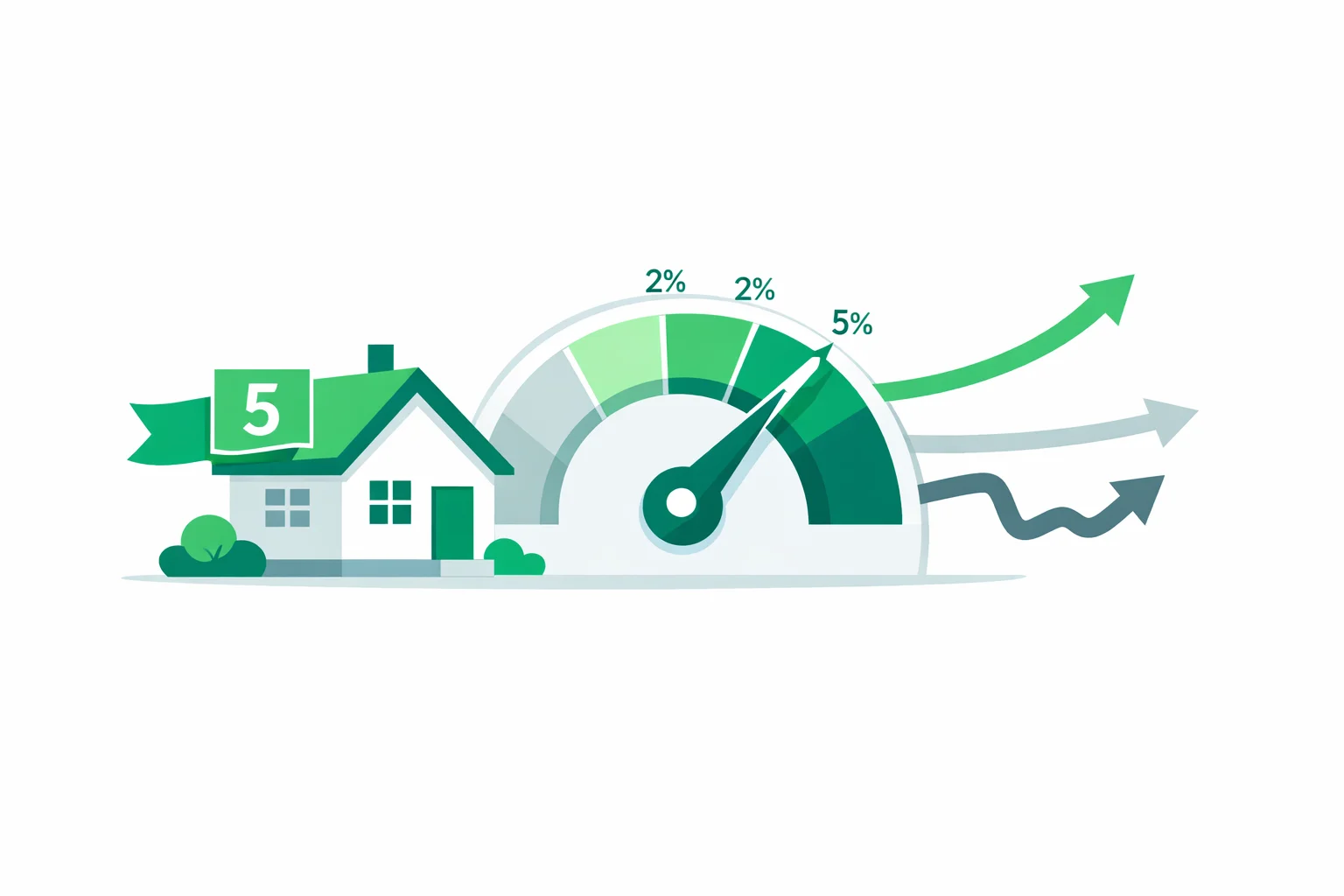
Your Rate Is Locked — Then the Clock Starts
An ARM has two lives. For the first stretch — five years on a 5/1, seven on a 7/1 — your rate and payment behave exactly like a fixed mortgage. Predictable, unchanging, easy to budget.
Then the fixed period ends and the loan wakes up. From that point, the rate resets on a schedule — once a year for the "/1" loans that dominate the market. Each reset recalculates your rate from a public index, then recasts your payment to pay off whatever balance is left over the years remaining. The lender isn't doing anything sneaky; this is the deal you signed. The trouble is that buyers fixate on the low teaser rate and skip past what happens in year six.
Reading a 5/1 ARM: What the Numbers Mean
The two numbers in "5/1" aren't random. The first is the fixed period in years. The second is how often the rate adjusts afterward, also in years. So a 5/1 is fixed for 5 years, then adjusts every 1 year. A 7/6 ARM — increasingly common — is fixed for 7 years, then adjusts every 6 months.
Here's a quick reference for the structures you'll actually be quoted, and roughly how their start rates compare to a 30-year fixed:
| ARM Type | Fixed Period | Adjusts | Typical Start-Rate Discount vs. Fixed |
|---|---|---|---|
| 3/1 | 3 years | Yearly | ~0.75%–1.0% lower |
| 5/1 | 5 years | Yearly | ~0.5%–0.875% lower |
| 7/1 | 7 years | Yearly | ~0.375%–0.625% lower |
| 10/1 | 10 years | Yearly | ~0.125%–0.375% lower |
The pattern is simple: the longer your rate stays fixed, the smaller the discount, because the lender carries the rate risk for longer. The 3/1 dangles the biggest savings and the shortest safety window.
Index + Margin Is Your Real Rate
When your ARM adjusts, the new rate isn't pulled from thin air. It's a formula: index + margin = your new rate. The index is a public benchmark that moves with the market — most new ARMs use SOFR. The margin is a fixed markup your lender sets at closing, and it never changes for the life of the loan. A typical margin runs 2.25% to 3.0%.
This is where people get blindsided. Say the index sits at 4.0% and your margin is 2.75%. Your fully-indexed rate isn't 4.0% — it's 6.75%. Borrowers who track only the headline index think their rate barely moved, then open a statement showing a rate nearly three points higher. The margin was riding on top the whole time. A lower margin is worth shopping for: shaving 0.5% off the margin saves about $120 a month on a $400,000 balance, every month for decades.
Caps Are All That Stand Between You and 10.5%
If the rate were just index plus margin with no limits, an ARM would be reckless. Caps are the guardrails. They come as three numbers — like 2/2/5 — and each one matters:
- Initial cap (the first 2): the most your rate can move at the very first adjustment. A 5.5% start rate can rise to 7.5% in year six, no higher — even if the fully-indexed rate would call for 9%.
- Periodic cap (the middle 2): the most it can move at each adjustment after the first. So 7.5% can become at most 9.5% the next year.
- Lifetime cap (the 5): the most your rate can ever rise above the start rate. With a 5.5% start and a 5% lifetime cap, your rate is hard-capped at 10.5% for the life of the loan, full stop.
That lifetime cap is the single most important number for sleeping at night. It defines your worst case. Run the figure through the mortgage calculator at the capped rate and you'll see the maximum payment you could ever face — the number you should be able to afford before you take the loan, not the teaser payment. The CFPB's guide to adjustable-rate mortgages walks through these cap mechanics in plain language and is worth reading before you sign.
Worked Example: A $400,000 5/1 ARM
Let's run a full loan. Loan amount $400,000, 5.5% start rate, 5/1 ARM, 30-year term, SOFR index at 4.0%, margin 2.75%, caps 2/2/5.
- Years 1–5 (fixed): $400,000 at 5.5% over 30 years = about $2,271 a month. Locked.
- Fully-indexed rate: 4.0% + 2.75% = 6.75%.
- Lifetime ceiling: 5.5% + 5% = 10.5%.
- Balance at year 5: roughly $371,000 after five years of payments.
- Year 6, expected: rate resets to 6.75% (within the 2% initial cap), recast over 25 years → about $2,560 a month.
- Year 6, worst case: rate jumps the full 2% to 7.5%, recast over 25 years → about $2,749 a month — a $478 jump from the fixed payment.
- Eventually, worst case: the rate steps up to the 10.5% ceiling, pushing the payment to roughly $3,350 a month at its peak.
Notice the recast. Each time the rate changes, the lender re-amortizes the remaining balance over the remaining years, so a higher rate and a re-spread balance both push the payment up. To see how much of each payment is actually chipping away at principal versus feeding interest, run the numbers through the principal and interest calculator.
Three Payments From One Loan
The honest way to evaluate an ARM is to look at three futures at once, because nobody knows which one arrives. The calculator above models all three from the same starting loan:
- Best case:the index falls, your rate drifts down toward the margin floor, and the payment actually drops below the fixed amount. This happens, but you can't bank on it.
- Expected: the index holds where it is, your rate resets once to the fully-indexed 6.75%, and the payment settles around $2,560. A reasonable middle estimate.
- Worst case:rates rise and your loan steps up cap by cap to the 10.5% ceiling. Plan as if this is possible, even if it's not likely.
The gap between best and worst on this loan is over $1,400 a month. That spread is the entire risk of an ARM in one number. If the worst case would break your budget, the lower start rate isn't a deal — it's a gamble.
Payment Shock and the Refinance Plan
Payment shock is the jump from your last fixed payment to your first adjusted one. On our example it's about $478 a month in the worst case — a 21% increase overnight. Lenders even stress-test for it, because a borrower who could afford $2,271 may not be able to absorb $2,749 four years later, especially after life changes.
Most ARM borrowers have an exit plan: sell or refinance before — or shortly after — the fixed period ends. It's a reasonable strategy, but it has a failure mode. Refinancing only helps if rates haven't climbed since you bought. If 30-year fixed rates are two points higher when your ARM adjusts, refinancing locks in a worse rate, and selling into a soft market may mean a loss. The plan that assumes you can always refinance out is the plan that fails when rates rise — which is exactly when you'd need the escape. Run the numbers in our mortgage refinance calculator before you count on that exit, then compare a refinance against a plain fixed-rate FHA loan or, if you served, a VA loan before you assume the exit is open.
ARM vs. Fixed: When the Lower Rate Pays Off
The ARM-versus-fixed decision comes down to one question: how long will you keep this loan? Here's the framework on our $400,000 example, comparing a 5/1 ARM at 5.5% against a 30-year fixed at 6.25%.
| If you keep the loan… | 5/1 ARM total cost | 30-yr Fixed total cost | Winner |
|---|---|---|---|
| 5 years, then sell | ~$136,300 paid | ~$147,800 paid | ARM by ~$11,500 |
| 10 years, rates rise | ~$310,000 paid | ~$295,600 paid | Fixed by ~$14,400 |
| Full 30 years, worst case | Much higher (caps hit) | Predictable, fixed | Fixed, clearly |
The decision rule writes itself. Choose the ARM ifyou're confident you'll be out of the loan before or soon after the fixed period ends — a job that moves you every few years, a starter home, a property you'll flip. Choose the fixed if this is your long-term home, your income is tight enough that payment shock would hurt, or you simply value certainty over a few thousand dollars of early savings.
Mistakes That Turn an ARM Into a Trap
- Budgeting around the teaser rate. Qualifying comfortably at 5.5% but not at the 7.5% first-adjustment rate is how people end up house-poor in year six. Budget for the adjusted payment, not the intro one.
- Ignoring the margin. Two ARMs with the same start rate can carry margins of 2.25% and 3.0%. That 0.75% difference is worth about $180 a month once the loan adjusts — roughly $54,000 over the life of the loan. Shop the margin, not just the start rate.
- Assuming you can always refinance.Refinancing depends on rates, your equity, and your credit all cooperating at the same time. Bake a backup into the plan in case they don't.
- Confusing the initial cap with the lifetime cap.A 2/2/5 structure limits the first jump to 2%, but the lifetime ceiling is a full 5% above your start. The first adjustment being mild doesn't mean later ones will be.
When an ARM Is the Wrong Loan
ARMs are a real tool, not a trap by default — but they fit a specific borrower. Lean toward a fixed rate when:
- This is your forever home.If you'll hold the loan past the fixed period with no plan to leave, you're volunteering for rate risk with no upside once the adjustments start.
- The start-rate discount is thin.When ARM rates are only 0.25% below fixed — as happens when the yield curve is flat — you're taking on years of uncertainty to save about $60 a month. That's a bad trade.
- Payment shock would break you.If you can't comfortably afford the worst-case payment this calculator shows, the loan is too risky regardless of how good the intro rate looks.
Before you decide, do one concrete thing: take the worst-case payment from the table above and ask whether you could pay it for a full year without selling or refinancing. If the answer is yes, an ARM can be a genuinely smart way to capture a lower rate during the years you most need the cash flow. If the answer is no, the safe money is on a fixed rate — and the few thousand dollars you'd save up front isn't worth the year-six surprise.