Deck Calculator: Sizing Boards, Framing, and the Real 25-Year Cost
A deck calculator earns its keep on one number: about $4,000. That's the gap between flooring a 192-square-foot deck in pressure-treated pine versus capped composite — roughly $6,000 against $10,000 installed. Most homeowners stop there and pick the cheaper one. But the sticker price is the wrong number to compare, and this tool exists to show you the right one: what each deck actually costs across the years you'll own it, down to the last bag of footing concrete.
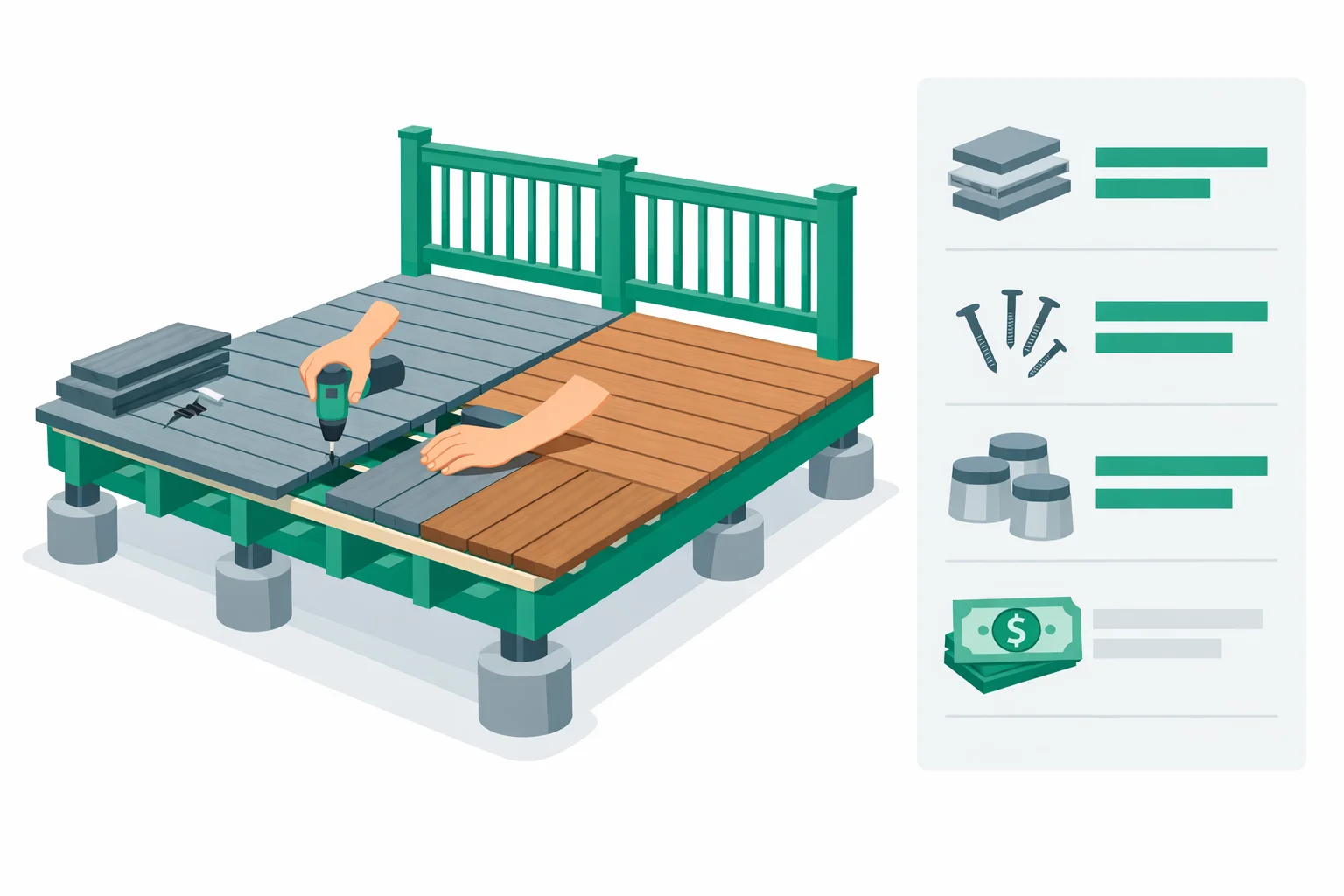
The $4,000 Decision: Composite vs. Pressure-Treated
Two boards sit on the rack at the lumberyard. The pressure-treated 5/4×6 is about $2 a linear foot. The composite next to it is closer to $4.80. On a 16×12 deck that needs roughly 450 linear feet of decking, that's $900 versus $2,160 — and once you add the matching composite railing at $55 a foot instead of a wood rail at $22, the spread widens fast.
Here's what the price tag hides. Pressure-treated lumber is real wood, and real wood moves. It cups, it checks, it grays, and it demands a stain or seal coat every two to three years to stay watertight. Composite is a wood-flour-and-polyethylene blend with a hard polymer cap — it doesn't drink water, so it doesn't need sealing, ever. You wash it with a hose. That single difference is the whole argument, and it plays out in dollars over time rather than at the register.
Why the Cheap Deck Isn't Cheaper Over 25 Years
Run the math on upkeep and the ranking flips. Staining a 192-square-foot deck costs about $1.20 a square foot in materials and a weekend of your time — call it $230 every two and a half years. Over 25 years that's ten cycles, or roughly $2,300 in stain alone, never mind the labor. A pressure-treated deck that started $4,000 cheaper has spent most of that head start by year 25, and it's on its second deck — PT decking typically lasts 15 to 20 years before boards need replacing, while composite runs 25 to 30.
This is exactly what the comparison table in the calculator shows. Plug in your real dimensions and the years you plan to stay, and it adds each material's upkeep on top of its install cost. For a homeowner staying put, composite usually wins the lifetime number. For someone selling in three years, pressure-treated almost always wins — you never live long enough to pay the maintenance penalty. The right answer depends on your timeline, not on which board feels expensive today.
What a Deck Is Actually Made Of, From the Ground Up
A deck is five systems stacked on top of each other, and the calculator counts each one. Start at the bottom. Footings are concrete piers poured below the frost line that carry the whole load into the ground. Posts — usually 6×6 pressure-treated — stand on those footings and hold up the beams.
Beams run horizontally across the posts; on a house-attached deck, a ledger board bolted to the house carries the other end. Joists span between the ledger and the beam, spaced 16 inches on-center, and form the skeleton you walk on. Finally the decking— the only part anyone sees — screws or clips down across the joists. Miss any layer in your estimate and you're back at the store. If you want to price the raw lumber by volume rather than by the piece, our board foot calculator converts those joists and beams into board feet.
Counting Decking Boards Without Running Short
The decking math starts with one fact people forget: a "6-inch" deck board is really 5.5 inches wide, and you leave a 1/4-inch gap between boards for drainage. So each row of decking covers 5.75 inches, or 0.48 feet. Divide your deck's width by that number to get the rows you need.
A 12-foot-deep deck needs 12 ÷ 0.48 = 25 rows, rounded up to 26. Each row spans the 16-foot length, so that's 26 × 16 = 416 linear feet of board before waste. Add 10 percent for end cuts and the occasional warped piece and you're buying about 458 linear feet — 29 sixteen-foot boards. Run the boards diagonally and the waste jumps to 15 percent, because every board meets the rim at 45 degrees and the offcut triangles are scrap. That's the difference between 29 boards and 31.
Framing a Real 16×12 Deck, Piece by Piece
Let's build the whole thing in numbers. A 16-foot-long, 12-foot-deep composite deck, 3 feet off the ground, straight boards, with railing on three sides:
- Decking: 26 rows × 16 ft = 416 lf, +10% waste = 458 lf → 29 boards × $4.80 ≈ $2,160
- Joists (16" OC): 13 joists × 12 ft = 156 lf
- Beams + ledger + rim: two 2-ply 16-ft beams plus a ledger and front rim ≈ 96 lf. Framing total ≈ 252 lf × $1.60 ≈ $400
- Footings:6 piers, 12" × 36" deep ≈ 14 cu ft of concrete → 32 bags × $6 ≈ $190
- Railing: 40 lf (16 + 12 + 12) × $55 ≈ $2,200
- Hardware + clips: hangers and 2 boxes of hidden fasteners ≈ $390
- Labor at $20/sq ft: 192 × $20 = $3,840
Total: roughly $9,200 installed, about $48 a square foot. Notice two things. Labor is the single biggest line — nearly 42 percent — which is why a DIY build that you frame yourself drops the project to around $5,400. And railing nearly matches the decking cost, a trap we'll come back to.
Footings and Concrete: The Part People Underestimate
Footings are where deck budgets quietly blow up, because the concrete is buried and invisible. A single 12-inch-diameter pier poured to a 36-inch frost depth holds 2.36 cubic feet of concrete. That's the volume of a cylinder: π × radius² × depth, or 3.14 × 0.5² × 3 = 2.36. Each one swallows five to six 60-pound bags.
Six footings on a typical deck means about 14 cubic feet, or 32 bags you have to mix and carry. In a cold climate where code pushes footings to 48 inches deep, the same six piers jump to nearly 19 cubic feet — a third more concrete for the same deck. That's not a rounding error; it's $60 to $80 and a lot more mixing. To size piers of a different diameter or depth, our concrete calculator handles the bag count directly. Always confirm your local frost depth — the IRC foundation provisions require footings to bear below the frost line for your region.
Decking Material Prices, Lifespan, and Maintenance
This is the table to shop with. Prices are per linear foot of a 5.5-inch board, and the maintenance column is the real differentiator — it's what the install price never tells you.
| Material | Board $/lf | Lifespan | Upkeep |
|---|---|---|---|
| Pressure-Treated | $1.50–$2.50 | 15–20 yrs | Seal every 2–3 yrs |
| Cedar / Redwood | $3–$5 | 20–25 yrs | Seal yearly |
| Composite | $4–$6 | 25–30 yrs | Wash only |
| PVC / Vinyl | $6–$8 | 30–40 yrs | Wash only |
| Tropical Hardwood (Ipe) | $6–$9 | 40+ yrs | Oil yearly |
The outliers tell a story. PVC costs the most up front and asks the least of you afterward. Ipe lasts longer than anyone's mortgage but demands an annual oiling or it weathers to gray — beautiful, but not zero-effort. Cedar looks and feels the best of the natural woods yet needs more babying than pressure-treated. There's no "best" board, only the best fit for how much weekend maintenance you'll actually do.
Railing: The Line Item That Hijacks Your Budget
Railing is priced per linear foot of perimeter, and that's why it ambushes people. On our 16×12 deck, the three open sides total 40 feet. At $55 a foot for a composite rail system, that's $2,200 — as much as the decking itself. The deck area didn't change, but a long, narrow deck has more perimeter per square foot than a square one, so it pays more for railing relative to its size.
This is the easiest place to save real money without touching the deck you walk on. A pressure-treated wood rail runs about $22 a foot installed — less than half. Mixing materials is common and sensible: composite decking underfoot where it matters, a stained wood rail to cut the bill. Just remember any deck more than 30 inches off the ground legally needs that guardrail, and it has to be 36 inches tall with balusters no more than 4 inches apart. The railing isn't optional; the material is.
Where Code Quietly Adds to Your Build
Code requirements aren't line items you choose — they're costs the inspector adds for you. Three catch people most often. First, the ledger connection: bolting the deck to your house with the right flashing and lag screws is non-negotiable, because a failed ledger is the number-one cause of deck collapses. Second, footing depth, which has to reach below your frost line and gets checked before you pour. Third, the guardrail and stair rail on anything over 30 inches high.
A permit usually costs $100 to $500 and triggers one or two inspections. It feels like friction, but an unpermitted deck can surface during a home sale and force a tear-out of finished work. If your deck has stairs, the rise and run have to be consistent and within code — our stair calculator sizes the stringers and steps so they pass inspection the first time.
What This Calculator Leaves for You to Add
This estimate covers the structure: decking, framing, footings, fasteners, railing, and basic stairs. A few real costs sit outside it. Built-in benches, pergolas, and skirting around the base are extras priced separately, and a railing or privacy screen around the deck perimeter is its own job — our fence calculator sizes the posts, pickets, and concrete if you wrap one around the yard. Demolition and haul-away of an old deck runs $5 to $15 a square foot. Tricky access — a steep yard, no gate wide enough for a wheelbarrow — quietly raises labor. And the framing model here assumes a simple rectangle attached to the house; an L-shape, a wrap-around, or a free-standing deck with two ledger-free beam lines needs more posts and footings than the quick math captures.
Treat the total as a solid planning number — accurate enough to set a budget and load the truck, close enough to sanity-check a contractor's bid. Then confirm with two or three real quotes before you commit. For a larger renovation where the deck is one piece of a bigger build, our construction calculator rolls the deck in with framing, concrete, and the rest of the project.