Quikrete Calculator: Exactly How Many Bags of Pre-Mixed Concrete You Need
A Quikrete calculatortells you exactly how many bags of pre-mixed concrete to buy for your project — whether you're setting fence posts, pouring a small pad, or filling Sonotube forms for a deck. Get this number wrong and you're either making a second trip to the hardware store mid-pour (bad) or returning 15 unopened bags that got rained on in your garage (worse). This guide walks through the math, the bag size trade-offs, and the real-world gotchas that trip up even experienced DIYers.
What Is Quikrete Pre-Mixed Concrete?
Quikrete is a brand of pre-mixed concrete — Portland cement, sand, and gravel already blended in the right ratios inside the bag. You add water, mix, pour, and it cures to roughly 4,000 PSI in 28 days. Sakrete is the other major brand, and functionally they're interchangeable for every project covered here.
Pre-mixed bags exist for projects too small to justify a ready-mix truck delivery. Most concrete companies won't even dispatch a truck for under 1 cubic yard, and many charge short-load fees below 3-5 yards. That's where bags fill the gap: a handful of post holes, a 3×3 equipment pad, or patching a crumbled step corner.
Bag Sizes and Coverage: 40lb vs 60lb vs 80lb
Every bag size uses the same concrete mix — the only difference is how much you get per bag and how much your back hates you at the end of the day. Here's what each size actually yields:
| Bag Size | Yield (cu ft) | 4" Slab Coverage | Typical Retail Price | Cost per Cu Ft |
|---|---|---|---|---|
| 40 lb | 0.30 cu ft | 0.90 sq ft | $3.50 – $5.00 | ~$14.17/cu ft |
| 60 lb | 0.45 cu ft | 1.35 sq ft | $4.50 – $6.50 | ~$12.22/cu ft |
| 80 lb | 0.60 cu ft | 1.80 sq ft | $5.50 – $8.00 | ~$11.25/cu ft |
The 80 lb bag saves 20-25% per cubic foot compared to the 40 lb bag. Over a 10-post fence job that adds up to $15-25 in savings. But if you're working alone, hauling and mixing 80 lb bags all day gets exhausting fast — the 60 lb bag is a solid compromise.
How to Calculate Bags Needed (Step by Step)
The math is straightforward once you know the shape you're filling. Every project boils down to: calculate the volume in cubic feet, add waste, divide by the bag's yield.
Worked example — setting 8 fence posts:
- Hole diameter: 10 inches (radius = 5 inches = 0.417 ft)
- Hole depth: 36 inches (3 feet)
- Post size: 4×4 (actual 3.5 inches = 0.292 ft)
Volume per hole = π × 0.417² × 3 = 1.64 cu ft. Subtract the post: 0.292 × 0.292 × 3 = 0.256 cu ft. Net concrete per hole = 1.38 cu ft. For 8 posts: 8 × 1.38 = 11.07 cu ft. Add 10% waste: 12.18 cu ft. At 0.6 cu ft per 80 lb bag: 12.18 ÷ 0.6 = 21 bags.
Worked example — 4×4 foot utility pad, 4 inches thick:
Volume = 4 × 4 × (4/12) = 5.33 cu ft. With 10% waste: 5.87 cu ft. In 80 lb bags: 5.87 ÷ 0.6 = 10 bags. In 60 lb bags: 5.87 ÷ 0.45 = 14 bags. That's a manageable single-trip purchase for most vehicles.
For larger projects, use our concrete calculator to estimate cubic yards and decide whether a ready-mix truck makes more sense than hauling bags.
Quick Reference: Bags Needed by Project Type
This table gives ballpark bag counts for common residential projects. Numbers include 10% waste and assume standard 80 lb bags at 0.6 cu ft each.
| Project | Typical Dimensions | Volume (cu ft) | 80 lb Bags |
|---|---|---|---|
| Fence post (4×4, 10" hole × 36") | Per post | 1.52 | 2-3 |
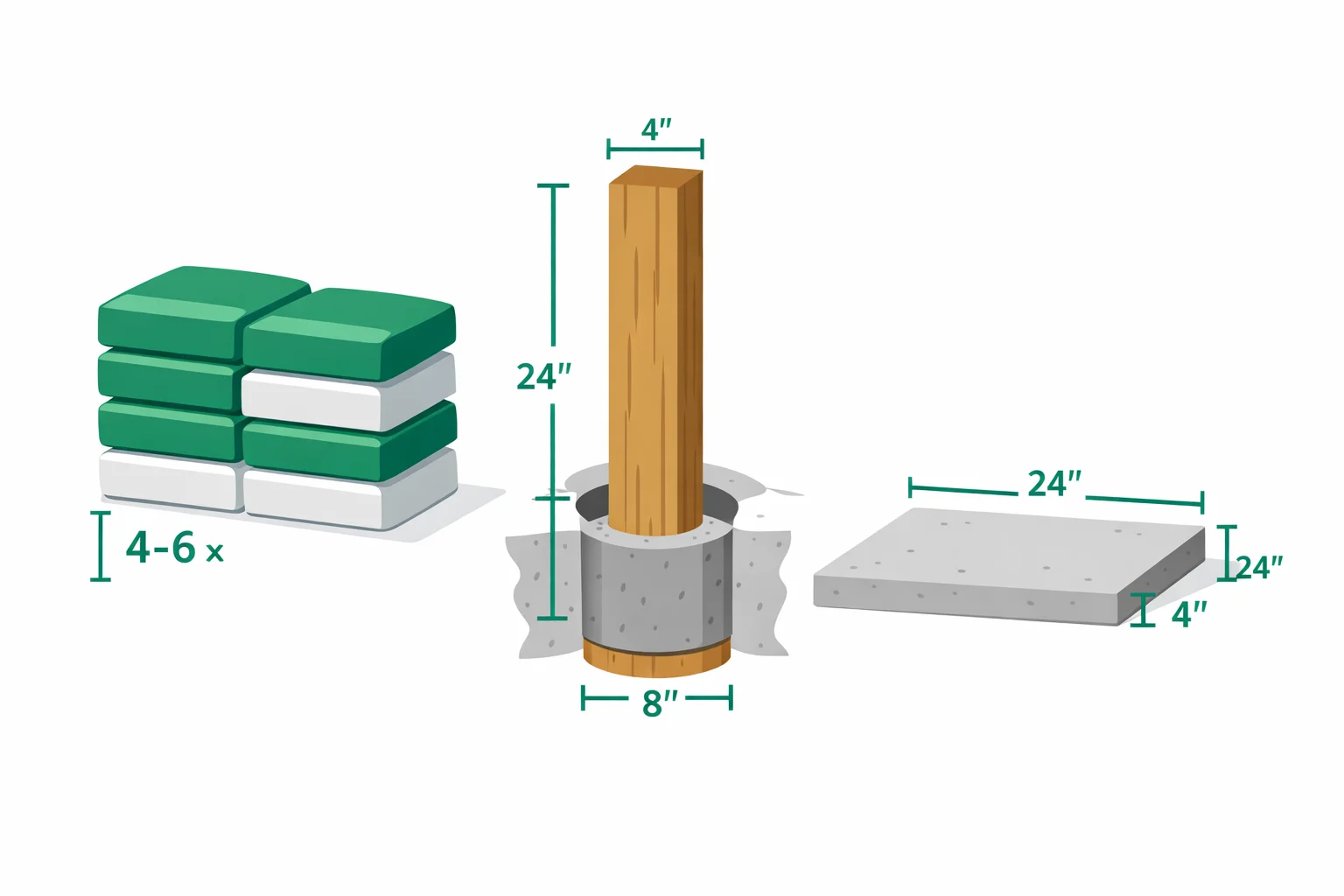
| Mailbox post | 8" hole × 24" | 0.58 | 1 |
| Basketball hoop base | 18" hole × 48" | 7.07 | 13 |
| Small walkway pad | 3 × 3 ft × 4" | 3.30 | 6 |
| AC unit pad | 3 × 3 ft × 4" | 3.30 | 6 |
| Trash can pad | 4 × 6 ft × 4" | 8.80 | 16 |
| Single car parking pad | 10 × 20 ft × 5" | 91.67 | 168 (use truck) |
| Deck pier (12" Sonotube × 42") | Per pier | 2.75 | 5 |
| Step repair | 3 × 1 ft × 8" | 2.20 | 4 |
For slab projects exceeding 50 sq ft, our concrete slab calculator provides rebar spacing, gravel base estimates, and a full cost breakdown that goes beyond bag counts.
Quikrete Bags vs. Ready-Mix Truck: When to Switch
The crossover point is roughly 0.5 cubic yards — about 22-23 bags of 80 lb mix. Below that, bags are more practical. Above it, a ready-mix truck saves money and hours of backbreaking mixing.
| Factor | Quikrete Bags | Ready-Mix Truck |
|---|---|---|
| Best for volume | Under 0.5 cu yd | 0.5+ cu yd |
| Cost per cu yd | $200 – $275 | $125 – $165 |
| Delivery fee | None (self-haul) | $0 – $50 (min order applies) |
| Short-load surcharge | None | $25 – $75 per yard under minimum |
| Mixing time | 5-10 min per bag | Arrives mixed, pour immediately |
| Shelf life | 60-90 days sealed | Must pour within 90 min |
| Schedule flexibility | Pour anytime | Scheduled delivery window |
A 10-post fence project (about 0.45 cu yd in 80 lb bags) sits right at the boundary. If you can mix at a comfortable pace over a weekend, bags work fine. If you need everything poured in one session, call for a truck. Need help converting between units? The cubic yard calculator handles all the dimension-to-yardage math.
Mixing Tips for Stronger Concrete
Pre-mixed doesn't mean foolproof. The number one mistake is adding too much water. Soupy concrete is easier to pour but loses 20-30% of its compressive strength. Here's what actually matters:
- Water ratio:Use about 3 quarts per 80 lb bag. Start with 2.5 quarts, then add small splashes until the mix holds its shape when squeezed but isn't crumbly. It should look like thick oatmeal, not pancake batter.
- Mix time: Blend for at least 3-5 minutes. Unmixed pockets of dry cement create weak spots that crack under load.
- Temperature matters:Don't pour when temperatures will drop below 40°F within 48 hours. Cold concrete cures slowly and may never reach full strength. Above 90°F, mist the surface periodically to prevent too-fast drying.
- Cure time isn't set time:Quikrete sets firm in 24 hours, but full 4,000 PSI strength takes 28 days. Don't load structural pours (deck piers, retaining wall footings) until the concrete has fully cured.
- Keep bags dry:Moisture in storage causes the cement to partially hydrate. If a bag has hard lumps, it's compromised — use it for non-structural fill only, not load-bearing projects.
Common Bag Estimation Mistakes That Cost You
After years of pouring concrete for residential projects, the same estimation errors keep showing up:
- Forgetting the waste factor. Post holes in rocky or sandy soil lose concrete to the surrounding ground. A 10% overage on a 20-bag job is only 2 extra bags ($11-16). Running 2 bags short mid-pour costs you $30+ in gas and a compromised cold joint.
- Using nominal post dimensions.A "4×4" post actually measures 3.5×3.5 inches. A "6×6" is 5.5×5.5. Using the nominal dimensions inflates the post volume you subtract and gives you fewer bags than you actually need.
- Ignoring the hole shape.Post hole diggers don't cut perfect cylinders. The bottom flares out, adding 10-20% more volume than a straight cylinder. Auger-drilled holes are more consistent.
- Calculating for exact volume with no rounding. If the math says 13.2 bags, buy 15. You can't use 0.2 of a bag, and that remaining 0.8 bag won't survive storage until your next project. Opened bags absorb humidity and harden within weeks.
- Not planning for vehicle capacity. Eighty bags of 80 lb Quikrete weigh 6,400 lbs — well past the payload limit of most pickup trucks (1,500-2,000 lbs). Plan for two trips or arrange delivery for large orders.
When to Use This Calculator
Pull up this calculator whenever you're heading to the hardware store for bagged concrete. Specifically:
- Fence and deck posts — enter hole diameter, depth, post size, and count. Get exact bags-per-post plus the total order.
- Small slabs and pads — equipment pads, hot tub bases, trash can areas. Enter length, width, thickness.
- Sonotube piers — deck footings, pergola posts, carport supports. Use the column mode with the tube diameter.
- Repair and patching — broken steps, wall sections, or filling old post holes. Calculate just the volume you need instead of guessing.
- Filling CMU block cores— if you're grouting rebar-reinforced block walls, use our concrete block calculator to get block, mortar, and grout quantities for the full wall, then come back here for the bag count on the grout fill.
- Budget planning — the cost estimate and bag comparison help you decide between bag sizes and whether a ready-mix truck is a better value for your project scale.
For projects larger than about 20 bags, check your result against a Quikrete's official calculator to double-confirm. And always round up — the cost of an extra bag is nothing compared to the cost of running short mid-pour.