Property Tax Calculator: How to Estimate Your Tax Bill Before You Buy
A property tax calculator turns one deceptively simple equation — assessed value times your local rate — into the third-largest line in your monthly housing payment. On a $400,000 home at the U.S. average rate near 1.1%, that's $4,400 a year, or about $367 folded into every mortgage payment through escrow. To see that tax figure sitting inside your full payment beside insurance and PMI, run the numbers through our mortgage calculator with taxes and insurance. But the number almost nobody guesses correctly is the one the calculator starts from: not the price you paid, but the value your county assessor assigns. Get that piece right and the rest is arithmetic.
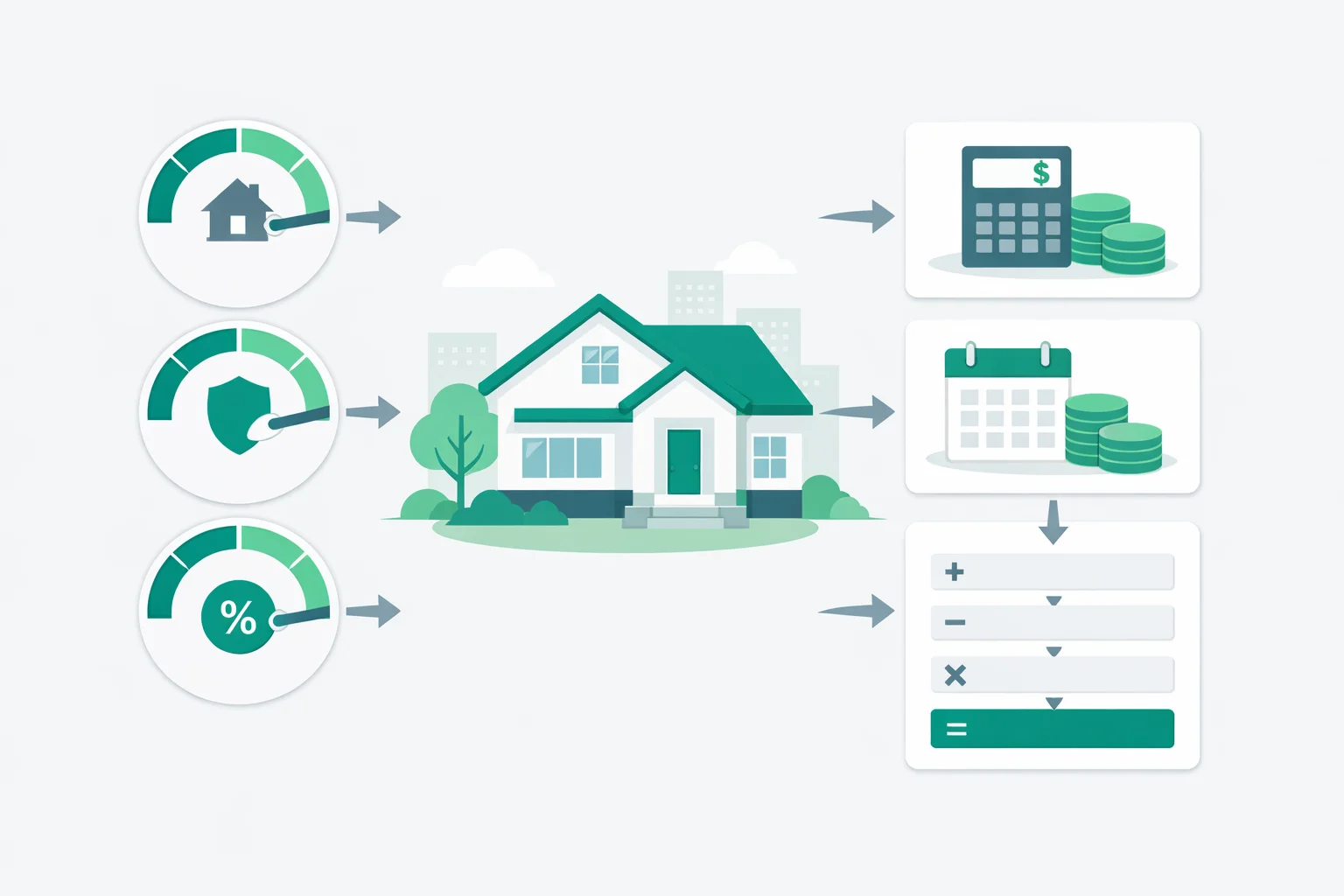
How Your Tax Bill Is Built, Step by Step
Every property tax bill in the country runs through the same five-step chain, even when the paperwork hides it:
- Market value — what your home would sell for. The county tracks this but rarely taxes it directly.
- Assessed value — market value multiplied by an assessment ratio. Some states assess at 100%; others tax only a slice, like 80% or even 10%.
- Taxable value — assessed value minus any exemptions, such as a homestead or senior exemption.
- Tax rate — the combined county, city, and school-district rate, quoted as a percentage or in mills.
- Annual tax — taxable value times the rate. Divide by 12 and you have the monthly escrow figure your lender collects.
Miss any one of those steps and your estimate drifts. The two that trip up buyers most are the assessment ratio and exemptions — both quietly change the taxable value before the rate ever touches it.
Assessed Value Isn't the Price You Paid
Here's where a clean estimate goes sideways. Your tax is calculated on assessed value, and in many counties that figure lags the market by years. A home worth $400,000 today might still carry a $310,000 assessment from the last reassessment cycle — so the prior owner's tax bill looks nothing like the one you'll inherit.
When you buy, most jurisdictions reassess the home to its sale price. That single event can jump the assessed value $90,000 overnight and add roughly $990 a year at a 1.1% rate. A few states soften the blow with assessment caps that limit annual increases — California's Proposition 13 holds growth to 2% a year, and Florida's Save Our Homes caps it at 3% — but those caps reset to full market value the moment the property sells. Buyers feel the entire jump; long-time owners barely notice it.
What's a Mill Rate? (And Why Your Bill Uses One)
Plenty of counties don't quote a percentage at all — they quote mills. One mill is $1 of tax per $1,000 of assessed value. It sounds archaic, but the conversion is easy: divide the mill rate by 10 to get a percentage. A rate of 11 mills is 1.1%; 22.5 mills is 2.25%.
Say your taxing authorities add up to 22.5 mills and your taxable value is $360,000. The math is $360,000 ÷ 1,000 × 22.5 = $8,100 a year. The mill format matters because your bill usually stacks several separate levies — county, municipality, school district, sometimes a fire or library district — each with its own mill rate. Add them and you get the combined rate the calculator above uses.
Walk Through One Bill: A $400,000 Home
Take a real scenario: you buy a $400,000 house, the county assesses at full market value, you claim a $40,000 homestead exemption, and the combined rate is 1.1%. Walk the chain:
- Market value: $400,000
- Assessment ratio 100% → assessed value: $400,000
- Minus $40,000 homestead → taxable value: $360,000
- Times 1.1% → annual tax: $3,960
- Divided by 12 → monthly escrow: $330
Now change one variable. Move that same house to a county that assesses at an 80% ratio. Assessed value drops to $320,000, the $40,000 exemption leaves $280,000 taxable, and the bill falls to $3,080 a year — $880 less for an identical home and rate. The ratio alone moved the bill more than $70 a month. This is exactly why two neighbors with similar houses can pay very different taxes, and why plugging your own county's ratio into a home affordability calculator matters before you set a price range.
Property Tax by State: an $8,000 Swing
Location decides this bill more than any other factor. The same $400,000 home costs about $1,080 a year in Hawaii and roughly $9,080 in Illinois — an $8,000 annual gap on an identical structure. These are average effective rates; your county and school district set the real number, but the ranking rarely changes:
| State | Avg. effective rate | Tax on a $400K home |
|---|---|---|
| Hawaii | 0.27% | $1,080 |
| Alabama | 0.40% | $1,600 |
| Colorado | 0.49% | $1,960 |
| South Carolina | 0.56% | $2,240 |
| California | 0.71% | $2,840 |
| Florida | 0.86% | $3,440 |
| U.S. average | 1.10% | $4,400 |
| Ohio | 1.59% | $6,360 |
| Texas | 1.68% | $6,720 |
| New Jersey | 2.23% | $8,920 |
| Illinois | 2.27% | $9,080 |
The U.S. Census Bureau publishes detailed housing and property tax data if you want to check your own county against the state average. A high-tax state can erase the savings of a cheaper home — a $350,000 house in Texas can carry a bigger tax bill than a $500,000 house in Colorado. For an income property, that same tax line is often the largest fixed operating expense; our rental property calculator folds it straight into monthly cash flow, cap rate, and cash-on-cash return.
Homestead and Other Exemptions Lower the Taxable Number
Exemptions are the most overlooked way to cut a tax bill, and they work before the rate is applied. The savings are simple: exemption amount times your rate. A $40,000 homestead exemption at 1.1% saves $440 every single year you own and occupy the home.
- Homestead exemption: available in most states for your primary residence, typically $5,000 to $50,000 of value, sometimes a percentage. Texas, for example, exempts $100,000 of value from school taxes alone.
- Senior exemption: many counties freeze or sharply reduce taxable value at age 65, occasionally wiping out school-tax increases entirely.
- Veteran and disability exemptions: can reach 100% of the bill for disabled veterans in some states — a five-figure annual savings.
Exemptions almost never apply automatically. You file once with the county assessor, usually in the first year you own the home, and the savings repeat every year after. Skipping the paperwork is one of the few ways homeowners leave hundreds of dollars on the table annually without realizing it.
Why Your Monthly Escrow Keeps Changing
If your mortgage payment crept up $80 last year even though your interest rate is fixed, property taxes are the usual culprit. Your lender doesn't pay taxes monthly — the county bills once or twice a year — so the lender collects one-twelfth each month and holds it in escrow until the bill is due. Insurance gets escrowed the same way, which is why your homeowners insurance premium rides alongside taxes in the same account.
Two things move that monthly number. First, the cushion: federal RESPA rules let lenders hold up to two months of payments in reserve, so they often pad collections when they expect a bill to rise. Second, reassessment. New buyers get hit hardest — your escrow was set on the seller's old, lower assessment, then the home reassesses to your purchase price and the bill jumps. The lender absorbs the shortage, then spreads it across your next 12 payments and raises the monthly collection to match. A $1,650 reassessment jump can add roughly $275 a month for a year: about $137 to repay the shortage plus $138 for the higher ongoing bill. It feels like a billing error. It's just the assessment catching up.
Property tax is also one of the ownership costs a renter never pays, which is why it's a key input in the buy-versus-rent decision. If you're still weighing whether to own at all, our rent vs buy calculator folds this exact tax line into a break-even year against renting.
Is Your Assessment Worth Appealing?
You can't argue your tax rate — that's set by voters and local budgets — but you can challenge your assessed value, and a successful appeal lowers your bill every year until the next reassessment. The question is whether yours is worth filing. Use a simple framework:
- Appeal ifyour assessed value is more than about 5–10% above what comparable homes nearby recently sold for, or if the assessor has your square footage, lot size, or condition wrong. Pull three recent sales of similar homes — that's your evidence.
- Skip it if your assessment is already at or below what you could sell for. Appealing a fair assessment wastes time, and in rare cases an assessor reviews the whole property and raises it.
The payoff is durable. Knock a $40,000 over-assessment off at a 1.1% rate and you save $440 a year — every year — for a few hours of paperwork. Roughly a third to a half of homeowners who appeal win at least a partial reduction. The catch is the deadline: most counties give you only 30 to 90 days after the assessment notice arrives, and miss it and you wait a full year. The smartest move the day your notice shows up is to compare the assessed value against three recent neighborhood sales — if the gap is real, file before the window closes. For the deduction side, the IRS caps the combined state and local tax (SALT) deduction at $10,000, so high property taxes aren't always fully deductible — another reason the bill itself, not the write-off, is what you should budget around.