Rental Property Cash Flow: What's Left After the Expenses Landlords Forget
A rental property calculator that shows rent minus mortgage is lying to you by about $400 a month. Rent of $2,600 against a $1,600 mortgage looks like $1,000 landing in your pocket — but vacancy, property taxes, insurance, repairs, and the capital reserve you owe your future roof quietly claim roughly half of every rent dollar before the loan is even paid. The number that actually matters is what's left after all of it, and on most 2026 deals it's a fraction of the back-of-the-napkin math.
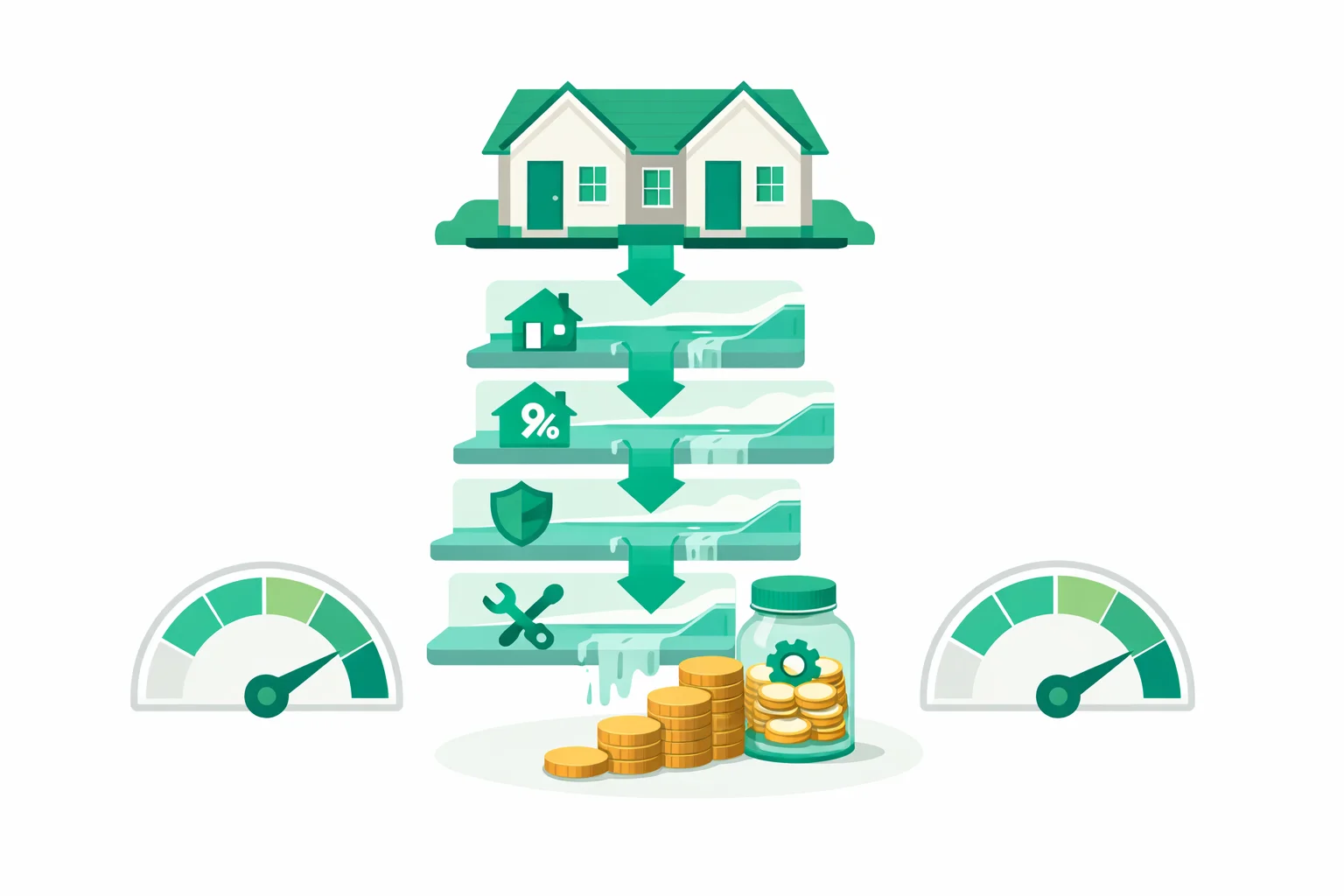
Rent Minus Mortgage Is Not Your Cash Flow
Here's the trap that turns first-year landlords into accidental donors. Rent comes in, the mortgage goes out, and the leftover feels like profit. It isn't. A rental has four buckets of cost, and only one of them is the loan.
- Vacancy — the weeks between tenants. Even a great unit sits empty 5-8% of the year.
- Operating expenses — property tax, insurance, management, and routine repairs. These bill monthly or annually and never stop.
- CapEx reserve — money set aside for the roof, furnace, and water heater. It doesn't show up on a monthly statement, which is exactly why people skip it.
- Debt service — the mortgage principal and interest.
Miss the first three and your "$1,000 of cash flow" is really $200, or nothing, or a monthly loss. The calculator above runs all four buckets so the leftover you see is the leftover you actually keep. That's the whole point: not to make a deal look good, but to show you the real number before you wire a down payment.
The 50% Rule: a 30-Second Gut Check
Before you build a spreadsheet, use the 50% rule as a screen. It says operating expenses plus reserves — everything except the mortgage — will eat about half your gross rent. A property renting for $2,000/month should be assumed to spend $1,000/month on taxes, insurance, management, repairs, vacancy, and CapEx, leaving $1,000 to cover the loan and produce cash flow.
It's a rough tool, and it cuts both ways. Newer single-family homes in low-tax states can run closer to 40%. A 1970s duplex with a tired roof and high turnover pushes past 50%. But as a first filter it's brutally effective: if a $2,000 rental can't cover its mortgage on $1,000 of assumed expenses, the margin is too thin to survive one furnace failure or a two-month vacancy. Run the full numbers only on deals that clear this bar.
CapEx: the Reserve That Separates Landlords from Donors
CapEx — capital expenditures — is the single most-skipped line in rental analysis, and it's the one that erases a year of profit in an afternoon. A furnace costs you nothing for 14 years, then costs $8,000 all at once. The professional move is to reserve for it every month, the way a business depreciates an asset. Price the components, divide by their lifespan, and you get the honest monthly number:
| Component | Replacement cost | Lifespan | Reserve / year |
|---|---|---|---|
| Roof (architectural shingle) | $10,000 | 25 yrs | $400 |
| HVAC (furnace + AC) | $8,000 | 15 yrs | $533 |
| Water heater | $1,500 | 12 yrs | $125 |
| Appliances (range, fridge, dishwasher) | $3,000 | 12 yrs | $250 |
| Flooring | $5,000 | 10 yrs | $500 |
| Interior paint & turns | $3,600 | 6 yrs | $600 |
| Windows & exterior doors | $9,000 | 30 yrs | $300 |
| Total | $40,100 | — | $2,708 |
That's about $226 a month — roughly 7-9% of a $2,600 rent — before a single tenant ever calls about a clogged drain. It's why the calculator keeps CapEx reserve as its own input, separate from routine repairs. Lumping them together hides the problem: routine repairs are small and frequent, CapEx is large and lumpy, and a landlord who only budgets for the first is one water heater away from a bad year. Older homes need a bigger reserve; a property with a brand-new roof and HVAC can run leaner for a while, then must rebuild the fund before those clocks run out.
A Single-Family Rental, Line by Line
Let's run a real one. You're looking at a $320,000 single-family house that rents for $2,600/month. You'll put 25% down, borrow the rest at 7% on a 30-year loan, and hire a manager at 8%. Walk the full waterfall:
| Line item | Annual |
|---|---|
| Gross scheduled rent ($2,600 × 12) | $31,200 |
| Vacancy (5%) | −$1,560 |
| Effective gross income | $29,640 |
| Property tax | −$4,200 |
| Insurance | −$1,700 |
| Management (8%) | −$2,371 |
| Repairs & maintenance (5%) | −$1,560 |
| Net operating income | $19,209 |
| CapEx reserve (7%) | −$2,184 |
| Mortgage (P&I, $240,000 @ 7%) | −$19,164 |
| Cash flow | −$2,139 |
Read that last line again. On paper, $2,600 rent minus a $1,597 mortgage looked like $1,003/month of profit. Run it honestly and the property losesabout $178 a month. The cap rate is 6.0% ($19,209 ÷ $320,000) while the mortgage costs 7% — and when your cap rate is below your loan rate, that's negative leverage: every borrowed dollar drags cash flow down instead of lifting it. Two fixes move the needle. Self-managing saves the $2,371 fee and nearly breaks the deal even. Putting 35% down instead of 25% cuts the loan by $32,000 and trims roughly $210 off the monthly payment, flipping it positive. Before you commit, size that loan precisely with our mortgage calculator and confirm the tax line against your county's rate using the property tax calculator.
Cap Rate, Cash-on-Cash, and Per-Door
Three metrics answer three different questions, and confusing them is how deals get mispriced.
Cap rateasks: how good is the property, ignoring how you paid for it? It's net operating income divided by price. A 6% cap rate means the building throws off 6% of its value in operating profit before any loan. Use it to compare two properties head-to-head, all-cash.
Cash-on-cash asks: how hard is my moneyworking? It's annual cash flow divided by the cash you actually invested — down payment, closing costs, and upfront repairs. This is the number that should beat a Treasury yield. Sink $89,600 into a deal that returns $1,800 a year and that's a 2% cash-on-cash — you'd earn more in a savings account with zero tenants.
Cash flow per doorasks: can this scale? Divide monthly cash flow by the number of units. Seasoned buy-and-hold investors want at least $100-$200 per door so one unit's vacancy doesn't sink the whole property. A duplex netting $300/month is $150 per door; the same $300 on a fourplex is a fragile $75. For the long-term appreciation and equity side of the picture, pair this with our real estate investment calculator, which projects total return over a 10-year hold.
What a Property Manager's 10% Really Costs
Management fees look small — 8% to 12% of collected rent — until you see them in dollars. On a $2,600 rent, a 10% fee is $260/month, or $3,120 a year. On a deal already producing thin cash flow, that fee is often the entire margin. The self-manage-versus-manager table in the calculator makes this concrete: toggle the fee and watch cash-on-cash swing by two or three percentage points.
The honest tradeoff isn't "save the fee." A good manager fills vacancies faster, screens tenants who don't trash the unit, and handles the 11 p.m. burst pipe. If self-managing means you skip screening and eat an extra month of vacancy plus a $3,500 turnover, you've spent more than the fee would have cost. Self-manage when you're local, handy, and have two or three units. Hand it off when you're remote, scaling past four or five doors, or your time is worth more than $30 an hour. When you do fill a unit mid-month, the new tenant's first payment is a prorated rent amount — fold that partial month into your turnover cash flow, not a full month's rent.
How Far Can Rent Fall Before You're Underwater?
Cash flow is a snapshot; the rent cushion is a stress test. It answers a question the headline number can't: how much room do you have before the deal goes red? The calculator solves for break-even rent — the point where every cost, fixed and variable, exactly consumes the rent — then shows the gap as a percentage.
Say your break-even rent is $2,300 and you're charging $2,600. That's about a 12% cushion. Rent could soften 12%, or you could eat an extra month of vacancy, and you'd still be at zero rather than writing checks. A deal with a 3% cushion is a coin flip — one rate reset on an adjustable loan, one bad tenant, and you're subsidizing it. This is the difference between an investment and an expensive obligation, and it's why a fat cushion beats a slightly higher return on a razor-thin one. According to HUD's Fair Market Rent data, local rents can move several percent year to year, so a cushion under 5% leaves little room for a normal market dip.
When Not to Trust the Cash-Flow Number
A calculator is only as honest as its inputs, and a few situations quietly break the estimate:
- Below-market leases.A tenant paying $1,100 when market rent is $1,400 makes the deal look weak — but you can't raise them 27% overnight without risking a vacancy. Model the current rent, not the fantasy.
- Seller pro formas. Listing packets inflate rent and lowball expenses. Verify rent against comparable listings and pull the real tax bill — reassessment after your purchase can jump the tax line hundreds of dollars a month.
- Short-term rentals. Airbnb-style income and expenses look nothing like a 12-month lease. Cleaning, furnishing, higher vacancy, and platform fees need a different model entirely.
- Deferred maintenance you haven't priced.A CapEx reserve assumes an average pace of replacement. If the roof is already 24 years into a 25-year life, that's not a reserve — it's a bill coming next spring.
Rental income is also taxable, and the rules around depreciation and deductible expenses change your real return — the IRS lays out what counts in Publication 527 on residential rental property. The smartest thing you can do with this calculator isn't to find a deal that works — it's to kill the deals that don't before they cost you. A property that only cash-flows at 0% vacancy, with no CapEx reserve and a seller's optimistic rent, isn't an investment. It's a bet you can't afford to lose.