What a U-Haul Actually Costs Once the $19.95 Banner Wears Off
A U-Haul cost calculator exists because the $19.95 on the side of the truck is one of the most misleading numbers in moving. It's not a lie — you really can rent a 10-foot truck for $19.95 a day. But by the time you drive it 40 miles, fill the tank, rent a dolly, and add SafeMove, that $19.95 truck rings up closer to $150. Most people don't get tripped up by the daily rate. They get tripped up by everything U-Haul charges separately, and the per-mile fee is the biggest culprit.
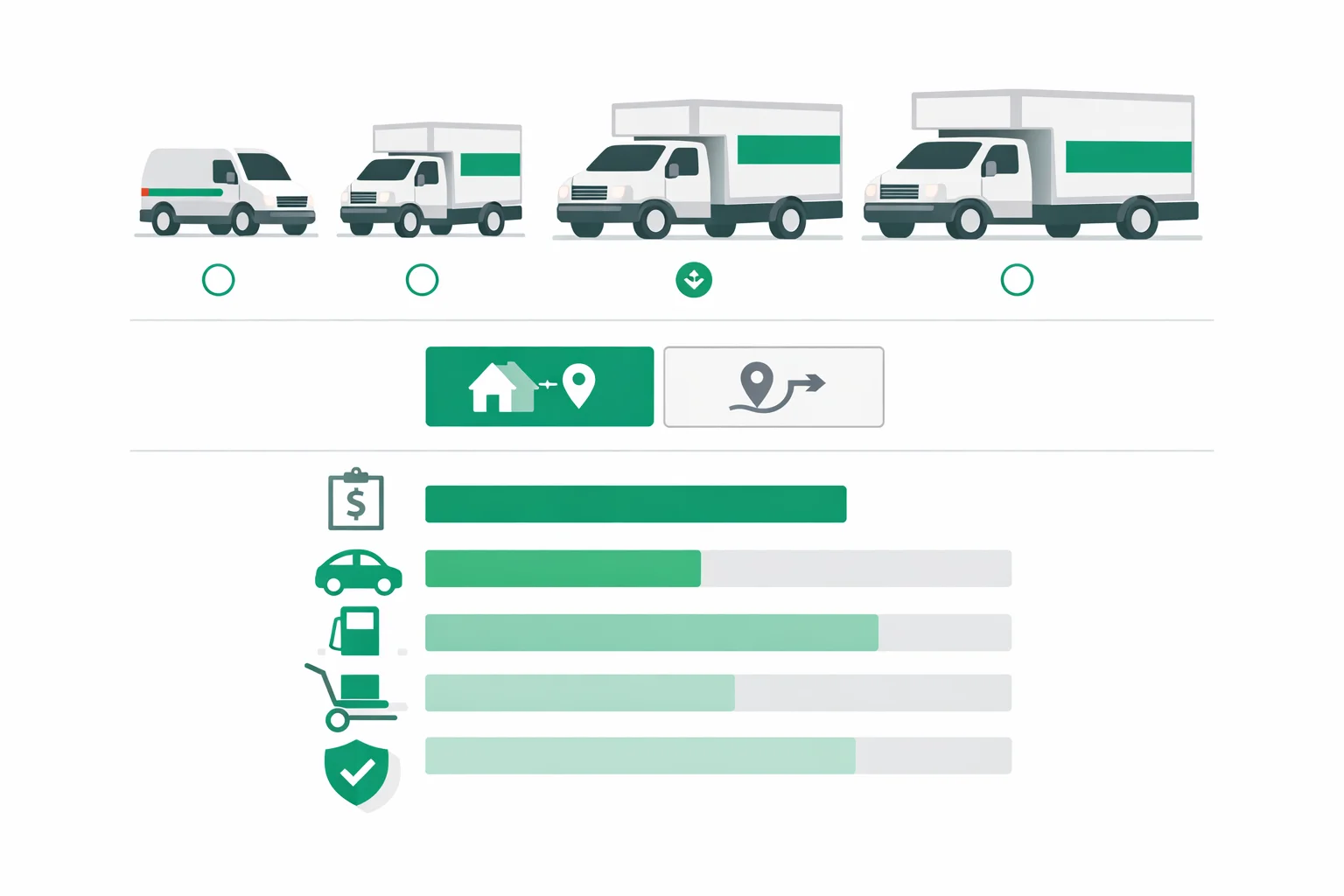
The $19.95 Price Is Real — It's Just Not the Whole Bill
The advertised rate covers the truck for 24 hours. Nothing else. U-Haul unbundles every other cost into its own line, and those lines are where a cheap-looking rental fattens up. Here's what a $19.95 banner actually turns into on a modest local move:
- Per-mile fee — about $0.99/mile.Drive 50 miles round-tripping between old and new place, and that's $49.50 — more than double the truck rate itself.
- Fuel — you buy it. A 10-foot truck at 12 mpg burns about 4 gallons over those 50 miles, roughly $15 at $3.50 a gallon.
- Equipment — $10 to $30.A furniture dolly and a dozen pads run about $20, and you'll want them.
- SafeMove + environmental fee + tax — $25 to $40. Coverage is $15-$28, the environmental fee is about $5, and tax applies to all U-Haul charges.
Add it up and the $19.95 truck is a $130-$160 day. That's not a scam — it's unbundling. The calculator above puts every line back together so the number you see is the number you'll actually swipe your card for.
In-Town and One-Way Are Two Different Pricing Models
This is the single most important thing to understand before you book, and it's where half of all U-Haul confusion comes from. There are two rental types, and they don't price the same way at all.
In-town rentalscharge a low daily rate plus roughly $0.99 for every mile on the odometer, and you bring the truck back to the same store. They're built for local moves — load up, drive across town, return. The per-mile fee is fine when you're driving 30 or 50 miles; it's catastrophic over long distances.
One-way rentalscharge a single flat fee that already includes all the miles between your pickup city and your drop-off city, and you leave the truck at the destination. There's no per-mile meter running. That flat rate is set by demand on that specific route, so a truck leaving a high-outflow city in summer costs more than the reverse trip in winter.
The trap: people see the cheap in-town daily rate and assume it applies to their cross-country move. Run a 600-mile trip through the in-town meter and the mileage fee alone would be nearly $600 — far more than the flat one-way quote. Toggle the calculator between the two to see the gap for your distance. If you're weighing the whole relocation, the moving cost calculator compares a DIY truck against containers and movers side by side.
Worked Example: A 1,200-Mile One-Way 15-Foot Truck
Let's price a real cross-country move. You're taking a 2-bedroom apartment 1,200 miles in a 15-foot one-way truck. Here's every line, step by step:
- One-way truck rate: a $165 base plus roughly $0.80 a mile baked into the flat quote works out to about $165 + $960 = $1,125.
- Fuel:at 10 mpg you'll burn about 126 gallons over 1,260 driven miles, which is $441 at $3.50 a gallon.
- Equipment: furniture dolly plus a dozen pads = $20.
- SafeMove: coverage on a multi-day one-way runs about $32.
- Environmental fee + tax: $5 plus roughly 8% tax on the rental charges = about $98.
Total: right around $1,816. Notice that fuel is $441 of that — nearly a quarter of the bill, and a line the banner rate never hints at. That's the number that surprises people on long hauls: the truck rate and the gas are almost in the same league. Full-service movers for the same 2-bedroom, 1,200-mile job would run $4,500 to $7,000, so the U-Haul saves real money — if you're willing to drive a box truck for two days.
Which U-Haul Truck Size Do You Actually Need?
Picking the wrong size costs you either way: too small means a second trip or a second day, too big means worse fuel economy and a harder drive. Here's the lineup with the numbers that actually matter:
| Truck | Cargo Space | Fits | ~MPG | In-Town Daily |
|---|---|---|---|---|
| Cargo Van | 245 cu ft | Studio / a few rooms | 16 | $19.95 |
| 10' Truck | 402 cu ft | Studio – 1 bedroom | 12 | $19.95 |
| 15' Truck | 764 cu ft | 1 – 2 bedrooms | 10 | $29.95 |
| 20' Truck | 1,016 cu ft | 2 – 3 bedrooms | 10 | $39.95 |
| 26' Truck | 1,611 cu ft | 3 – 4 bedrooms | 10 | $39.95 |
Two things stand out. First, fuel economy barely changes once you're past the 15-foot truck — they all hover near 10 mpg — so on a long one-way move, sizing up from a 15 to a 20 costs you in the rate, not much in gas. Second, the jump from a 10-foot to a 15-foot is the biggest capacity leap for the smallest money. When in doubt between two sizes on a long-distance move, take the bigger one; a second trip isn't an option when your old place is 1,000 miles behind you.
How Mileage Fees and Fuel Stack Up
Mileage and fuel are two separate costs that people constantly blur together. On an in-town rental you pay both: $0.99 a mile to U-Haul and the gas to move the truck. On a one-way you pay only fuel, because the miles are inside the flat rate. That distinction flips which move type is cheaper.
Fuel is bigger than most expect because these trucks are thirsty. A loaded 26-foot truck gets about 10 mpg, so every 100 miles eats roughly 10 gallons — about $35 at current prices. Over a 1,500-mile move that's 150 gallons and more than $500 in gas alone. You can sanity-check pump prices against the U.S. Energy Information Administration's weekly gasoline data before you budget. One rule of thumb that holds up: on any move over about 500 miles, plan for fuel to land somewhere between a quarter and a third of your total truck cost.
The Add-Ons U-Haul Leaves Off the Banner
Beyond miles and gas, a short stack of extras shows up at the counter. None are huge alone, but together they routinely add $50 to $100:
- Furniture and appliance dollies — $7 to $10 each. A furniture dolly and an appliance dolly together are about $20, and they save your back and your security deposit.
- Furniture pads — about $10 a dozen.Cheap insurance against scratched dressers; one gouged tabletop costs more than every pad you'd ever rent.
- SafeMove — $15 to $28, more on one-way. Your personal auto policy and credit card almost never cover a rental moving truck, so this fills a real gap. Skipping it to save $20 can expose you to thousands in truck-repair and loss-of-use charges.
- Environmental fee — about $5.Small and non-negotiable; just don't be surprised by it.
Before you sign anything, it's worth reading the U.S. Department of Transportation's Protect Your Move guidance, even for a DIY rental — it spells out your rights on estimates, deposits, and coverage so a counter upsell doesn't catch you flat-footed.
When U-Haul Wins — and When It Doesn't
A U-Haul is the cheapest way to move when you can supply the labor and the driving. That's not every move. Here's the honest decision framework:
- Choose a U-Haul ifyou've got help loading, you're comfortable driving a box truck, and you want the lowest sticker price. A local 1-2 bedroom move for $150-$250 is hard to beat.
- Choose a moving container if you want to load on your own schedule but dread driving a 26-foot truck across several states. You skip the white-knuckle interstate driving and often pay only a little more — price it with the PODS cost calculator and compare.
- Choose full-service movers ifyou're moving a 4-bedroom home, you're short on time or can't lift, or someone else is paying. The premium buys speed and transfers the liability off your shoulders.
One honest gut check: people badly overrate their appetite for a DIY drive. The truck is cheap; hour two of merging a 26-footer through mountain passes is not. If the savings over a container are only a few hundred dollars on a long move, the container often wins on every axis except the sticker price.
Five Ways People Overpay for a U-Haul
- Using in-town pricing for a long move. Running 600 miles through the $0.99 per-mile meter instead of booking one-way can cost you $400+ more. Always quote both.
- Renting a truck that's too small.A second day or a second trip on a local move adds $50-$100 in rate, miles, and fuel. Size up one notch when you're on the fence.
- Returning the tank low.Bring it back below the level you got it and you'll pay U-Haul's refueling fee plus a per-gallon charge well above pump price — an easy $30-$50 penalty. Top it off near the drop-off.
- Booking peak dates. One-way rates spike on summer weekends and the first and last days of the month. A mid-week, mid-month pickup can shave 15-25% off a one-way quote.
- Declining coverage to save $20.Without SafeMove, a single fender-bender or backing mishap can leave you owing thousands. It's the worst $20 to cut.
Do one thing before you book: price your exact move both ways — in-town and one-way — and at two truck sizes. The five minutes it takes usually surfaces the cheapest combination, and whatever you save on the truck is cash that stays in your down payment instead of the gas tank.