PODS Pricing Has a Hidden Third Variable: Time
A PODS moving cost calculator has to answer a question a rental-truck quote never asks: not just what it costs to haul your stuff, but what it costs to parkit. That's the whole reason people choose a container. Your closing date slips two weeks, the new place isn't ready, or you're between leases — so the box sits in a driveway or a storage yard, quietly billing $150 to $300 a month. A move that looked like $2,400 becomes $2,900 because the calendar, not the mileage, ran up the tab. Get the time variable right and a container is brilliant. Ignore it and you overpay without ever moving the box an inch.
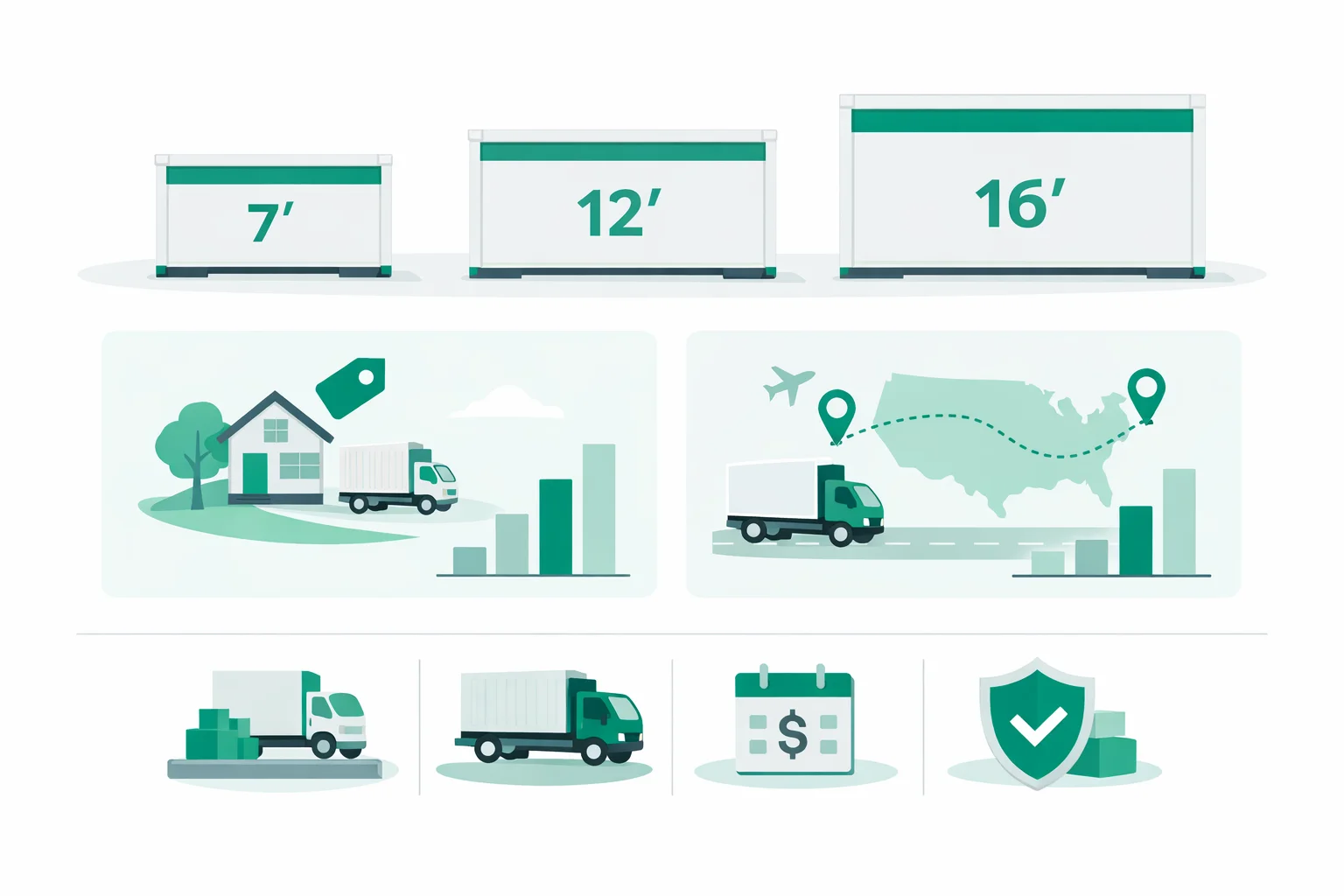
Three Separate Bills Hide Inside One PODS Quote
A container quote looks like one number, but it's three costs stacked together, and they don't move in sync. Understanding them separately is the only way to control the total.
- Delivery and transport.This is the cost of dropping the empty container, then physically moving it — across town or across the country — and picking it up at the end. On a local move it's a flat $300 to $500. On a long haul it's the biggest line by far, often $1,500 to $3,000.
- Monthly rental.A flat $150 to $300 per container, per month, for as long as you keep it. One month is plenty for a fast move; it's the renovation and sold-but-not-closed crowd who watch this line balloon.
- Content protection.Optional coverage, roughly $10 to $150 a month depending on the tier. It's the one line you can skip — but only if your homeowners policy already covers stored goods, which most cap low.
The calculator above keeps these three on separate bars so you can see exactly which one is driving your price. On a quick local move, rent is a rounding error. On a six-month storage stint, rent can outrun the move itself.
Local and Long-Distance Don't Use the Same Math
Here's where most people misjudge a container. The price doesn't scale smoothly with distance — it switches formulas the moment your move leaves the local service zone.
Local movesare a flat service fee. PODS delivers the container, you load it over a few days, they drive it to your new address a few miles away, and they haul it off when you're done. That bundle is typically $300 to $500 for the move itself, plus your monthly rent. Distance barely matters inside a metro.
Long-distance movesthrow out the flat fee and rebuild the price as a base rate plus a per-mile charge. A 16-foot container might carry a $900 base and roughly $1.75 a mile, so 1,000 miles works out to about $900 + $1,750 = $2,650 before any storage. That per-mile meter is why a cross-state move costs five to six times a cross-town one. If you're weighing the container against driving it yourself, the U-Haul cost calculator breaks down the rental-truck side with mileage and fuel.
Worked Example: A 900-Mile Move with a Month of Storage
Let's price a real scenario. You're moving a 2-to-3-bedroom home 900 miles, you need a 12-foot container, and your new place won't be ready for about two months — so the box goes into a PODS storage center after pickup. Here's every line:
- Transport (base + miles): $780 base plus $1.45 × 900 miles = $780 + $1,305 = $2,085.
- Monthly rental: $190 × 2 months = $380.
- Content protection: $60 × 2 months = $120.
Total: about $2,585. Now notice what happens if your move-in date slips and you need four months of storage instead of two: rent climbs to $760 and protection to $240, pushing the total to roughly $3,085. The container never moved — you paid $500 more just for time. That single line is why a container can either save you money or quietly drain it, and it's the variable a truck rental simply doesn't have. For the bigger picture across every method, the moving cost calculator compares DIY, container, and full-service side by side.
What Fits in a 7, 12, or 16-Foot Container?
Right-sizing matters more with containers than with trucks, because a half-empty container costs exactly the same as a full one — there's no per-mile discount for traveling light. Order by what you actually own, not by your home's square footage. Here's the lineup:
| Container | Usable Space | Fits | ~Monthly Rent |
|---|---|---|---|
| 7' Container | 385 cu ft | Studio or 1 room | $150 |
| 12' Container | 689 cu ft | 2 – 3 rooms | $190 |
| 16' Container | 835 cu ft | 3 – 4 rooms / ~1,200 sq ft home | $230 |
A rule that holds up: one 16-foot container handles most homes up to about 1,200 square feet. Past that, two containers beat trying to cram everything into one — and because you're billed per container, a 16 plus a 7 is often cheaper than people fear. When you're torn between two sizes for the same load, the smaller one only wins if you're genuinely confident it fits; a second trip isn't an option once the box is sealed and rolling.
The Storage Month Is Where the Bill Quietly Grows
Storage is the container's superpower and its trap. The superpower: you load on your own schedule, keep the box as long as you need, and never touch a truck. The trap: every month you hold it adds $150 to $300 that does nothing to advance your move.
Run the numbers on a 16-foot container at $230 a month. Two months of slip is $460. Six months — a common renovation timeline — is $1,380, more than half the cost of the move itself. The time chart in the calculator makes this visible: the bar climbs with every month even though the transport line never changes. If your dates are firm, you'll barely notice rent. If they're soft, build a buffer into your budget and check whether a traditional self-storage unit is cheaper for long holds — sometimes it is, once the move is done and the container's mobility no longer matters.
PODS vs. a Rental Truck vs. Full-Service Movers
A container sits in the middle of the moving market: cheaper than full-service, pricier than a truck you drive yourself, and the only option that bundles storage in. Here's how a 1,000-mile, 2-to-3-bedroom move compares across the three:
| Method | Typical Cost | You Do | Best When |
|---|---|---|---|
| Rental truck (DIY) | $1,500 – $1,900 | Load, drive, unload | Cheapest sticker, you'll drive |
| PODS container | $2,200 – $3,000 | Load, unload | You want storage or won't drive |
| Full-service movers | $4,500 – $7,500 | Point and supervise | No time, no labor, no driving |
The decision usually comes down to two questions. Will you drive a big truck across several states?If no, the container's premium over a U-Haul buys you out of two days behind the wheel — often worth it. Do you need storage?If yes, the container is in a class of its own; bolting storage onto a truck rental or movers means a separate unit and a double handling of every box. The U.S. Department of Transportation's Protect Your Move resource is worth a read before you commit to any of the three, especially full-service, where estimate and deposit rules matter most.
When a Container Is the Wrong Call
Containers aren't the right answer for every move, and the honest version of this guide says so. Skip the container if:
- Your driveway can't hold it.A 16-foot container needs roughly 16 feet of flat, accessible space plus clearance for the delivery truck. Tight urban lots, steep driveways, and many condos simply can't take one — and street placement often triggers a permit.
- Your city caps how long it can sit. Many municipalities limit a portable container to 7 to 30 days on residential property. If your timeline needs months on-site, you may be forced into the PODS storage yard anyway, which changes the math.
- It's a short local move with help. For a 1-bedroom across town with a couple of friends, a $150 rental truck beats a $400-plus container handily. Containers earn their keep on distance and storage, not on a quick hop.
Before booking, confirm placement rules with your city or HOA. A code-enforcement fine for an over-stayed container can wipe out the convenience you paid for.
Where People Overpay on a Container Move
- Over-ordering on size. Sizing to square footage instead of belongings can push you from a 12 to a 16 — an extra $40 a month in rent plus higher transport for space you never fill. Inventory first, then size.
- Holding the box longer than the move needs. Each idle month is $150 to $300. If storage stretches past two or three months, price a self-storage unit; a stationary hold is often cheaper than container rent.
- Booking peak summer dates. Long-distance transport rates climb 10 to 25 percent from June through August. Shifting a flexible move to spring or fall can save several hundred dollars on the same route.
- Buying protection you already have — or skipping it blind. Check your homeowners or renters policy first; coverage for stored goods is often capped near 10 percent of personal property, per the Insurance Information Institute. If that limit won't cover a full household, content protection is cheap insurance; if it will, you can drop it.
Do one thing before you reserve: price your exact move at two container sizes and two storage timelines. The five minutes it takes almost always reveals a cheaper combination — and whatever you save on the container is cash that can stay in your down payment instead of a storage yard.