What a Move Really Costs: The Three Prices Behind Every Relocation
The same moving cost calculator can quote you $450 or $2,400 for the identical 3-bedroom move across town — and both numbers are right. The gap is labor: rent a truck and you supply the muscle, hire movers and you buy back your weekend. That single choice swings the bill more than distance, more than the boxes, more than anything else you'll decide. Before you call a single company, it helps to know which of the three prices you're actually shopping for.
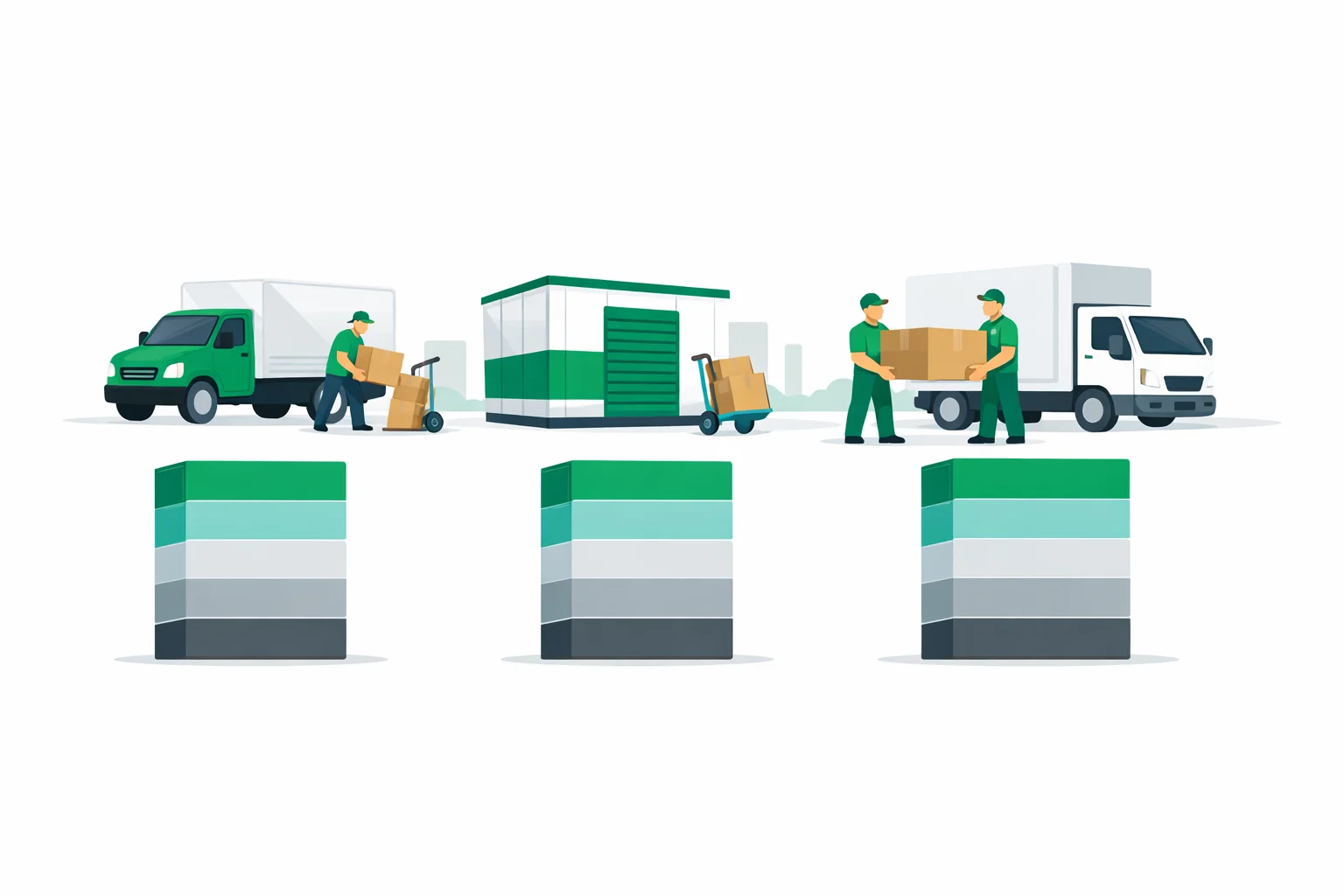
The Same Move Has Three Very Different Prices
Every relocation is really three quotes wearing the same address. A DIY truck rental, a portable container, and full-service movers solve the identical problem — get your stuff from A to B — but they split the work differently, and you pay for whatever you don't do yourself.
- DIY truck rentalis the floor. For a local 2-bedroom move you might pay $70 for a day's truck rental, $55 in fuel, and $35 in pads and a dolly — call it $350 once mileage fees are in. Our U-Haul cost calculator breaks that truck rental down line by line. You pack, you carry, you drive.
- Portable containerssit in the middle. The company drops a box, you load it on your schedule, and they haul it. A local container runs roughly $500 including the first month's rental; you skip the truck-driving but still do the lifting. Price one precisely with the PODS cost calculator, which adds storage months and container count.
- Full-service moversare the ceiling. A three-person crew at $65 an hour for seven hours is $1,365 in labor before the truck fee — but you lift nothing and it's done in an afternoon.
That's a 4x spread on one move. The calculator above shows all three at once so you can see the trade instantly: the cheaper the price, the more of the job lands on you. Your move gets financed from somewhere — usually your home sale proceeds — so the method you pick is money straight off that net check.
Why 100 Miles Flips the Entire Pricing Formula
Here's the part that catches people off guard. A local move and a long-distance move aren't priced on the same scale — they use two different formulas entirely. Under roughly 100 miles (or within a state), movers bill by the hour: crew size times hours times an hourly rate. Cross that line and they switch to weight times distance, the way freight is priced.
That switch is brutal on heavy homes. A 9,000-pound 3-bedroom move generates close to $5,000 in linehaul before you've bought a single box. The hourly local version of that same home? Around $1,800. Nothing about your furniture changed — only the pricing model did. It's also why decluttering pays off so much more on a cross-country move: every 1,000 pounds you shed is real money on a long haul but almost nothing on a local hourly job. Run your full cash-to-close on the new home alongside this estimate, because a long-distance move can rival a chunk of your closing costs.
Worked Example: A 1,000-Mile 3-Bedroom Move
Let's price a real one. You're moving a 3-bedroom home (about 9,000 pounds, 60 boxes) 1,000 miles for a job. Here's how the three methods stack up, with packing supplies and full-value protection added to each:
- Full-service movers: linehaul at roughly $0.67/lb works out near $6,000, plus $200 in supplies and about $495 in full-value protection = ~$6,700. You lift nothing.
- Two containers: around $800 base plus $950 in transport each, so $3,500, plus the same $695 in add-ons = ~$4,200. You load; they drive.
- DIY 26-foot truck: $420 base plus $1,100 in one-way mileage, $390 in fuel, $35 in equipment, plus two nights of lodging and meals near $350, plus add-ons = ~$3,000. You do all of it.
The DIY route saves about $3,700 over movers — but you're driving a 26-foot truck for two days and carrying every box twice. The container splits the difference: $2,500 cheaper than movers and no truck to white-knuckle down the interstate. There's no universally right answer here; there's the answer that matches how much your time and back are worth that week.
Average Moving Cost by Home Size and Distance
These are full-service mover ranges — the ceiling price — so you have a benchmark to judge any quote against. DIY typically lands at 30-45% of these figures; containers around 50-65%.
| Home Size | Local (<100 mi) | ~500 Miles | ~1,500 Miles |
|---|---|---|---|
| Studio | $400 – $700 | $1,300 – $2,000 | $2,000 – $3,200 |
| 1 Bedroom | $550 – $1,000 | $2,000 – $3,200 | $3,200 – $5,000 |
| 2 Bedrooms | $1,000 – $1,600 | $3,200 – $5,000 | $5,000 – $7,800 |
| 3 Bedrooms | $1,600 – $2,400 | $4,500 – $7,000 | $7,000 – $11,000 |
| 4 Bedrooms | $2,200 – $3,400 | $6,000 – $9,500 | $9,500 – $14,500 |
Notice how the columns don't scale evenly. Doubling the bedrooms roughly doubles a local price, but on the 1,500-mile column it more than doubles, because both the weight and the per-pound handling climb together. Use these as a sanity check: a quote 25% above the top of the range deserves a second bid.
The Add-On Costs That Blow Up Budgets
The headline number from any mover is rarely the final number. Four add-ons quietly stack on top, and each has a dollar figure worth knowing before you sign:
- Packing supplies — $150 to $300. A 3-bedroom home swallows about 60 boxes at $2.50-$3 each, plus tape, paper, and bubble wrap. Free used boxes cut this in half, but buy real dish-pack boxes for the kitchen.
- Professional packing — $500 to $1,500.Having the crew pack for you adds roughly $7 per box in labor plus materials. It's the fastest line to cut if you're tight on cash but flush with time.
- Full-value protection — about $11 per $1,000 declared.The free default, released-value coverage, pays a laughable $0.60 per pound — a 40-pound, $1,200 TV reimburses $24. For a $45,000 home that's about $500 well spent.
- Storage — $90 to $340 a month.Gaps between closings push your goods into storage, and containers double neatly as storage if your move dates don't line up. Factor it in if you're selling and buying in the same week.
The U.S. FMCSA's Protect Your Move guidance is blunt about this: an estimate that doesn't itemize these add-ons is a lowball waiting to grow on moving day. Make every line explicit on the written estimate.
DIY, Container, or Movers: How to Choose
Skip the agonizing — this is mostly a three-line decision once you're honest about your constraints:
- Choose DIY ifyou have help, a flexible weekend, and a move under about 800 miles. You'll save 50-65% versus movers, and the truck-driving is manageable at that range. A studio or 1-bedroom is ideal — light load, small truck.
- Choose a container ifyou want to load on your own schedule but dread driving a box truck across three states, or if your move-in date is fuzzy and you need built-in storage. It's the sweet spot for 2-3 bedroom long-distance moves.
- Choose full-service ifyou're moving a 4-bedroom home, you're short on time or physically can't lift, or the company is footing the relocation bill. The premium buys speed and a transferred liability.
One honest gut check: people chronically overrate their willingness to do a DIY move. The truck is cheap; the second flight of stairs at hour six is not. If you've got young kids, a bad back, or a demanding job, the "expensive" movers often win on every axis that isn't the sticker price.
Where the Real Savings Hide
The biggest discounts aren't in haggling — they're in timing and weight. Movers charge premium rates on weekends, at the start and end of every month, and all summer. Booking a mid-week, mid-month move in the fall can knock 20-30% off the labor bill: that $1,800 Saturday-in-July job drops near $1,300 on a Tuesday in October.
Weight is the other lever, and it only matters on long hauls. Selling or donating 1,500 pounds of furniture before a cross-country move can save $800-$1,000 in linehaul — often more than the furniture is worth keeping. The math flips for local moves, where you're paying for hours, not pounds, so a fast pre-pack does more than decluttering. Whatever you save here is cash that stays in your down payment rather than the moving truck.
Costly Moving-Quote Mistakes
- Taking a phone estimate as gospel. A number quoted without a virtual or in-home survey is a guess, and guesses grow on moving day. Insist on a binding or not-to-exceed estimate after a real walkthrough — the difference can be $1,000+ on a big home.
- Getting only one quote.Bids for the identical job routinely vary 30% or more. Three written quotes on a $6,000 move can surface a $1,800 spread — the best hour of work you'll do all month.
- Skipping protection to save $500.Released-value coverage's $0.60 per pound means a $2,000 sofa pays out about $50 if it's destroyed. On anything you couldn't cheaply replace, that's a false economy.
- Forgetting the cash-flow gap.Movers often want payment on delivery, while your home-sale funds may not have cleared. Line the dates up so you're not floating a five-figure move on a credit card.
Do one thing before you book: gather three itemized written quotes for the same method on the same dates. The spread alone usually pays for the better mover, the protection, and a few boxes of pizza for the friends who help you carry the couch.