Cash-Out Refinance Calculator: How Much Equity Can You Tap and At What Cost?
A cash-out refinance calculator exposes a number lenders rarely put on the quote: borrowing $50,000 against your home can cost you nearly $194,000. Not because of the $50,000 — that part is cheap. The expensive part is what happens to the other$250,000 you already owe. A cash-out refinance doesn't hand you a loan for the cash; it replaces your whole mortgage with a bigger one, re-pricing every dollar at today's rate. If your current rate is low, that's where the real money goes.
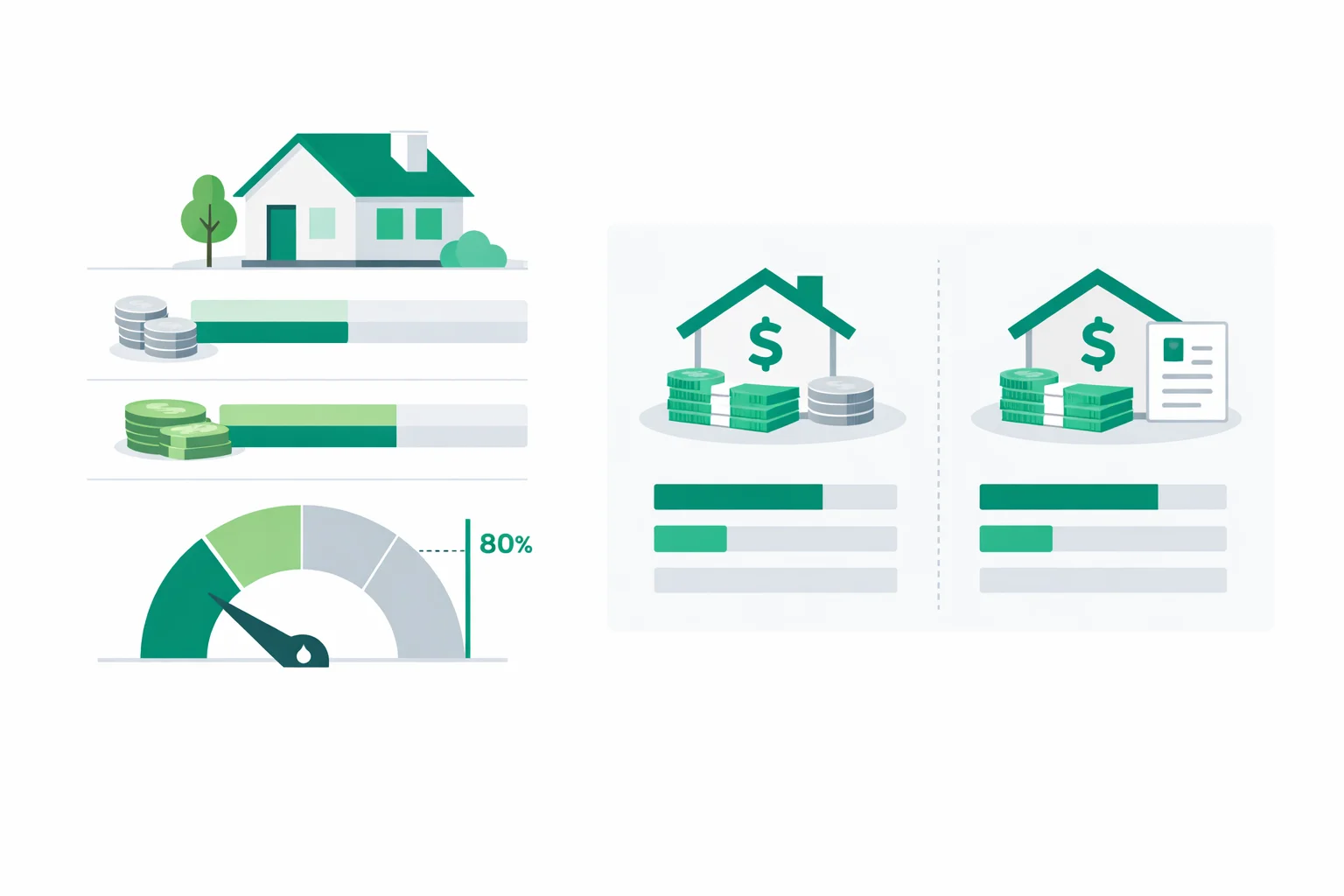
The Real Cost Isn't the Cash — It's the Re-Rate
Here's the mechanic almost every explanation skips. A home equity loan or HELOC is a second loan stacked on top of your mortgage. Your first mortgage keeps its rate, its balance, its payoff date. A cash-out refinance is different in kind: it pays off your old loan entirely and writes a brand-new one for the old balance plus the cash.
That distinction is everything when rates have moved. Say you owe $250,000 at 4% and you want $50,000. A cash-out refi creates a $300,000 loan at 6.75%. The $50,000 you wanted is now financed at 6.75% — fair enough. But so is the $250,000 you were happily paying at 4%. You just gave yourself a 2.75-point rate increase on a quarter-million dollars to get fifty grand. The cash is the small line item; the re-rate is the bill.
How Much Cash Can You Actually Pull Out?
Your ceiling is set by loan-to-value (LTV). Most lenders cap a cash-out refinance at 80% LTV, meaning the new loan can't exceed 80% of your home's appraised value. The formula for your maximum cash is simple:
Max cash = (Home value × 0.80) − Current balance − Closing costs
On a $450,000 home with a $250,000 balance, 80% of value is $360,000. Subtract the $250,000 you owe and you have roughly $110,000 of borrowing room before fees. Cross that 80% line and you either get denied or pay for it: dropping below 20% equity adds private mortgage insurance, which you can price with our PMI calculator. VA cash-out loans are the exception and can reach 90-100% of value. The CFPB's overview of cash-out refinancing walks through how lenders set these limits.
Worked Example: Tapping $50,000 With a 4% Mortgage
Let's run the headline scenario in full. Home worth $450,000, $250,000 left at 4% with 26 years to go. The current payment is about $1,290 a month, and the loan has roughly $152,000 of interest left to pay. Now you take $50,000 cash at 6.75% on a fresh 30-year term:
- New loan: $300,000 at 6.75%, 30 years
- New payment: $1,946/mo — up $656 from $1,290
- Total interest on the new loan: about $400,560
Compare that to the alternative: keep the 4% mortgage and take a separate $50,000 home equity loan at 8.5% over 20 years. The home equity loan runs about $434 a month and costs roughly $54,000 in interest. Add that to the $152,000 still owed on the untouched first mortgage and the total interest is about $207,000.
The gap is staggering: $400,560 versus $207,000 — about $194,000 more to take the cash-out route. And only $54,000 of the cash-out's interest is the actual cost of the $50,000. The rest is the penalty for re-rating your low-rate balance and restarting the amortization clock at 30 years. That's the trade the headline payment hides.
Your Existing Rate Decides the True Cost
The single biggest factor in whether a cash-out refinance makes sense isn't the new rate — it's the gap between your old rate and the new one. The lower your current rate, the more a cash-out refi punishes you. This table holds everything constant (same $250,000 balance, $50,000 cash, 6.75% new rate over 30 years) and only changes your existing rate, comparing total interest against the keep-mortgage-plus-home-equity-loan path:
| Your Current Rate | Keep Loan + HE Loan | Cash-Out Refi | Extra Cost of Cashing Out |
|---|---|---|---|
| 7.0% (above new) | $348,000 | $400,560 | ~$53,000 |
| 6.0% | $298,000 | $400,560 | ~$102,000 |
| 5.0% | $251,000 | $400,560 | ~$150,000 |
| 4.0% | $207,000 | $400,560 | ~$194,000 |
| 3.0% | $165,000 | $400,560 | ~$236,000 |
Read the bottom rows carefully. A homeowner sitting on a pandemic-era 3% mortgage who cashes out pays roughly $236,000 more in interest than one who leaves that loan alone. The cash-out column never moves — it can't, because the new loan is the same regardless of your old rate. All that changes is how much you're throwing away by giving up the rate you already locked.
Cash-Out Refi vs. HELOC vs. Home Equity Loan
Three tools tap the same equity, but they touch your first mortgage very differently. Pick by what your current rate is and how you'll use the money.
| Option | Touches 1st Mortgage? | Typical Rate | Best For |
|---|---|---|---|
| Cash-out refinance | Replaces it entirely | New first-mortgage rate | When your current rate is at or above market |
| Home equity loan | No — second lien | ~1.5-3% above first mortgage, fixed | A fixed lump sum while keeping a low first rate |
| HELOC | No — second lien | Variable, tied to prime | Flexible or staged draws (renovations) |
The decision pivots on one question: is your current mortgage rate a treasure or a burden? If it's below today's market, protect it — use a second lien and leave the first mortgage alone. If your current rate is already higher than what you'd refinance into, a cash-out refi can lower your rate and hand you cash in one move, which is the rare scenario where it genuinely wins. Run both against a plain rate-and-term refinance before committing.
When a Cash-Out Refinance Actually Wins
The calculator isn't anti-cash-out — it's anti-surprise. There are clean cases where cashing out is the smart play:
- Your current rate is higher than today's.If you're at 7.5% and can refinance to 6.5% while pulling cash, you lower the payment on the whole balance and get money — the re-rate works in your favor.
- You're consolidating high-interest debt.Swapping 22% credit card debt for 6.75% mortgage debt can save real money monthly — provided you shorten the term or pay extra so you don't stretch a $15,000 balance across 30 years.
- The cash funds value-adding home improvements. Beyond the return on the renovation, the interest may be tax-deductible when the funds buy, build, or improve the home — see IRS Publication 936 for the deductibility rules.
What Comes Off the Top: Closing Costs
Cash-out refinances carry the same 2-5% closing costs as any refinance — roughly $6,000 to $15,000 on a $300,000 loan. The catch is that these come straight out of your proceeds. Ask for $50,000 with $6,500 in costs and you walk away with $43,500 unless you roll the fees into the balance, which quietly bumps your loan and your LTV.
Rolling costs in feels painless because nothing leaves your pocket, but you then pay 6.75% interest on that $6,500 for up to 30 years — about $8,000 in total. Cash-out loans also tend to price 0.125% to 0.5% higher than rate-and-term refinances because lenders treat them as riskier. Use our closing costs calculator to estimate the bite before you assume the full cash amount lands in your account, and run a refinance break-even calculator to see how many months it takes those fees to pay for themselves.
Mistakes That Turn Equity Into a Money Pit
- Cashing out a sub-5% mortgage. The most expensive mistake on this page. Re-rating a $250,000 balance from 4% to 6.75% can cost $190,000-plus over the loan — money a second lien would have saved entirely.
- Restarting at 30 years every time.If you're 8 years into a loan, a fresh 30-year term means 38 total years of payments and a return to the interest-heavy front of the schedule. Match the new term to your remaining years when you can.
- Funding depreciating purchases.Putting a $40,000 car or a wedding on a 30-year mortgage means paying for it long after it's gone — and the interest isn't deductible. You'll pay roughly $53,000 over 30 years for that $40,000 at 6.75%.
- Ignoring the equity you're spending. Cash-out converts equity into debt. Check your current equity position first — drain it too far and you have no cushion if home values dip or you need to sell.
Before you sign anything, run your exact numbers through the calculator above with your real current rate filled in — not a round estimate. The difference between a 4% and a 5% starting rate can swing the verdict by $40,000 or more, and that's the kind of detail a lender quoting you a shiny new payment has no reason to mention.