HELOC Calculator: How to Estimate Your Credit Limit, Draw Period, and Repayment Costs
Most people misuse a HELOC calculator by plugging in numbers for only one phase of the loan. A home equity line of credit isn't one loan — it's two: a draw period where you borrow and pay interest only, followed by a repayment period where your payment jumps because you're suddenly paying principal too. On a $60,000 HELOC at 8.5%, that jump is $425/month to $521/month — a 23% increase that catches roughly 60% of borrowers off guard, according to a 2023 CFPB consumer advisory on HELOCs.
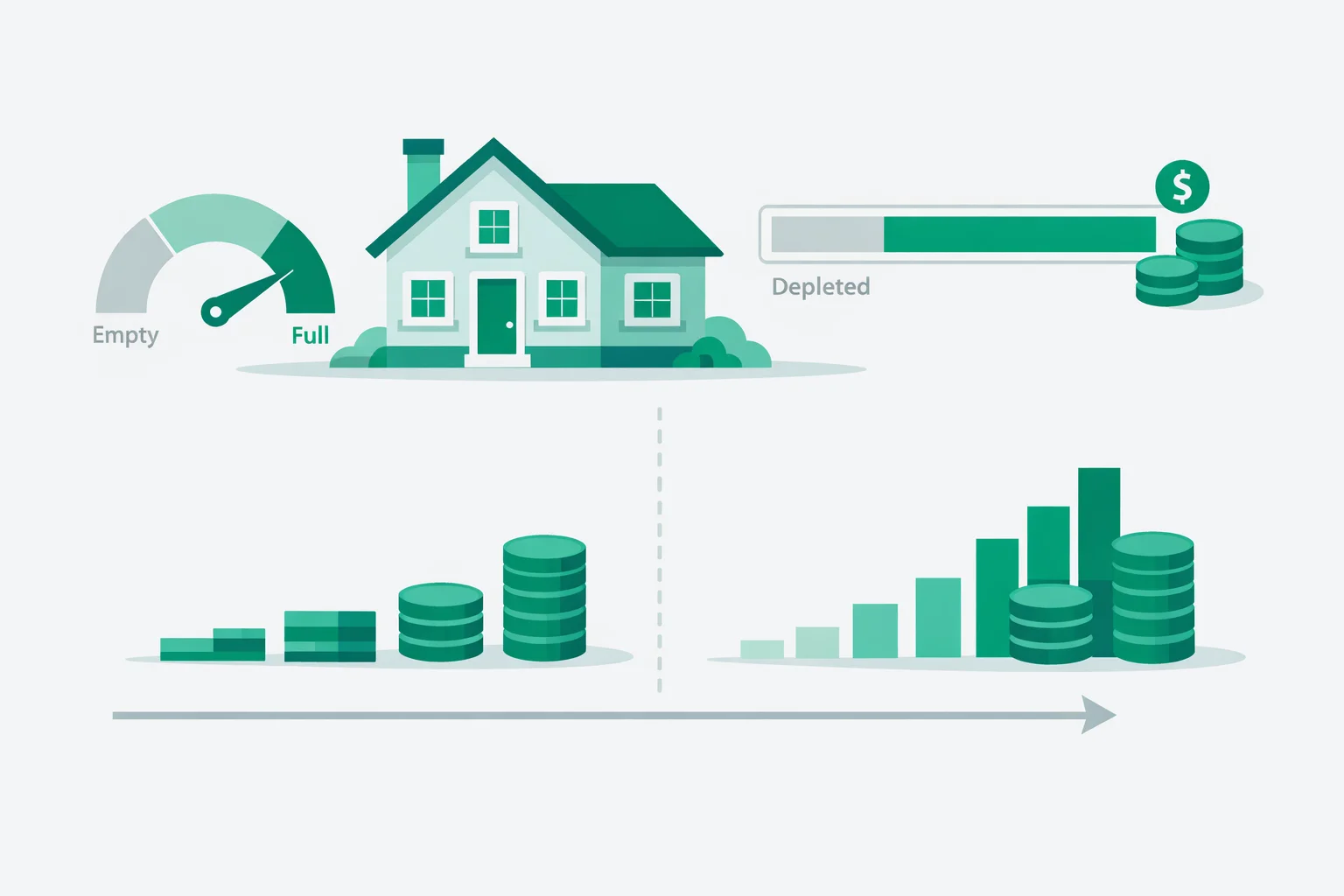
The Two-Phase Trap Most Borrowers Miss
Here's a scenario that plays out thousands of times a year. A homeowner opens a $75,000 HELOC at 8% to renovate their kitchen. During the 10-year draw period, they pay $500/month in interest only. Comfortable. Manageable. Then year 11 hits: the draw period ends, the credit line freezes, and the lender starts a 20-year amortization on the full $75,000 balance. The new payment? $627/month. That's $127 more every month for 20 years.
The total interest over the full 30-year lifecycle — $60,000 during the draw period plus $75,572 during repayment — adds up to $135,572. The $75,000 renovation actually costs $210,572. You won't find that number on most lender websites because they only show the draw-period payment.
How Your HELOC Credit Limit Is Calculated
Lenders use a simple formula: Home Value × Max CLTV − Mortgage Balance = Credit Line. CLTV stands for combined loan-to-value, and it's the ceiling on how much total debt your home can secure.
Take a $400,000 home with a $260,000 mortgage. At an 80% CLTV cap, the lender allows $320,000 in total borrowing. Subtract the $260,000 first mortgage, and the maximum HELOC is $60,000. Bump the CLTV to 85%, and the credit line rises to $80,000 — but expect a rate premium of 0.25-0.5% above 80%.
One detail that trips people up: lenders use the appraisedvalue, not your Zillow Zestimate. Appraisals frequently come in 3-8% below online estimates, which can shrink your expected credit line by $5,000-$15,000. If you're counting on a specific amount, order a pre-application appraisal ($300-$500) before committing.
Draw Period Payments: The Interest-Only Math
During the draw period, you pay only interest on the amount you've actually borrowed — not the full credit line. The monthly payment is straightforward:
Monthly Payment = Outstanding Balance × (Annual Rate ÷ 12)
On a $60,000 draw at 8.5%, that's $60,000 × 0.0070833 = $425/month. Draw only $30,000, and you pay $212.50. This flexibility is the HELOC's biggest advantage over a home equity loan, where you pay interest on the full lump sum from day one.
But here's the catch: every dollar of interest-only payment goes to the lender. Your balance doesn't shrink by a penny during the draw period unless you voluntarily pay extra toward principal. Ten years of $425/month = $51,000 in interest, and you still owe the original $60,000.
Repayment Period Shock — A Worked Example
Let's walk through the full math for a common scenario: $60,000 HELOC at 8.5%, 10-year draw, 20-year repayment.
Draw period (years 1-10):$60,000 × 0.085 ÷ 12 = $425.00/month. Over 10 years: $425 × 120 = $51,000 in total interest. Balance remains $60,000.
Repayment period (years 11-30):Now the lender amortizes the $60,000 over 240 months at 8.5%. Using the standard amortization formula: $60,000 × [0.0070833 × (1.0070833)^240] ÷ [(1.0070833)^240 − 1] = $520.89/month. Over 20 years: $520.89 × 240 = $125,014. Interest during repayment: $65,014.
Grand total: $51,000 (draw interest) + $65,014 (repayment interest) = $116,014 in interest. The $60,000 credit line costs $176,014. Compare that to a straight 30-year home equity loan at 8.5% for $60,000: $461/month for 360 months = $105,894 in total interest. The HELOC costs $10,120 more because the draw period delays principal repayment.
How Variable Rates Change Your HELOC Cost
HELOC rates are pegged to the prime rate, which tracks the Federal Reserve's federal funds rate. When the Fed raises rates by 0.25%, your HELOC rate rises 0.25% — usually within one billing cycle. The math is direct: each 0.25% increase adds $12.50/month per $60,000 of outstanding balance.
Between March 2022 and July 2023, the Fed raised rates by 5.25 percentage points. A homeowner who opened a HELOC at 4.5% in early 2022 saw it climb to 9.75% by mid-2023. On a $60,000 balance, the monthly interest-only payment went from $225 to $487.50 — a 117% increase with zero additional borrowing.
Most HELOCs have a lifetime rate cap (often 18%) and a floor (the initial rate or prime at closing). Some lenders offer a fixed-rate conversion option that lets you lock a portion of your balance at a fixed rate, usually 0.5-1% above the current variable rate. If you're drawing $40,000+ and plan to carry the balance for 5+ years, the conversion premium can be worth the predictability. Check your lender's terms — according to Federal Reserve guidance on HELOCs, lenders must disclose rate adjustment caps in the initial agreement.
HELOC vs. Home Equity Loan — When Each Wins
The decision between a HELOC and a home equity loan comes down to three variables: how much you need, when you need it, and how long you'll carry the balance.
| Factor | HELOC Wins | Equity Loan Wins |
|---|---|---|
| Borrowing pattern | Phased draws ($10K now, $20K in 6 months) | One-time lump sum ($50K kitchen remodel) |
| Rate environment | Rates are falling or stable | Rates are rising (lock in fixed) |
| Repayment timeline | You'll pay it off within the draw period | You need 10-20 years to repay |
| Interest cost ($60K, 8.5%, 15 yrs) | $0 if repaid in draw period | $46,352 fixed over 15 years |
| Payment predictability | Low — variable rate, flexible draws | High — same payment every month |
A HELOC's real advantage is optionality. If you open a $60,000 line but only draw $25,000, your interest-only payment is $177/month instead of $425. You can't do that with a lump-sum loan. Use our home equity calculator to determine your available equity before choosing between the two.
Five HELOC Mistakes with Dollar Consequences
- Treating the draw period as "free money." Interest-only payments feel cheap, but $425/month for 10 years is $51,000 in pure interest with zero principal reduction. Budget voluntary principal payments from day one.
- Ignoring the rate cap in your agreement.A HELOC at 8.5% with an 18% cap means your $425 interest-only payment could theoretically reach $900/month. Stress-test your budget at the cap rate, not today's rate.
- Maxing out the credit line immediately.Drawing the full $60,000 on a $400,000 home pushes your CLTV to 80%. If home values drop 5% ($20,000), you're underwater on the HELOC — and the lender can freeze or reduce your line.
- Skipping the appraisal gap risk.You estimated $80,000 in equity based on Zillow, but the appraisal came in $25,000 lower. Now your maximum HELOC is $55,000 instead of $80,000, and you've already committed to a $70,000 renovation contract.
- Forgetting closing costs exist. HELOCs carry $2,000-$5,000 in closing costs (appraisal, title search, recording fees). Some lenders waive these but claw them back if you close the line within 3 years. Factor this into your break-even calculation.
When a HELOC Is the Wrong Move
Don't open a HELOC if your first mortgage rate is above 7.5% and you have 20%+ equity. A cash-out refinance rolls both debts into one payment at a single rate — potentially lower than your current mortgage if rates have dropped. Running two loans (6.5% first mortgage + 8.5% HELOC) costs more than one refinanced loan at 6.75% for the combined balance.
Skip the HELOC if you're using it to consolidate credit card debt but haven't fixed the spending pattern. Converting unsecured debt (credit cards) to secured debt (your home) means defaulting costs you the house, not just your credit score. The median HELOC borrower who consolidates credit card debt re-accumulates 35% of the original card balance within 3 years.
And avoid it if you're planning to sell within 2-3 years. Closing costs of $2,000-$5,000 plus the early-closure clawback penalty wipe out any short-term benefit. A personal loan at 10-12% costs more per month but has zero closing costs and no lien on your home.
Three Strategies to Cut Your Total HELOC Cost
Pay principal during the draw period. Adding $200/month toward principal on a $60,000 balance at 8.5% during the 10-year draw period reduces the balance to $36,000 by year 11. Your repayment-period payment drops from $521 to $313/month, and total lifecycle interest falls from $116,014 to $78,400 — a $37,614 savings. Model different extra-payment amounts with our HELOC payment calculator to find the sweet spot for your budget.
Use the fixed-rate conversion option. If your lender offers it, locking $40,000 of your $60,000 balance at a fixed 9.0% while keeping $20,000 variable gives you predictability on the bulk of the debt. You lose some flexibility, but you eliminate the risk of the variable portion spiking during a rate-hike cycle.
Refinance before the repayment period starts.In year 8 or 9 of the draw period, shop for a new HELOC or a home equity loan to replace the remaining balance. You'll reset the clock with a new draw period (if HELOC) or lock in a fixed rate (if equity loan). This avoids the payment shock entirely — but only works if you have sufficient equity and rates haven't moved dramatically against you.