How Much Does It Really Cost to Build a House in 2026?
A cost to build a house calculator gives you a realistic budget range before you talk to a single contractor — and that matters, because the gap between what people thinka new build costs and what it actually costs is often $80,000 or more. The national average sits around $150 per square foot for standard finishes, but that number shifts dramatically based on where you're building, what materials you choose, and how complex the floor plan is. This guide breaks down every major cost category, walks through a real-dollar example, and explains where money quietly disappears on most builds.
What Drives the Cost to Build a House?
Three variables control roughly 80% of your final number: square footage, finish quality, and location. Square footage is obvious — more house means more material and labor. But finish level is where most budgets get wrecked. Upgrading from laminate to hardwood floors adds $8-$15 per square foot. Swapping builder-grade cabinets for semi-custom raises the kitchen bill by $10,000-$25,000. These choices compound fast.
Location matters because labor rates vary by region. A framing crew in rural Arkansas might charge $4-$6 per square foot; the same work in the San Francisco Bay Area runs $9-$14. Material delivery costs, permit fees, and impact fees amplify the gap further. According to the U.S. Census Bureau's Survey of Construction, the median cost of a new single-family home (excluding land) was $292,000 in recent data — but regional variation spans from under $200,000 in parts of the South to over $500,000 along the coasts.
Cost Per Square Foot Breakdown
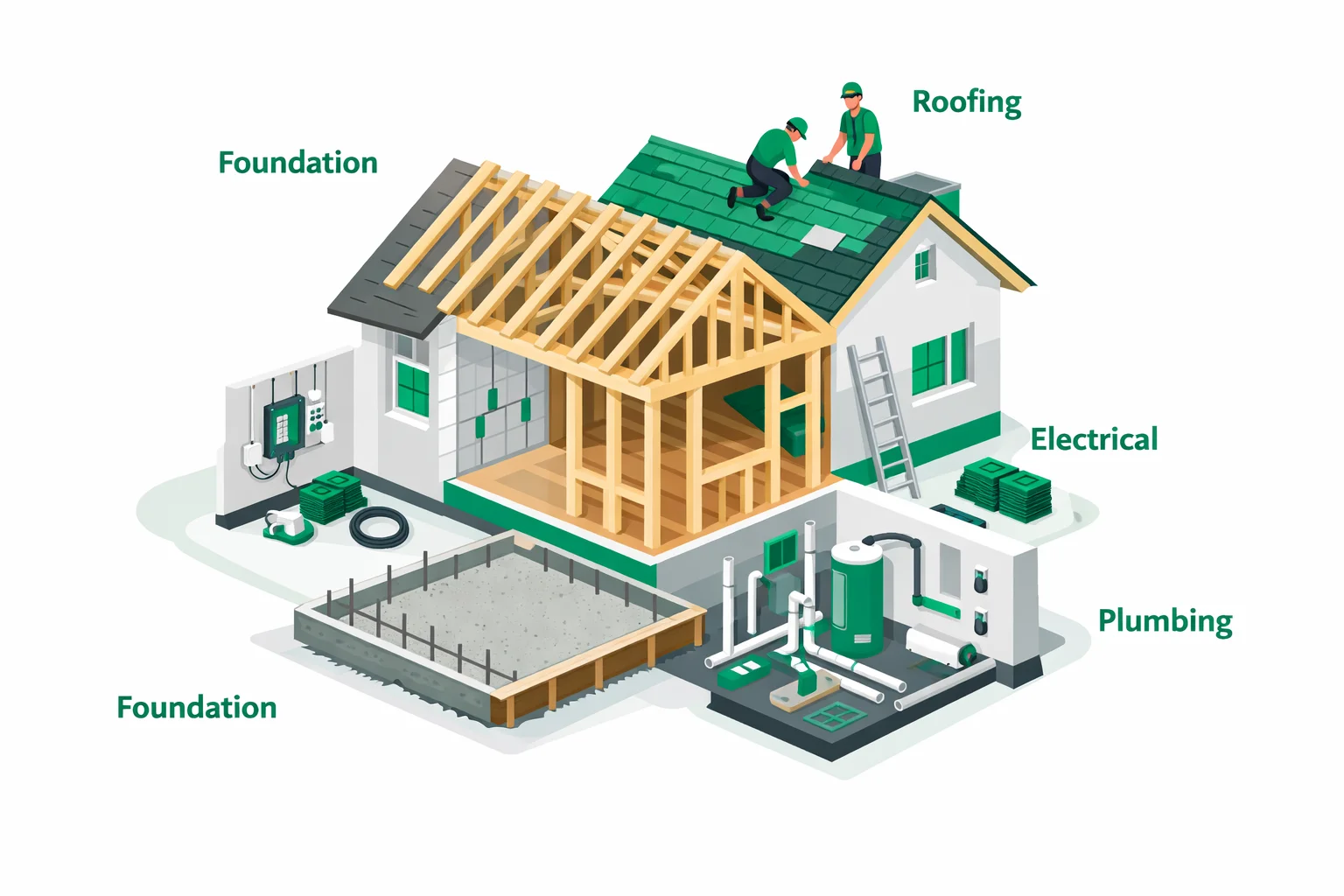
Here's how a typical $150/sq ft standard build divides across major construction categories:
| Category | % of Budget | Cost / sq ft | On a 2,000 sq ft Home |
|---|---|---|---|
| Site Work & Foundation | 14% | $21 | $42,000 |
| Framing & Structural | 18% | $27 | $54,000 |
| Roofing | 6% | $9 | $18,000 |
| Exterior Finishes | 8% | $12 | $24,000 |
| Electrical | 9% | $13.50 | $27,000 |
| Plumbing | 9% | $13.50 | $27,000 |
| HVAC | 8% | $12 | $24,000 |
| Interior Finishes | 28% | $42 | $84,000 |
Interior finishes eat the biggest slice because the category is broad: flooring, cabinets, countertops, paint, trim, doors, lighting fixtures, and bathroom tile all live here. It's also the category where upgrade fever hits hardest. A $12,000 kitchen becomes $35,000 once you pick quartz countertops, soft-close drawers, and a tile backsplash.
Worked Example: 2,000 Sq Ft Home
Let's price out a real scenario: a 2,000 square foot, single-story ranch in a mid-cost suburban area with standard finishes, an attached 2-car garage, and no basement.
- Base construction: 2,000 sq ft × $150/sq ft = $300,000
- Attached garage: ~$15,000 (slab, framing, door, electrical)
- Contingency (10%): $31,500
- Estimated total: $346,500
Now add the items the per-square-foot price doesn't cover: land ($50,000-$150,000 depending on location), site preparation ($5,000-$15,000 for grading and utility trenching), permits ($3,000-$10,000), architectural plans ($5,000-$15,000), and landscaping ($5,000-$20,000). The all-in number for this modest ranch — land included — lands somewhere between $420,000 and $550,000. That's the number to compare against listed homes in the same area when deciding whether to build or buy.
If you already know you can afford this range, run the numbers through our mortgage calculator to see what the monthly payment looks like on a construction-to-permanent loan.
Build vs. Buy: A Real Comparison
The sticker price of a new build almost always looks higher than a resale home in the same neighborhood. But that comparison is deceptive.
| Cost Factor | New Build | Existing Home (10-20 yrs old) |
|---|---|---|
| Purchase price (2,000 sq ft) | $346,500 | $310,000 |
| Immediate repairs / updates | $0 | $15,000 - $35,000 |
| Energy costs (annual) | ~$1,800 | ~$2,800 |
| Maintenance (first 5 yrs) | ~$3,000 | ~$12,000 - $20,000 |
| Warranty coverage | 1-10 yr builder warranty | None (unless purchased) |
Over a 10-year ownership window, the new build often costs less in total occupancy dollars — especially if the existing home needs a roof, HVAC replacement, or significant plumbing updates. Use our home buying calculator to run the full purchase cost of an existing home side by side.
Regional Cost Differences
Geography reshapes your budget more than any single design decision. The same 2,000 sq ft plan at standard finish prices out very differently across the country:
| Region | Cost / sq ft | 2,000 sq ft Total |
|---|---|---|
| Rural Midwest / South | $100 - $130 | $200,000 - $260,000 |
| Suburban Mid-Atlantic | $140 - $170 | $280,000 - $340,000 |
| Metro / Pacific Northwest | $175 - $220 | $350,000 - $440,000 |
| Coastal CA / NYC Area | $220 - $300+ | $440,000 - $600,000+ |
The spread isn't just labor. Coastal cities stack on higher permit fees, stricter energy codes (California Title 24, for example, adds $5,000-$15,000 in compliance costs), and longer inspection timelines that burn carrying costs. If you're weighing whether building fits your income, our home affordability calculator shows a safe price range based on the 28/36 DTI rule.
Hidden Costs Most People Miss
The per-square-foot number gets all the attention, but these line items blindside first-time builders every year:
- Site work and grading: $5,000-$20,000. A sloped lot or one with rock near the surface can triple the excavation bill. Always get a soil test before you close on land.
- Utility connections: $5,000-$25,000. Bringing water, sewer, electric, and gas to a rural lot costs far more than tapping existing infrastructure in a developed subdivision.
- Impact and tap fees:$2,000-$15,000. Many municipalities charge new construction fees for schools, roads, and water systems. These aren't negotiable.
- Interest during construction:A 9-month build at 8% on a $300,000 draw schedule costs roughly $12,000-$18,000 in construction loan interest alone. That money doesn't buy a single nail.
- Landscaping: $5,000-$25,000. New builds hand you a dirt yard. Sod, grading, a driveway approach, and basic plantings are separate from the house budget.
How to Reduce Building Costs Without Cutting Corners
- Keep the footprint simple. Corners are expensive — every jog in the foundation adds $1,500-$3,000 in concrete, framing, and roofing. A rectangular plan costs 15-20% less per square foot than an L- or U-shape of the same size. If you want to estimate concrete quantities for the foundation, run the numbers before finalizing the footprint.
- Build up, not out. A two-story home shares one foundation and one roof across more living space. On a 2,000 sq ft plan, going to two stories saves roughly $10,000-$20,000 in foundation and roofing costs compared to a sprawling ranch.
- Standardize window and door sizes. Custom-sized openings require special-order windows and non-standard headers. Sticking to manufacturer stock sizes saves $2,000-$5,000 on a typical home.
- Spend on the envelope, save on cosmetics.Upgrade insulation, windows, and air sealing first — they pay back in lower energy bills for decades. Countertops and light fixtures are easy to swap later; wall insulation isn't.
- Get three bids minimum. Builder pricing varies 15-25% for the same plan in the same market. Three bids give you a reliable range and negotiating leverage.
When Building Makes More Sense Than Buying
- Limited resale inventory: When existing homes in your target area are overpriced or require $40,000+ in updates, building to your exact specs can be the smarter financial play.
- You own the land already: Inherited land or a purchased lot removes the single biggest variable cost. The build-only budget is much easier to finance.
- Energy efficiency matters to you: New construction built to 2024+ energy codes uses 30-50% less energy than a home built before 2000. Over 20 years, that's $20,000-$40,000 in utility savings — according to the U.S. Department of Energy, modern building techniques and materials dramatically cut heating and cooling costs.
- Accessibility or specific needs: Widened doorways, zero-step entries, and first-floor primary suites are vastly cheaper to include during construction than to retrofit later.