How to Calculate Stair Dimensions That Pass Building Code Every Time
A stair calculator takes the guesswork out of one of the trickiest parts of residential construction: getting every riser and tread to land within building code limits while still feeling comfortable underfoot. Mess up the math by even half an inch per step and you'll either fail inspection or — worse — build stairs that trip people for the life of the house. This tool does the division for you, checks your numbers against IRC requirements, and shows you exactly how much lumber to buy.
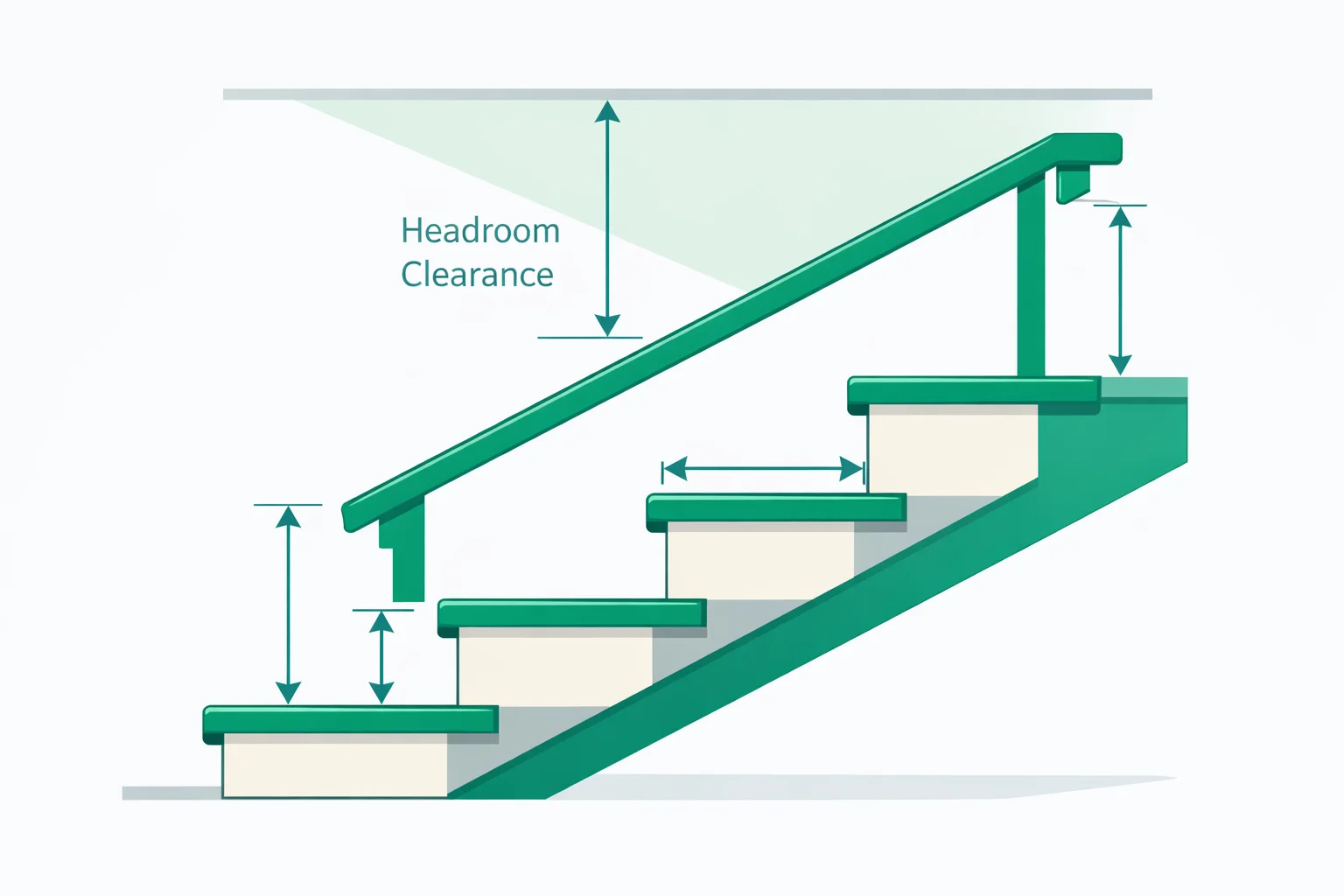
Stair Anatomy: Risers, Treads, and Stringers
Every staircase breaks down into three core parts. The riser is the vertical board between steps — its height determines how steep the staircase feels. The tread is the horizontal surface you actually step on. And the stringer is the sawtooth-cut board that runs diagonally underneath everything, carrying the load from the top landing down to the floor.
Most residential stairs use three stringers: one on each side and one down the center. Wider stairs (over 36 inches) need a fourth stringer to prevent bounce and flex in the treads. The stringers are typically cut from 2×12 lumber, which gives enough meat left in the board after you notch out the step profile. That remaining wood is called the throat, and it has to stay thick enough to carry the load — generally at least 3.5 inches.
IRC Building Code Requirements for Residential Stairs
The International Residential Code sets hard limits on stair geometry. These aren't suggestions — they're the numbers your inspector will check with a tape measure:
- Maximum riser height: 7 3/4 inches (7.75")
- Minimum tread depth: 10 inches (measured horizontally, nosing to nosing)
- Nosing overhang: 3/4" to 1 1/4" projection beyond the riser face
- Riser variation: no more than 3/8" difference between the tallest and shortest riser in a flight
- Minimum width: 36 inches clear between walls or between a wall and the handrail
- Headroom: 80 inches (6'-8") minimum clearance above the nosing line
- Handrail height: 34 to 38 inches above the stair nosing
Local jurisdictions sometimes amend these numbers — a few states allow 7 7/8" risers, and some require 11" treads. Always verify with your local building department before you cut. You can find the full IRC stair provisions in IRC Chapter 3, Section R311.7.
How to Calculate Stair Dimensions Step by Step
The starting point is always total rise— the vertical distance from the finished floor at the bottom to the finished floor at the top. Don't just measure the ceiling height; you need to add the floor framing depth above (joists, subfloor, finish flooring — typically 10-12 inches total).
Here's the process:
- Measure total rise in inches. For a 9-foot ceiling: 108" + ~10" floor assembly = 118".
- Divide by your target riser height (aim for 7-7.5"). 118 ÷ 7.25 = 16.28, so round to 16 risers.
- Calculate actual riser height: 118 ÷ 16 = 7.375" per riser. That's under 7.75" — code compliant.
- Set tread depth at 10-11". Number of treads = risers minus 1 = 15.
- Calculate total run: 15 treads × 10.5" = 157.5" (13'-1.5").
- Calculate stringer length: √(118² + 157.5²) = √(13924 + 24806) = √38730 ≈ 196.8" (16'-5").
That last number is critical — it tells you the minimum lumber length for your stringers. If it exceeds 16 feet (a common stock length for 2×12s), you'll need to either add a landing to break the staircase into two flights or order longer boards.
Worked Example: 9-Foot Ceiling Staircase
Let's walk through a real scenario. You're building stairs from a basement with a 9-foot ceiling up to the first floor. After measuring, the total rise from finished basement floor to finished first floor is 118 inches.
You want comfortable stairs, so you start with a 7.25" target riser. Dividing 118 by 7.25 gives 16.28 — round to 16 risers. Actual riser height: 118 ÷ 16 = 7.375 inches. That's well within the 7.75" IRC maximum.
With 10.5" treads and 15 treads total (one fewer than risers), the total run is 157.5 inches — about 13 feet 1.5 inches. The rise + run sum is 7.375 + 10.5 = 17.875, which falls right in the sweet spot of the 17-18 comfort range.
Stringer length: √(118² + 157.5²) = 196.8 inches, or roughly 16 feet 5 inches. You'll need 16-foot 2×12 stock — just barely. Consider ordering 18-foot boards to give yourself trimming room, or adjust to 17 risers (bringing the stringer under 16 feet). Use the board foot calculator to price out the lumber once you settle on dimensions.
Cutting Stair Stringers: Layout and Sizing
Stringer layout is where most DIY stair projects go sideways. You're cutting a repeating right-triangle pattern out of a board, and every cut has to be identical — remember that 3/8" maximum riser variation rule.
Use a framing square with stair gauges clamped at your riser height (tongue) and tread depth (blade). Walk the square down the board, marking each step. Before cutting, check the throat depth: measure from the inside corner of the notch perpendicular to the uncut edge of the board. A 2×12 has 11.25" of actual depth, and after cutting notches for 7.375" risers and 10.5" treads at a 36.8° angle, you'll have about 4.2" of throat remaining. That's adequate, but it gets tight with larger step dimensions.
If your throat drops below 3.5 inches, upsize to a 2×14 or reduce your riser height. The framing calculator can help you estimate overall lumber quantities when the staircase is part of a larger framing project. Also don't forget the bottom riser adjustment: the first riser is cut shorter by one tread thickness (typically 1" for standard tread stock) because the tread board on top adds that height back.
Stairwell Opening and Headroom Clearance
Headroom is the silent killer of stair projects. You can nail every riser and tread dimension perfectly and still fail inspection because the stairwell opening in the floor above is too short. The IRC demands 80 inches (6'-8") of clearance measured vertically from the stair nosing to any obstruction above — ceiling, header beam, floor joist, anything.
The critical zone is where the stairs pass beneath the floor framing of the level above. As you walk up, the ceiling drops with each step. The stairwell opening has to extend far enough back that you maintain 80 inches of clearance at every point on the walking surface.
For the 9-foot ceiling example: the floor assembly above is about 10 inches deep. Headroom starts running out about 4-5 treads from the top. Working backwards from the header, you'd need a stairwell opening of roughly 10-11 feet to stay clear. This calculator does that math automatically based on your floor assembly depth and headroom requirement.
Comfort Formulas: The 17-18 Rule and Beyond
Building code keeps stairs safe. Comfort formulas make them feel right. The most common is the riser + tread = 17 to 18 inchesrule. A 7.25" riser with a 10.75" tread totals exactly 18" — that's a staircase most people will describe as "comfortable" without knowing why.
Two other formulas contractors use:
- 2R + T = 24-25: Two times the riser height plus the tread depth should equal 24-25 inches. For our example: 2(7.375) + 10.5 = 25.25 — just slightly above the range but still very good.
- R × T = 70-75: Riser times tread should be between 70 and 75. Our example: 7.375 × 10.5 = 77.4 — a bit over, meaning the stairs lean toward the steeper/shallower end of comfortable.
These formulas all aim at the same thing: an angle between 30° and 37°. Steeper than 37° and stairs start feeling like a ladder. Shallower than 30° and your gait breaks into awkward shallow steps. The ideal is around 33-35 degrees.
Common Stair Building Mistakes That Fail Inspection
After years of seeing stair projects go wrong, these are the issues that come up again and again:
- Measuring ceiling height instead of total rise. A 9-foot ceiling is 108 inches, but the total rise to the floor above is 118-120 inches once you add floor joists, subfloor, and finish flooring. This 10-inch error means your risers will be almost an inch too short, leaving a big gap at the top.
- Forgetting the bottom riser adjustment. The bottom stringer cut must be shortened by one tread thickness (usually 1"). Without this adjustment, the first step will be taller than all others — violating the 3/8" variation rule and creating a trip hazard.
- Undersized stairwell opening. Cutting the floor opening too small means someone will hit their head partway up the stairs. Fixing this after the floor is framed means cutting additional joists and adding headers — expensive rework that can cost $500-$1,500 in lumber and labor.
- Using construction-grade lumber for stringers. Warped or crowned 2×12s produce uneven steps. Use straight, #1 or better grade lumber for stringers. Sight down the edge of every board before buying — construction grade from a big box store has about a 30% cull rate for stringer use.
If you're also framing the walls around the stairwell, the construction calculator can estimate the full materials list including the header beams needed to frame the stairwell opening.
When to Use This Calculator
Pull up this stair calculator whenever you need to:
- Plan a new staircase from scratch — basement to first floor, deck stairs, loft access. Enter the total rise and iterate on riser count until you hit both code compliance and a comfortable angle.
- Verify stringer stock before purchasing — the throat depth check prevents you from buying 2×10s that are too shallow for your step dimensions. A $12 mistake per board adds up fast when you need 3-4 stringers.
- Size a stairwell opening before cutting floor joists. Getting this right on paper is worth an hour of extra planning. Getting it wrong can mean tearing out framing.
- Compare riser configurations — the comparison table shows how adding or removing one riser changes every dimension. That flexibility helps you fit stairs into tight floor plans.
- Generate a materials list for bidding or purchasing. The calculator counts stringers, tread boards, and riser boards with board foot totals you can hand to a lumber yard. For more detailed lumber pricing, pair it with the current lumber prices at Home Depot or your local yard.