Roofing Calculator: How to Estimate Shingles, Underlayment, and Total Material Cost
A roofing calculator turns your roof dimensions into a complete shopping list — shingle bundles, underlayment rolls, ridge caps, drip edge, nails, and starter strip — so you can order materials accurately and avoid the $200 mid-project supply run that wastes half a day of labor. Whether you're getting quotes from contractors or pricing a DIY tear-off, knowing exactly how many squares of shingles your roof needs puts you in control of the budget from day one.
What Is a Roofing Square?
A roofing square is exactly 100 square feet of roof surface area. Contractors, suppliers, and manufacturers all price materials by the square because it simplifies the math on large roofs. A 2,000 sq ft roof? That's 20 squares. Simple.
Three bundles of standard 3-tab or architectural shingles cover one square. Premium and designer shingles sometimes need 4 or 5 bundles per square — always check the packaging. Metal roofing is priced per square directly, not per bundle.
The Roof Area Formula: Footprint × Pitch Factor
Here's where most DIYers go wrong: they measure the house footprint and assume that's the roof area. It isn't. A pitched roof has more surface area than the flat footprint below it, and steeper roofs have proportionally more.
The formula is straightforward:
Roof Area = Footprint Area × Pitch Factor
The pitch factor comes from the Pythagorean theorem. For a 6/12 pitch, it's √(6² + 12²) ÷ 12 = 1.118. That means a 1,500 sq ft footprint actually produces 1,677 sq ft of roof surface — nearly 12% more material needed. A steep 12/12 pitch? The factor jumps to 1.414, adding 41% more area. Use our roof pitch calculator if you need to find your pitch first.
| Pitch | Factor | 1,000 sq ft footprint becomes |
|---|---|---|
| 2/12 | 1.014 | 1,014 sq ft |
| 4/12 | 1.054 | 1,054 sq ft |
| 6/12 | 1.118 | 1,118 sq ft |
| 8/12 | 1.202 | 1,202 sq ft |
| 10/12 | 1.302 | 1,302 sq ft |
| 12/12 | 1.414 | 1,414 sq ft |
Worked Example: Materials for a 1,500 Sq Ft Roof
Let's walk through a real estimate. Suppose you've got a 50 × 30 ft gable roof with a 6/12 pitch. You're installing architectural shingles.
- Footprint: 50 × 30 = 1,500 sq ft
- Roof area: 1,500 × 1.118 = 1,677 sq ft
- Roofing squares: 1,677 ÷ 100 = 16.77 squares
- Shingle bundles: 16.77 × 3 bundles × 1.12 waste = 57 bundles
- Shingle cost: 57 × $42 = $2,394
- Underlayment: 1,677 × 1.1 overlap ÷ 1,000 sqft/roll = 2 rolls ($110)
- Drip edge: 160 ft perimeter × 1.1 ÷ 10 = 18 pieces ($144)
- Ridge caps: 50 ft ridge ÷ 25 ft/bundle = 2 bundles ($110)
- Starter strip: 100 ft eave ÷ 105 ft/bundle = 1 bundle ($28)
- Nails: 16.77 sq × 320 nails × 1.12 = 6,000 nails → 1 box ($45)
Total materials: roughly $2,950.Add labor at $2–$5 per sq ft ($3,354–$8,385) and you're looking at $6,300–$11,300 installed. That's a typical range for a 1,500 sq ft gable roof with architectural shingles — contractors in higher-cost markets will be at the top end, rural areas at the bottom.
Shingle Types Compared: Cost, Lifespan, and Wind Rating
Picking the right shingle type is a 30-year decision. The cheapest option upfront isn't always the cheapest over the life of the roof. Here's how the main residential options stack up:
| Material | Cost/Bundle | Lifespan | Wind Rating | Best For |
|---|---|---|---|---|
| 3-Tab | $25–$35 | 15–25 yrs | 60–70 mph | Budget, rental properties |
| Architectural | $35–$50 | 30–50 yrs | 110–130 mph | Most residential — best value |
| Premium/Designer | $50–$70 | 40–70 yrs | 130+ mph | Curb appeal, coastal areas |
| Metal (Standing Seam) | $300–$400/sq | 40–70 yrs | 140+ mph | Longevity, energy savings |
| Metal (Exposed Fastener) | $150–$200/sq | 25–40 yrs | 110+ mph | Barns, workshops, budget metal |
Architectural shingles dominate the residential market for good reason. They cost only $10–$15 more per bundle than 3-tab but last nearly twice as long. On a 20-square roof, that's roughly $600–$900 more upfront for 15–25 extra years of service. Hard to argue with that math.
Beyond Shingles: The Full Material Breakdown
Shingles get all the attention, but they're only about 60–70% of your total material cost. Here's what else goes on a roof:
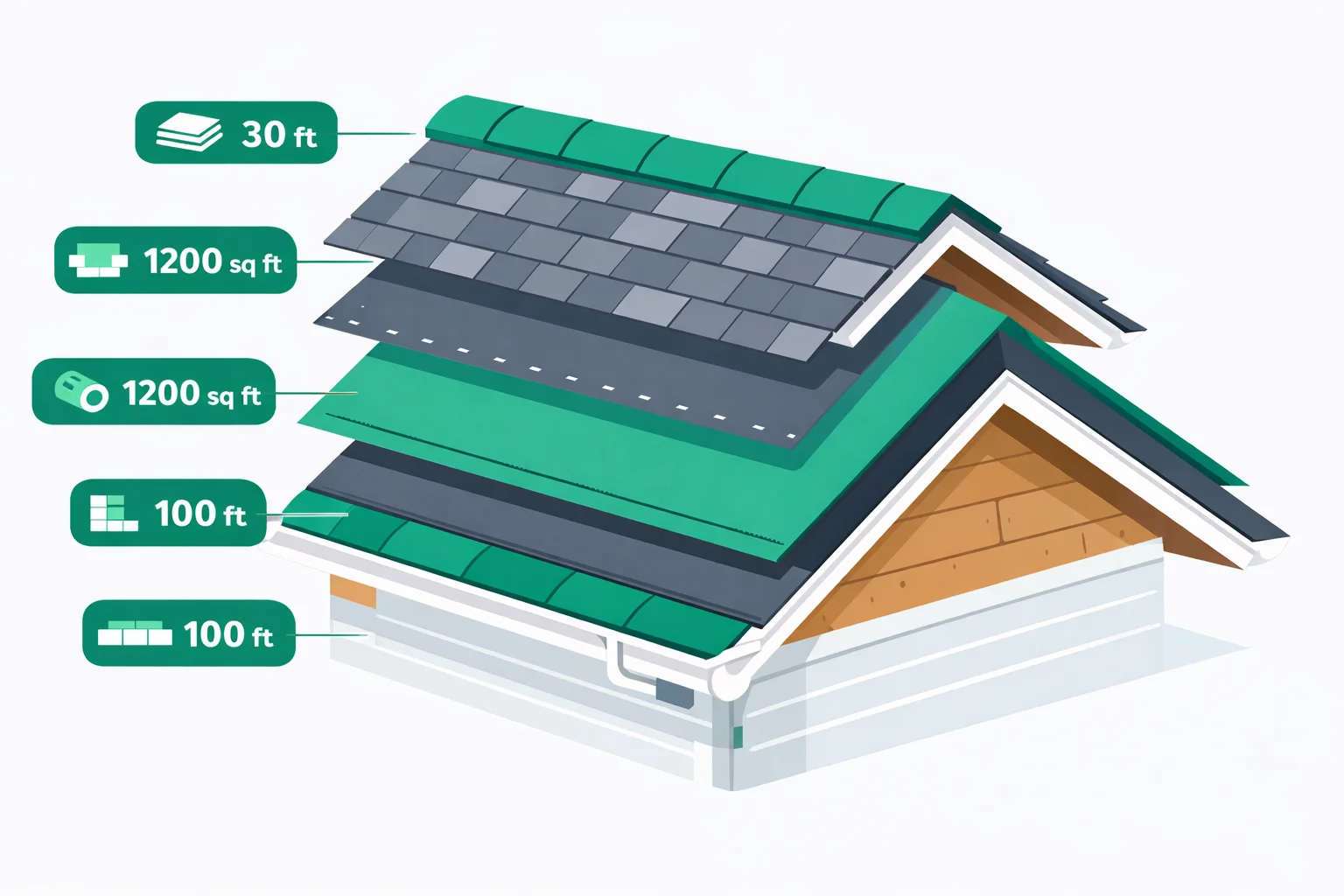
- Synthetic underlayment — goes down first as a water barrier. Modern synthetic rolls cover about 1,000 sq ft and cost $50–$60 each. It replaced felt paper on most residential jobs because it's lighter, doesn't tear as easily, and lies flat even on steep pitches.
- Ice and water shield — self-adhesive membrane applied along eaves (the first 3 feet up from the edge) and around valleys. Required by code in freeze-thaw climates. Roughly $90–$100 per 75 sq ft roll.
- Drip edge — metal flashing along the roof perimeter that channels water into the gutter. Sold in 10-foot sections for about $6–$10 each. You need enough to line the entire eave and rake edges.
- Ridge caps — specially cut shingles that cover the ridge line where two slopes meet. One bundle covers about 25 linear feet. Hip roofs need more because each hip is also a ridge.
- Starter strip — the adhesive first course along eaves that seals the bottom edge of the first shingle row against wind uplift. About $25–$30 per bundle, each covering 100+ linear feet.
- Roofing nails — coil or bulk. Four per shingle is standard; six for high-wind zones. A 50-lb box (roughly 7,200 nails) covers about 22 squares at standard nailing.
- Ridge vent — allows attic air to escape along the ridge. Sold in 4-foot sections. Proper ventilation extends shingle life by preventing heat buildup and ice dams. Our rafter calculator or truss calculator can help you size the framing that supports the roof deck and ventilation system.
Waste Factors by Roof Shape
Waste factor is the single biggest variable in roofing estimates, and getting it wrong means either running short or overspending. The shape of your roof determines how much material ends up as scrap.
| Roof Shape | Waste Factor | Why |
|---|---|---|
| Simple Gable | 10–12% | Only ridge cuts and starter trimming |
| Hip Roof | 15% | Four hip lines create angled cuts with scrap on every course |
| Cross Gable | 15–18% | Valleys require mitered shingles, more scrap per valley |
| Complex (dormers, turrets) | 18–22% | Frequent direction changes, small sections, lots of trimming |
| Mansard / Gambrel | 15–20% | Multiple slope transitions, each one a cutting line |
A quick rule of thumb: count the number of valleys and hips on your roof. Each one adds about 1–2% to your waste factor on top of the base 10%.
Labor Costs vs. DIY: What to Expect
Roofing labor runs $2–$5 per square foot of roof area, depending on your market, the pitch, and complexity. That breaks down roughly like this:
- Tear-off: $1–$1.50/sq ft — removing the old roof is messy, heavy work
- Installation: $1.50–$3/sq ft — laying underlayment, shingles, and flashing
- Steep-slope surcharge: add $0.50–$1/sq ft for anything above 8/12 pitch
- Second story: add $0.25–$0.75/sq ft for safety equipment and ladder time
DIY roofing is doable on a single-story gable at 6/12 or less, but it's physically brutal work. A crew of three roofers can strip and re-shingle a 20-square roof in 2 days. Solo, that same job takes a week or more — and you're exposed to weather the entire time. Most homeowners save 40–50% on labor doing it themselves, but the risk of injury, voided material warranties, and weather delays make professional installation the smarter bet for most roofs.
Common Roofing Mistakes That Blow Your Budget
- Using footprint area instead of roof area. This is the #1 ordering mistake. A 6/12 pitch adds 12% more area. On a 2,000 sq ft footprint, that's 236 extra sq ft — about 7 more shingle bundles you didn't account for ($294 in architectural shingles).
- Skipping the starter strip. Without it, the first row of shingles has no adhesive seal and the bottom edge becomes a wind entry point. A $28 bundle of starter strip prevents a $500 wind-damage repair.
- Forgetting ice and water shield. In freeze-thaw climates, ice dams push meltwater under shingles at the eave. The IRC building code Section R905.1 requires ice barrier protection in areas where the average January temperature is 25°F or below.
- Underestimating waste on complex roofs. Every valley, hip, and dormer means angled cuts with scrap. Ordering at 10% waste for a hip roof with two dormers will leave you 5–8 bundles short — and a partial pallet costs more per bundle than the original order.
- Mixing shingle batches. Color varies slightly between manufacturing runs. Order all your shingles at once and verify the lot numbers match. A mismatched section is visible from the street and can't be fixed without tearing off an entire slope.
When to Use This Calculator
- Before calling contractors — knowing your material quantities lets you compare quotes on a level playing field. If a bid lists 75 bundles for a 15-square roof, you know something's off.
- Planning a DIY roofing project — get a printable shopping list with exact quantities for the hardware store so you're not making multiple trips
- Comparing material options — use the comparison table to see how switching from 3-tab to architectural or metal changes your total budget
- Budgeting a new build — pair this with our construction calculator to estimate the full material cost of a house
- Insurance claims — if you're filing for storm damage, having an independent material estimate helps you verify the adjuster's numbers