Framing Calculator: How to Estimate Studs, Plates, and Lumber for Any Wall
A framing calculator tells you exactly how many studs, plates, and headers you need before you drive the first nail. That matters because lumber is both expensive and heavy — ordering 15% too many 2x4s means hauling back unused boards, and ordering 10% too few means a second trip that kills your schedule. Whether you're building a single partition wall or framing an entire house, getting the count right upfront saves real money and real time.
What Is Wall Framing?
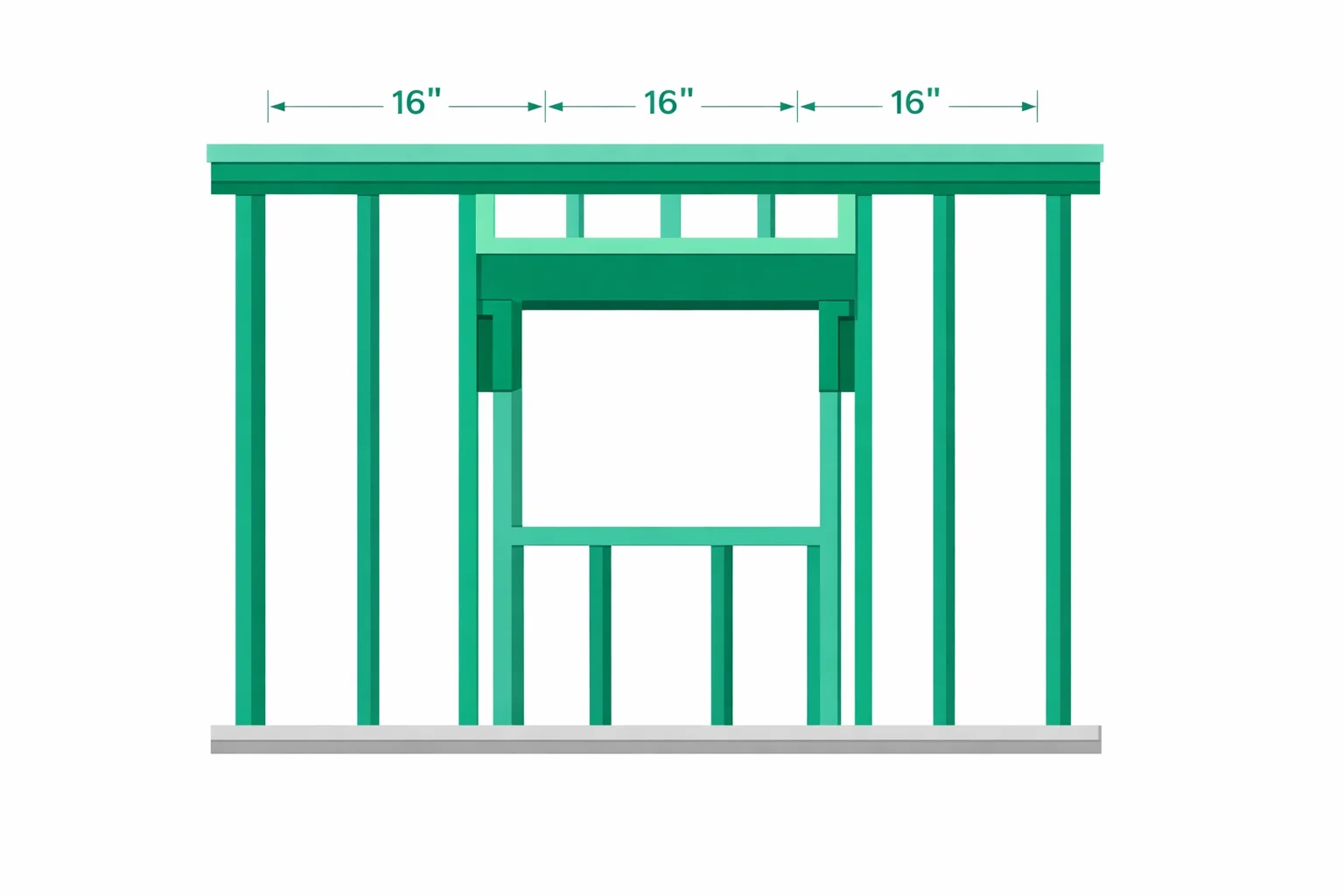
Wall framing is the skeleton of every stick-built home. Vertical studs carry the weight of the roof and upper floors down to the foundation, while horizontal plates tie the studs together at the top and bottom. The framing also defines where doors and windows go — every opening requires extra components (king studs, jack studs, headers, and cripple studs) to reroute structural loads around the hole.
Most residential framing in North America uses dimensional lumber — 2x4s for interior partitions and many exterior walls, or 2x6s where deeper insulation cavities or greater structural capacity are needed. The International Residential Code (IRC) specifies minimum stud sizes, spacing, and bracing requirements by climate zone and building height.
Anatomy of a Framed Wall
Every framed wall shares the same basic parts, regardless of length or height:
- Bottom plate (sole plate): One horizontal board laid flat on the subfloor. It anchors the studs and gets nailed or bolted to the floor system below.
- Top plates: One or two horizontal boards across the stud tops. Load-bearing walls require a double top plate so overlapping joints can tie intersecting walls together. Non-load-bearing partitions can use a single top plate.
- Field studs: The regularly spaced vertical members — typically 16 or 24 inches on-center (OC) — that run from bottom plate to top plate.
- King studs: Full-height studs on each side of a door or window opening. They're part of the regular layout but must be positioned exactly at the edges of the rough opening.
- Jack studs (trimmers): Shorter studs nailed to the king studs that support the header. Their height equals the rough opening height.
- Headers: Doubled horizontal members spanning an opening, sized to carry the load above. Width depends on span — a 3-foot door might use a doubled 2x6, while a 6-foot window needs a doubled 2x10 or 2x12.
- Cripple studs: Short studs above the header (filling to the top plate) and below the sill of a window. They maintain the regular stud spacing for sheathing and drywall attachment.
The Stud Count Formula
The basic stud count formula is straightforward:
Field studs = (wall length in inches ÷ stud spacing) + 1
That "+1" accounts for the starting stud at one end. A 10-foot wall (120 inches) at 16-inch spacing gives you (120 ÷ 16) + 1 = 8.5, rounded down to 8 studs. At 24-inch spacing, the same wall needs (120 ÷ 24) + 1 = 6 studs — a 25% reduction.
But field studs are only part of the story. You also need to add:
- 3 studs per corner — an L-shaped or U-shaped assembly that provides nailing surfaces for both intersecting walls and drywall backing.
- 2 king studs + 2 jack studs per opening — the structural frame around every door and window.
- Then subtract any field studs that would have fallen within the opening width, since the opening replaces them.
Once you know stud count, plate count is simple: one bottom plate and one or two top plates, each running the full wall length. Use our construction calculator if you need a full-project material estimate covering framing, drywall, roofing, and more.
Worked Example: 12-Foot Wall With a Window
Let's walk through a real calculation. You're framing a 12-foot exterior wall, 8 feet tall, with one 36-inch-wide window:
Step 1 — Field studs: 144 inches ÷ 16" OC = 9, plus 1 = 10 field studs.
Step 2 — Opening studs: The 36-inch window displaces about 1 field stud (one would have fallen inside the opening). Add 2 king studs and 2 jack studs. Net change: +3 studs.
Step 3 — Cripple studs: One cripple above the header and one below the sill (maintaining 16" OC spacing across the opening width). That's 2 cripple studs.
Step 4 — Plates: Double top plate + bottom plate = 3 plates × 12 feet = 36 linear feet of plate material. That's 3 boards at 12-foot length (or 4 boards if you can only find 10-footers and need to splice).
Step 5 — Header: Doubled 2x6 header, each piece 42 inches long (36" opening + 3" bearing on each side) = 2 header pieces.
Totals before waste: 12 studs + 2 cripples + 3 plates + 2 header pieces = 19 pieces. With 10% waste: 21 pieces. At $3.98 each for 2x4 lumber, that's roughly $84 for this wall section.
Stud Spacing: 16" vs. 24" On-Center
Spacing choice affects cost, structural strength, and insulation options. Here's a direct comparison for a 20-foot wall at 8-foot height:
| Factor | 16" OC | 24" OC |
|---|---|---|
| Stud count | 16 studs | 11 studs |
| Board feet (studs) | 85.3 BF | 58.7 BF |
| Lumber cost (studs) | ~$64 | ~$44 |
| Insulation cavities | 15 bays (14.5" wide) | 10 bays (22.5" wide) |
| Thermal bridging | Higher (more wood) | Lower (less wood) |
| Code approval | All walls | Interior partitions only* |
*Some energy codes now allow 24" OC on exterior walls when using 2x6 lumber — this "advanced framing" or "OVE" (Optimum Value Engineering) approach reduces lumber by up to 30% and improves insulation coverage. Check with your local building department before committing to 24" OC exterior framing.
Headers, Jack Studs, and Cripple Studs
Openings are where framing gets interesting — and where most DIYers make mistakes. The header must span the opening and transfer loads to the jack studs on each side. Jack studs transfer those loads down to the bottom plate and into the floor system.
Here's a quick header sizing reference for single-story, load-bearing walls:
| Opening Width | Header Size | Typical Use |
|---|---|---|
| Up to 3 ft | Doubled 2x6 | Standard interior door |
| 3 - 5 ft | Doubled 2x8 | Wide window, patio door |
| 5 - 7 ft | Doubled 2x10 | Sliding glass door, picture window |
| 7 - 10 ft | Doubled 2x12 | Garage door, wide opening |
Cripple studs maintain the stud spacing above and below the opening so drywall and sheathing have nailing surfaces at regular intervals. They're short, but don't skip them — drywall without backing at the right spacing will crack at the joints.
Board Feet and Lumber Costs
Lumber yards price framing stock by the piece, but understanding board feet helps you compare costs across different sizes and lengths. One board foot equals a volume of 1 inch × 12 inches × 12 inches, or 144 cubic inches.
For a 2x4 stud that's 8 feet long: (2 × 4 × 8) ÷ 12 = 5.33 board feet. A 2x6 of the same length contains (2 × 6 × 8) ÷ 12 = 8.0 board feet — 50% more lumber by volume, which explains the higher price. Need an exact board footage total for a lumber order? Our board foot calculator handles multi-piece lumber lists with cost estimates by species.
As of 2025, standard SPF (spruce-pine-fir) 2x4 studs run $3-5 per 8-foot board at big-box retailers. Douglas fir and southern yellow pine cost 10-20% more. Prices swung wildly during 2021-2023 — a 2x4 that cost $3 in 2019 peaked at $10+ before settling back down. Always check current prices and buy in bulk if your lumber yard offers a volume discount (most do for orders over 100 pieces).
Common Framing Mistakes That Cost Extra
Mistakes during framing get buried behind drywall, but they still cause problems years later. Here are the expensive ones:
- Forgetting the waste factor: Ordering exact quantities guarantees a second trip. Warped boards, miscuts, and damaged ends eat 10-15% of every delivery. On a $2,000 lumber order, that's $200-300 worth of boards you can't use.
- Wrong stud spacing on exterior walls: Framing an exterior wall at 24" OC without checking code can mean tearing it apart during inspection. The re-framing labor alone runs $500-1,000 per wall — far more than the studs you "saved."
- Undersized headers: A header that's too small for its span will sag over time, cracking drywall and jamming doors and windows. Upgrading a header after drywall is a $300-500 fix.
- Skipping cripple studs: Drywall screwed to nothing cracks at the joints within a year. Patching drywall seams over every window in the house costs $50-100 per opening in materials and time.
If you're planning the foundation that sits under these walls, run the numbers through our concrete slab calculator before your pour date to make sure the slab dimensions match your framing layout.
When to Use This Calculator
- Before placing a lumber order — get an accurate piece count and board footage total so you order enough without blowing your budget on extras.
- When bidding a framing job — contractors can plug in wall dimensions to generate a quick material takeoff for estimates and proposals.
- Comparing 2x4 vs. 2x6 walls — toggle between lumber sizes to see the cost difference and decide where the extra insulation depth is worth the investment.
- Planning a room addition or partition — even a single wall needs accurate counts when you factor in door openings, corners, and plate boards.