Construction Calculator: How to Estimate Materials and Costs for Any Building Project
A construction calculator turns your project's square footage into a concrete shopping list — literally. Instead of guessing how many studs, drywall sheets, or shingle bundles you'll need, you punch in dimensions and get itemized quantities with cost estimates for every construction phase. Whether you're a homeowner planning a new build, a contractor bidding a job, or a DIYer framing an addition, accurate material estimation is the difference between staying on budget and blowing past it by 20%.
What Is a Construction Calculator?
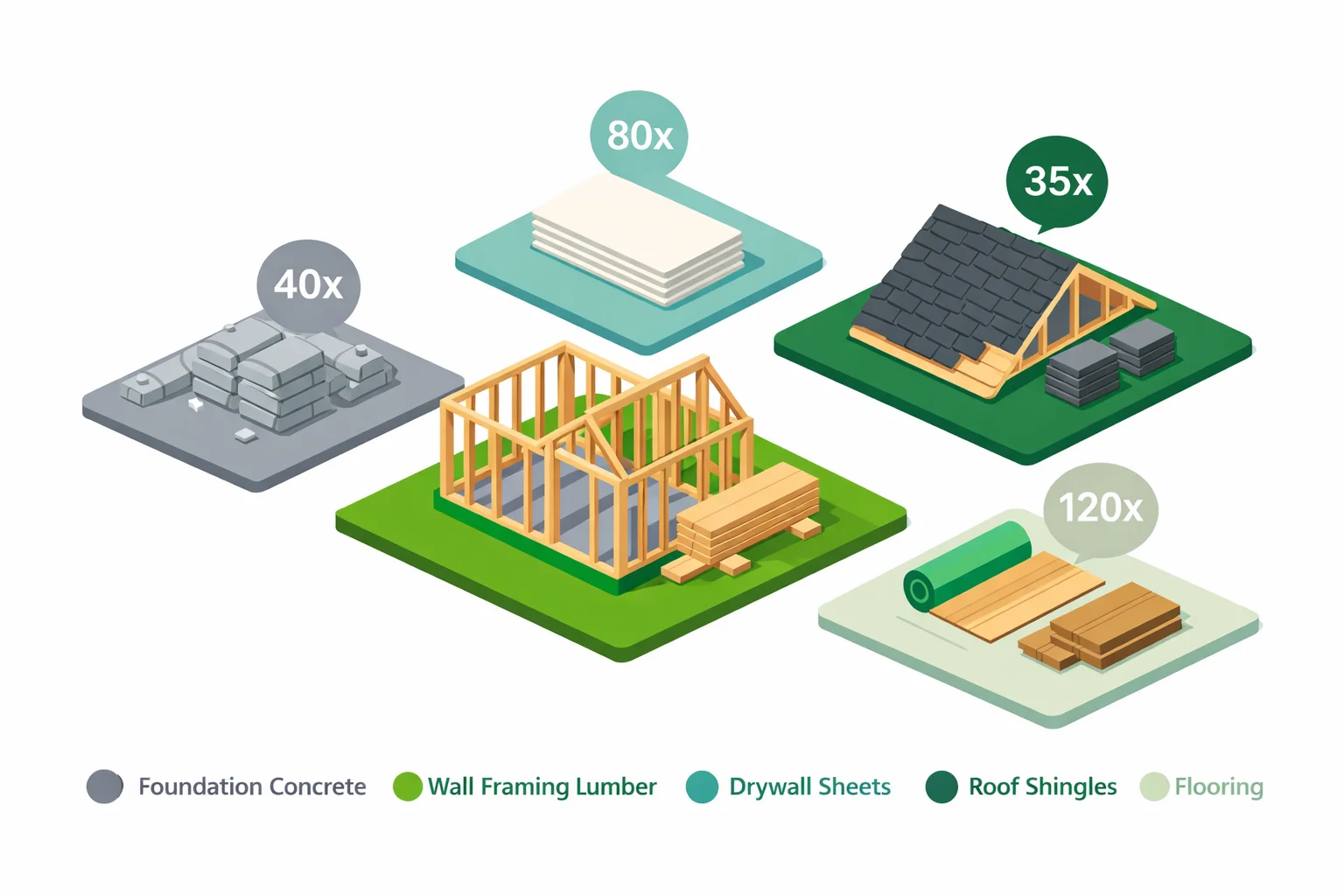
A construction calculator is a material takeoff tool that converts building dimensions into quantities of lumber, concrete, drywall, roofing, and flooring. Professional estimators call this a "quantity takeoff" or MTO (material takeoff) — the foundation of every construction bid. Our calculator handles five phases in one pass: foundation concrete, wall framing, drywall, roofing, and finish flooring.
The critical difference between a rough guess and a proper takeoff? Waste factors. Raw calculations tell you the theoretical minimum — but cuts don't fall neatly, pieces crack, and measurements drift. That's why every quantity gets multiplied by a waste factor (typically 10-15%) before you place your order. Skip this step, and you'll make at least one emergency trip to the lumber yard mid-project.
The Five Phases of Material Estimation
Residential construction follows a predictable sequence. Each phase has its own materials, its own math, and its own pitfalls.
- Foundation: Concrete volume depends on the foundation type. A 4-inch slab needs about 1.23 cubic yards per 100 sq ft, plus footings around the perimeter. Basements triple the concrete because you're pouring 8-foot walls and a floor.
- Framing: Wall studs at 16" on center work out to roughly 1 stud per linear foot of wall. Don't forget the three plates per wall (double top, single bottom) plus headers over every door and window opening.
- Drywall: Both sides of every interior wall plus ceilings. A 2,000 sq ft home typically needs 170-200 sheets of 4×8 drywall, plus joint compound and tape.
- Roofing: Roof area equals the footprint multiplied by a pitch factor (a 4/12 pitch adds about 12%). Three bundles of shingles cover one roofing square (100 sq ft).
- Flooring: Usually the simplest calculation — total square footage plus a 10% waste factor — but costs swing wildly between vinyl plank ($2/sq ft) and hardwood ($8-12/sq ft).
If you need detailed calculations for just one of these phases, try our cubic yard calculator for foundation concrete or our square footage calculator to nail down room dimensions before estimating materials.
Worked Example: 2,000 Sq Ft Ranch Home
Here's what the numbers look like for a single-story, 2,000 sq ft ranch on a slab foundation with standard-quality materials and a 10% waste factor:
- Footprint: 2,000 sq ft (single story, so footprint = living area)
- Perimeter: ~179 ft (assuming a roughly square layout — 4 × √2,000)
- Foundation: ~27 cubic yards of concrete (slab + footings) — about $4,200
- Framing: ~315 studs + 120 plates + 26 header pieces — about $2,900
- Drywall: ~188 sheets + compound and tape — about $3,200
- Roofing: ~74 shingle bundles + underlayment + ridge caps — about $3,000
- Flooring: ~110 boxes of standard flooring — about $7,700
Grand total for materials: roughly $21,000 at standard quality. Jump to premium materials and that climbs to about $29,000. Go economy and you're closer to $17,000. These are material costs only — labor typically adds 40-60% on top, and that varies heavily by region.
Material Cost Reference Table
Material prices fluctuate with lumber markets and supply chains, but these ranges give you a realistic planning baseline for 2025-2026:
| Material | Unit | Economy | Standard | Premium |
|---|---|---|---|---|
| Ready-mix concrete | cu yd | $125 | $155 | $215 |
| 2×4 stud (8 ft) | each | $4.40 | $5.50 | $7.70 |
| Drywall sheet (4×8) | sheet | $12 | $15 | $21 |
| Asphalt shingles | bundle | $28 | $35 | $49 |
| Flooring (LVP/hardwood) | box (~20 sq ft) | $40 | $65 | $110 |
Prices sourced from national home improvement retailer averages. Your local market may run 10-20% higher or lower depending on proximity to distribution centers and regional demand. Check current pricing at your local supply house before committing to a budget — lumber prices alone can swing 30% in a single quarter.
Waste Factors: Why You Always Need More
Every experienced contractor builds waste into their estimate. Here's why 10-15% isn't padding — it's math:
- Cutting waste: A 12-foot wall needs a full 16-foot board. That 4-foot offcut often can't be reused. Drywall sheets get trimmed around outlets, windows, and odd corners.
- Breakage and defects: Framing lumber arrives bowed or split about 5% of the time. Drywall corners crack during transport. Shingles tear in high winds before you nail them down.
- Measurement drift: Framing isn't perfect. Walls end up 1/4" out of square, and that compounds across 200 linear feet. Better to have spare material than re-order mid-project.
The real cost of running short isn't just the material — it's the project delay. A crew standing idle while you wait on a delivery costs $500-$1,000 per day in lost labor. That $150 worth of "extra" drywall is cheap insurance.
Common Material Estimation Mistakes
These errors cost homeowners and contractors thousands of dollars every year. Most are avoidable with basic math.
- Forgetting interior walls: A 2,000 sq ft home has about 120 linear feet of interior partition walls in addition to the exterior perimeter. That's 120+ extra studs, plates, and double the drywall (both sides). Missing this can undercount framing by 30-40%.
- Ignoring the roof pitch: A flat-roof estimate for a home with a 6/12 pitch understates the roof area by 12%. On a 2,000 sq ft footprint, that's 240 sq ft of missing roofing — about 7 bundles of shingles you didn't order.
- Using the wrong concrete thickness: Confusing a 4-inch residential slab spec with a 6-inch commercial spec inflates your concrete order by 50%. That's 12 extra cubic yards at $155 each — $1,860 in unnecessary concrete.
- Pricing based on last year's costs: Lumber prices swung from $350 to $1,700 per thousand board feet between 2020 and 2022. Always get current quotes within 30 days of your pour or delivery date.
DIY vs. Contractor Material Ordering
Contractors get trade discounts — typically 10-25% below retail — but they also mark up materials 15-30% when they pass costs to you. So the net price you pay through a contractor is often within 5-10% of what you'd pay buying materials yourself.
The real advantage of contractor ordering isn't price. It's accuracy and logistics. An experienced framer knows exactly how many jack studs, king studs, and cripples a window opening needs. They'll order one delivery with everything staged in the right sequence. DIY builders often end up making 3-4 smaller orders as they discover what they missed.
If you're ordering yourself, use this calculator's material takeoff as your starting point, then refine it with your actual floor plan dimensions. The area calculator can help you measure irregular room shapes before plugging into the construction estimate.
Tips for Accurate Construction Estimates
- Measure twice, literally. Walk every wall with a tape measure and record dimensions. Don't rely on architectural plans alone — as-built dimensions can differ by inches, and inches matter when you're ordering sheets of material cut to 4-foot widths.
- Get 3 concrete quotes. Ready-mix concrete pricing varies $20-40 per cubic yard between suppliers, and delivery fees add $100-200 per truck. On a 30-yard pour, that difference is $600-$1,200.
- Buy commodity materials in bulk. Studs, drywall, and shingles are commodity items — full-pallet pricing saves 5-15% over buying individual units. Most lumber yards deliver free above $1,500 orders.
- Stage material deliveries. Don't order everything at once. Foundation materials first, framing lumber second (after the slab cures), then interior materials. This prevents weather damage and job-site theft.
- Keep 5% of budget as contingency. Even the best takeoff misses something. A 5% contingency fund on a $20,000 material budget ($1,000) covers the surprises that don't show up until you open a wall or dig a footing.
When to Use This Calculator
This construction calculator is built for early-stage planning — the point where you need realistic numbers but don't yet have detailed blueprints. Use it when:
- Budgeting a new build: Before you talk to a contractor, know what materials alone will cost. It gives you leverage in negotiations and helps you spot inflated bids.
- Comparing foundation types: A basement adds $8,000-15,000 in concrete over a slab. This calculator shows you exactly how much, so you can decide whether the extra living space is worth the foundation cost.
- Planning a home addition: Plug in just the addition's square footage to estimate materials for that phase of work.
- Verifying a contractor's bid: If a contractor quotes $35,000 for materials on a 2,000 sq ft home, compare it against this calculator's estimate. A 50% discrepancy in either direction is a red flag worth investigating.
For more precise single-phase estimates, check the volume calculator for concrete and excavation volumes, or watch for our upcoming framing calculator and roofing calculator — both will offer deeper material-level detail for those specific construction phases.