How to Size Electrical Conduit Per NEC Code
A conduit fill calculator takes the guesswork out of one of the most code-critical steps in any electrical installation: figuring out how many wires you can legally run through a given conduit. Get it wrong, and you're pulling wires back out during inspection. Get it right the first time, and the job goes smooth. The National Electrical Code (NEC) devotes an entire chapter to conduit fill limits, and the math isn't hard once you know where the numbers come from.
NEC Conduit Fill Rules Explained
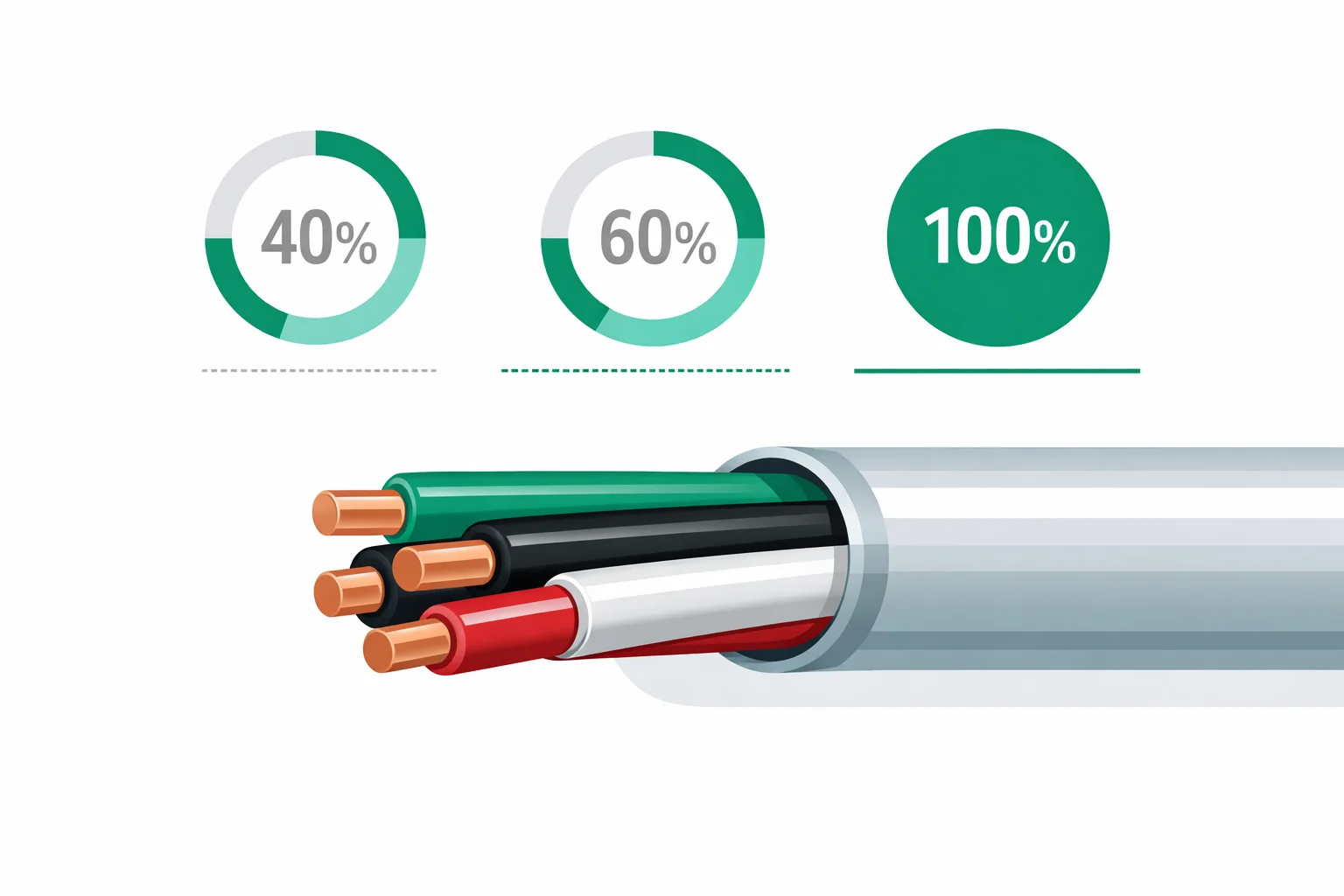
NEC Chapter 9, Table 1 sets three fill thresholds based on how many conductors you're pulling. One conductor gets 53% of the conduit's internal area. Two conductors drop to 31%. Three or more? You're limited to 40%. Those numbers feel arbitrary until you understand the reasoning.
A single wire naturally centers itself inside the conduit, so it can safely take up more space. Two wires stack side by side, and the 31% limit accounts for the dead space between two circles inside a larger circle. Three or more wires pack more efficiently but generate more combined heat, so the 40% cap keeps temperatures within insulation ratings and leaves enough room to pull wires without damaging them. Overfilled conduit is a fire hazard and an inspection failure — there's no wiggle room on these limits.
The Conduit Fill Formula Step by Step
The calculation itself is straightforward once you have two pieces of data: your conduit's internal area (NEC Table 4) and each wire's insulated cross-sectional area (NEC Table 5). Here's the process:
- Look up conduit area. Find your conduit type and trade size in NEC Chapter 9, Table 4. For 3/4" EMT, the total internal area is 0.533 in².
- Apply the fill percentage. For three or more wires: 0.533 × 0.40 = 0.2132 in² of allowable fill.
- Add up wire areas. Each 12 AWG THHN wire is 0.0133 in². Four wires: 4 × 0.0133 = 0.0532 in².
- Compare. Total wire area (0.0532 in²) ≤ allowable fill (0.2132 in²)? You pass.
When you're running mixed wire sizes — say three 12 AWG and one 10 AWG ground — you add each wire's area individually. The 40% rule applies regardless, since mixed sizes always means three or more total conductors.
Conduit Types Compared: EMT vs RMC vs PVC
Conduit choice affects fill capacity more than most people realize. At the same trade size, internal areas differ significantly because wall thickness varies. Here's a side-by-side at 1" trade size:
| Conduit Type | Internal Area (in²) | 40% Fill (in²) | Max 12 AWG THHN |
|---|---|---|---|
| EMT | 0.864 | 0.346 | 26 |
| IMC | 0.959 | 0.384 | 28 |
| RMC | 0.887 | 0.355 | 26 |
| PVC Sch 40 | 0.832 | 0.333 | 25 |
| PVC Sch 80 | 0.688 | 0.275 | 20 |
PVC Schedule 80 loses the most capacity because its thicker walls eat into the interior. That's 6 fewer 12 AWG wires compared to IMC at the same trade size. If you're borderline on fill, switching from Schedule 80 to EMT can sometimes eliminate the need to upsize. You can also check material costs with our construction calculator to weigh the trade-offs.
Common Wire Fill Reference Table
Electricians memorize a handful of common fill counts for quick job-site estimation. This table covers the most frequent combinations using THHN/THWN-2 wire (the industry standard for conduit pulls):
| Conduit (EMT) | 14 AWG | 12 AWG | 10 AWG | 8 AWG | 6 AWG |
|---|---|---|---|---|---|
| 1/2" | 12 | 9 | 5 | 3 | 2 |
| 3/4" | 22 | 16 | 10 | 5 | 4 |
| 1" | 35 | 26 | 16 | 9 | 6 |
| 1-1/4" | 61 | 44 | 28 | 16 | 11 |
| 1-1/2" | 83 | 61 | 38 | 22 | 16 |
| 2" | 138 | 100 | 63 | 36 | 26 |
These counts assume all conductors are the same size (the 40% rule for 3+ wires). For a run with just one or two wires, the maximums are different. And remember — the equipment grounding conductor counts toward fill too, which trips up a surprising number of apprentices.
Worked Example: Sizing a 20A Branch Circuit
Say you're running a 20-amp branch circuit from a panel to a junction box, roughly 80 feet away. You need two 12 AWG THHN current-carrying conductors (hot and neutral) plus a 12 AWG THHN equipment ground. That's 3 conductors total.
Each 12 AWG THHN wire: 0.0133 in². Total wire area: 3 × 0.0133 = 0.0399 in². The fill rule for 3+ wires is 40%. A 1/2" EMT conduit has 0.304 in² total area, giving you 0.304 × 0.40 = 0.1216 in² allowable. Since 0.0399 < 0.1216, you pass with 1/2" EMT. In fact, you're only using about 13% of the conduit — plenty of room if you need to add a circuit later.
Now what if the spec calls for two separate 20A circuits sharing the same conduit? That's six 12 AWG THHN wires. Wire area: 6 × 0.0133 = 0.0798 in². Still under 0.1216 in², so 1/2" EMT still works for six 12 AWG THHN conductors. But bump that up to 10 AWG for a longer run, and each wire jumps to 0.0211 in². Six 10 AWG wires: 6 × 0.0211 = 0.1266 in². That exceeds the 1/2" EMT limit of 0.1216 in² — you'd need to upsize to 3/4" (0.2132 in² allowable). Tools like our rebar calculator handle similarly detailed material sizing when working on the structural side of the job.
Mistakes That Fail Inspection
Conduit fill violations are among the most common electrical inspection failures. Here's what to watch for:
- Forgetting the ground wire. Equipment grounding conductors count toward fill. A run with three 12 AWG hots plus a 12 AWG ground is four wires, not three. The areas still add up the same way — there's no exemption for grounds.
- Using the wrong wire area. A 12 AWG THHN wire is 0.0133 in², but a 12 AWG RHW-2 is 0.0260 in² — nearly double. Mixing up insulation types means your actual fill is higher than calculated. Always verify the wire type stamped on the jacket.
- Ignoring derating. NEC 310.15(C)(1) requires ampacity derating when more than 3 current-carrying conductors share a conduit. You might pass fill calculations but still need to upsize wire gauge for thermal reasons, which changes the fill calculation too.
- Not accounting for conduit bends. Fill rules don't change for bends, but more bends means harder pulls. A run with three 90-degree bends will jam wires that would pull easily through a straight run at the same fill percentage. Experienced electricians keep fill well below 40% on runs with multiple bends.
Conduit Nipples and Special Cases
Not every conduit run follows the standard 40% rule. A conduit nipple — any run 24 inches or shorter between two enclosures — is allowed 60% fill per NEC 376.22. That 50% increase in allowable area can make the difference between a 3/4" nipple and a 1" nipple when connecting a panel to a gutter.
Short nipples don't generate meaningful heat buildup, and wires don't need to be pulled far, so the physics support the relaxed limit. Just make sure you document the measurement — inspectors will verify that 24-inch threshold with a tape measure.
Another edge case: if you're running a single conductor in a conduit (rare, but it happens with large feeders), you get 53% fill. Two conductors: 31%. That 31% figure catches people off guard because it's actually lower than the three-wire rule. The geometry of two circles inside a larger circle creates more wasted space than you'd expect.
Tips From the Field
- Size up one trade size on long runs. Technically, a 200-foot run of 3/4" EMT at 38% fill is code-compliant. In practice, pulling wires through that run is brutal. Going to 1" costs a few extra dollars but saves hours of labor and reduces the chance of insulation damage during the pull.
- Use THHN/THWN-2 whenever possible. Its thinner insulation means smaller cross-sectional area per wire, which directly translates to more wires per conduit. Compared to RHW-2, THHN lets you fit roughly 30-40% more conductors in the same conduit.
- Plan for future circuits. If there's any chance an additional circuit might share this conduit later, upsize now. Pulling new conduit after drywall is 5-10x more expensive than going one size bigger during rough-in.
- Keep a wire fill chart on your phone. The quick reference table above covers 90% of residential and light commercial scenarios. For complex jobs with mixed wire sizes, use this calculator to verify exact compliance before ordering material.
- Check your jurisdiction. Some local codes are stricter than the NEC. Always verify whether your AHJ (Authority Having Jurisdiction) has amended the conduit fill percentages or added additional requirements. Use our stair calculator for another example of how local code amendments can change acceptable dimensions.
When to Use This Calculator
- Bidding a job. Accurate conduit sizing prevents material waste and change orders. Oversizing costs money; undersizing costs more in rework.
- Rough-in planning. Before cutting and bending conduit, verify that your planned sizes accommodate all conductors for every run, including future expansion.
- Inspection prep. Run your fill calculations before the inspector arrives. Having the numbers ready (and printed) shows professionalism and speeds approvals.
- Retrofit or addition work. Adding circuits to existing conduit? Enter the current wires plus the new ones to see if you can reuse the existing run or need to pull a parallel conduit.