Board Foot Calculator: How Lumber Is Actually Measured, Priced, and Ordered
A board foot calculator converts lumber dimensions into the standard volume unit that sawmills, hardwood dealers, and lumber yards use to price wood. If you've ever stood at a lumber counter confused by the difference between "board feet" and "linear feet," you're not alone — the system dates back to colonial-era timber trade and it trips up professionals and hobbyists alike. This guide breaks down the formula, shows you exactly how to calculate board footage for any lumber size, and covers the pricing and waste factors that determine what you actually spend.
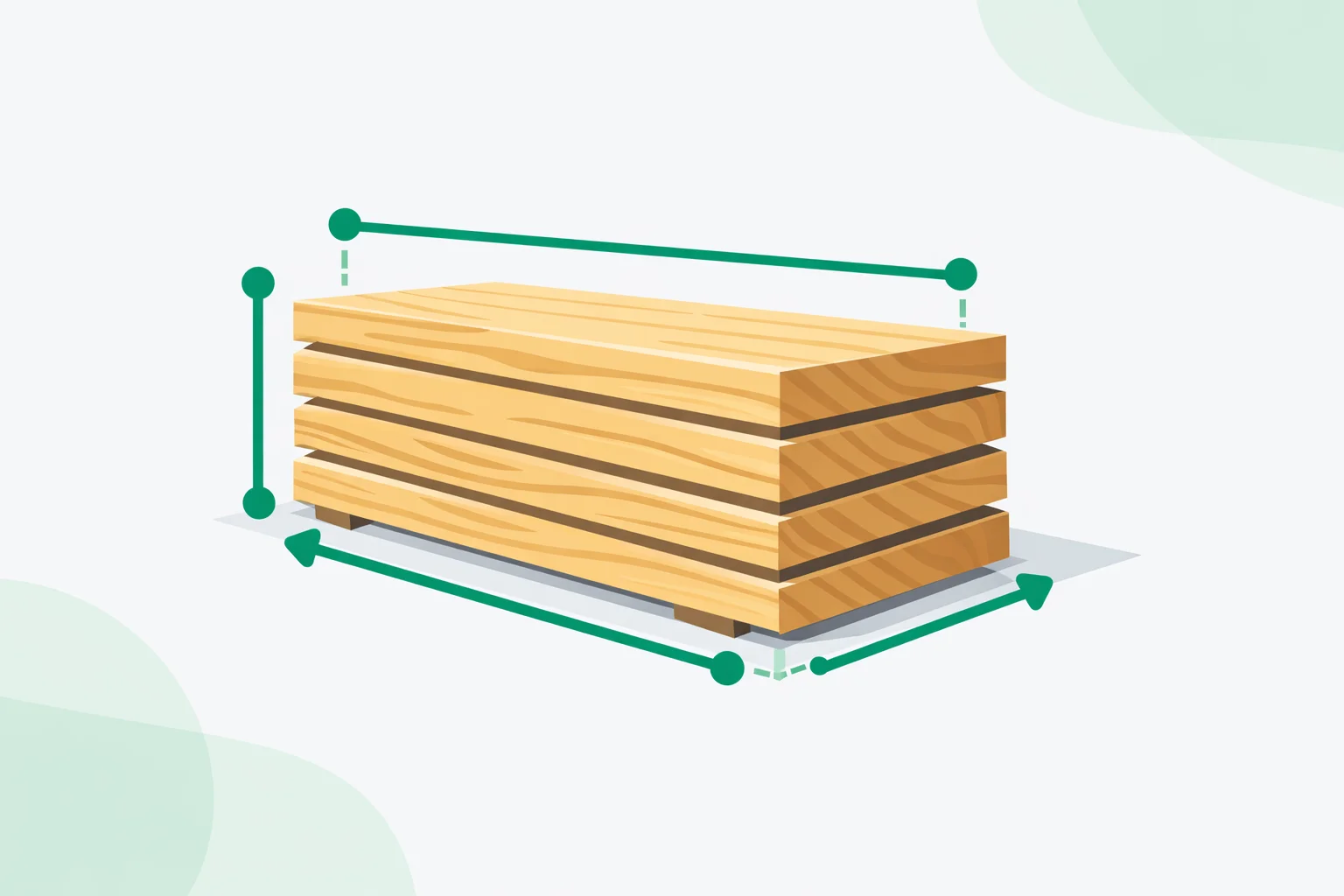
What Is a Board Foot?
One board foot equals 144 cubic inches of wood. Picture a plank 1 inch thick, 12 inches wide, and 12 inches long — that's your baseline. The measurement exists because lumber comes in wildly different thicknesses and widths, and you need a common unit to compare prices fairly. A 2×4 and a 1×12 might cost the same per linear foot, but the 2×4 contains significantly less wood per foot of length.
Softwood framing stock (2×4s, 2×6s) is usually sold by the piece or per linear foot at big-box stores. Hardwoods — oak, maple, walnut, cherry — are almost always priced per board foot. If you're buying rough lumber from a mill, board footage is the only language they speak.
The Board Foot Formula (With Worked Examples)
The formula is straightforward:
Board Feet = (Thickness × Width × Length) ÷ 12
Thickness and width are in inches, length in feet. That's it. Let's run through three real scenarios.
Example 1 — Framing lumber:You're buying 20 pieces of 2×6 at 10 feet long. Each piece: (2 × 6 × 10) ÷ 12 = 10 board feet. Total: 10 × 20 = 200 board feet. At $4/BF, that's $800 worth of lumber before tax.
Example 2 — Hardwood for a bookshelf: You need 6 boards of 1×8 red oak at 6 feet. Each piece: (1 × 8 × 6) ÷ 12 = 4 board feet. Total: 4 × 6 = 24 board feet. At $6.50/BF for red oak, that's $156 in material — plus 20% waste for jointing and cutoffs brings the order to about 29 BF ($189).
Example 3 — Thick slab for a table top: One 3-inch-thick walnut slab, 18 inches wide, 7 feet long. (3 × 18 × 7) ÷ 12 = 31.5 board feet. At $12/BF for kiln-dried walnut, that single slab costs $378. Suddenly you understand why live-edge tables are expensive.
Board Feet vs. Linear Feet vs. Square Feet
These three measurements confuse people constantly, so here's the cheat sheet:
| Unit | Measures | Accounts For | Used For |
|---|---|---|---|
| Board Foot | Volume | Thickness + Width + Length | Hardwood pricing, mill orders |
| Linear Foot | Length only | Length (ignores size) | Trim, molding, per-piece pricing |
| Square Foot | Area | Width + Length | Flooring, paneling, coverage |
A quick conversion: for 1-inch-thick lumber, board feet and square feet are identical numbers. For thicker stock, divide board feet by the thickness to get square feet of coverage. So 100 board feet of 2-inch-thick oak gives you 50 square feet of tabletop material. If you need help with area calculations for a project, our square footage calculator handles rooms, irregular shapes, and material coverage.
Nominal vs. Actual Dimensions — Which to Use
Here's a detail that catches first-time buyers: a "2×4" doesn't actually measure 2 inches by 4 inches. After kiln drying and planing, it's 1.5 × 3.5 inches. The industry has used nominal dimensions (the rough-sawn size before milling) for board foot calculations since long before anyone alive today was born, and that's not changing.
Always use nominal dimensions for board foot math.When you tell a lumber yard you need 100 board feet of 2×6, they know exactly what you mean. If you calculated using actual dimensions (1.5 × 5.5), your numbers won't match their invoices and you'll end up confused at the counter.
The one exception: rough-sawn lumber from a small mill that hasn't been planed. If you're buying a board that truly measures 2 inches thick because it hasn't been surfaced yet, the nominal and actual dimensions happen to match. But most lumber you'll encounter at retail has been surfaced (S4S — surfaced four sides), so nominal rules apply.
Lumber Pricing by Species
Lumber prices fluctuate with supply, demand, and the general chaos of commodity markets — but species-to-species ratios stay fairly stable. Here's what to expect in 2025-2026:
| Species | Price Range (per BF) | Common Uses |
|---|---|---|
| SPF (Spruce/Pine/Fir) | $2 – $4 | Framing, sheathing, utility |
| Poplar | $2.50 – $4.50 | Paint-grade trim, shelving, drawers |
| Soft Maple | $3.50 – $5.50 | Furniture, cabinets, turning |
| Red Oak | $4.50 – $7 | Furniture, flooring, cabinets |
| Hard Maple | $5 – $8 | Cutting boards, flooring, workbenches |
| White Oak | $5.50 – $9 | Outdoor furniture, boats, whiskey barrels |
| Cherry | $6 – $10 | Fine furniture, cabinetry |
| Walnut | $8 – $14 | Furniture, gun stocks, accent pieces |
| Teak / Exotic | $15 – $30+ | Outdoor furniture, marine, specialty |
Rough lumber (unsurfaced) typically costs 20-30% less than S4S at the same yard. If you have a planer and jointer, buying rough saves real money on large orders. A $500 order of S4S red oak might cost $350-375 as rough — that gap adds up over a year of projects.
Waste Factors for Different Projects
No project uses 100% of the lumber you buy. Between defects, knots, sapwood, checking, jointing, and plain old miscuts, a chunk of every board goes to the scrap bin. The right waste factor depends on what you're building:
- Framing (10%): Studs and plates are cut to standard lengths with minimal waste. Warped boards and miscuts account for most of it.
- Decking and fencing (10-15%): Standard-length boards with some cuts for corners, angles, and damaged ends.
- Furniture and cabinetry (20-30%): You're jointing edges, ripping to width, cutting around knots, and matching grain. Hardwood waste stacks up fast.
- Hardwood with specific grain matching (25-35%): If you need bookmatched panels or continuous grain across multiple boards, you'll reject more material than you keep.
- Turning and carving (30-50%): Blanks are rough-cut oversized, then most of the wood becomes shavings. A 6-inch-diameter bowl from an 8-inch blank wastes over 40% of the material.
When planning material for a framing project, our framing calculator builds waste directly into the stud count and gives you a ready-to-order piece list.
How to Order Lumber from a Mill or Yard
Buying from a hardwood dealer or sawmill is different from picking boards at the home center. Here's what you need to know:
Thickness notation:Mills use the "quarter" system. 4/4 (four-quarter) means 1 inch thick rough. 5/4 is 1.25 inches, 6/4 is 1.5, 8/4 is 2 inches. After surfacing, 4/4 finishes to about 13/16 inch, and 8/4 finishes to about 1-3/4 inches.
Width and length vary.Unlike dimensional lumber at the big box stores, hardwood boards from a mill come in random widths and lengths. You might order 100 board feet of 4/4 cherry and get boards ranging from 4 to 10 inches wide and 6 to 12 feet long. Some mills let you specify minimums (e.g., "6 inches and wider, 8 feet and longer") for a small premium.
Moisture content matters. Kiln-dried (KD) lumber runs 6-8% moisture content and is ready to use in furniture. Air-dried (AD) sits around 12-15% and needs time to acclimate in your shop — or a trip through your own kiln. Green lumber from a portable mill can be 30%+ and will warp, check, and shrink substantially as it dries. The USDA Forest Products Laboratorypublishes detailed drying schedules if you're kiln-drying your own stock.
Common Board Foot Mistakes That Cost You Money
- Using actual dimensions instead of nominal: Calculating a 2×6 as 1.5 × 5.5 instead of 2 × 6 underestimates by 31%. On a 200 BF order, that means arriving at the yard expecting to pay $1,200 and getting invoiced for $1,740. Awkward.
- Forgetting the waste factor: Ordering exactly the board footage your cut list requires guarantees a second trip. For hardwood projects, add 25% minimum. Running short on walnut at $12/BF doesn't just cost money — the next batch might not color-match.
- Mixing up board feet and linear feet: Telling a mill you need "50 feet of 2×8" when you mean 50 board feet will get you 50 linear feet — which is actually 66.7 board feet. That's a 33% overorder and a surprise on the receipt.
- Ignoring thickness when comparing prices: A hardwood dealer selling 8/4 walnut for $14/BF is actually cheaper per piece than another dealer selling 4/4 walnut for $10/BF once you account for the doubled thickness. Board feet normalize this comparison automatically — that's the whole point of the unit.
If you're estimating lumber alongside concrete, rebar, and other construction materials, our construction calculator gives you a full project material breakdown with cost estimates.
When to Use This Calculator
- Before a hardwood lumber order — total up your cut list in board feet so you order the right amount with waste factor built in.
- When comparing lumber prices — different dealers quote different ways (per board foot, per piece, per linear foot). Converting everything to board feet makes the comparison honest.
- Planning a woodworking project budget — multiply board footage by species price to get a realistic material cost before you commit to a design.
- Selling or buying rough lumber — if you're milling your own trees or buying from a portable mill operator, board feet is how both parties agree on quantity and price.