How Long Will My Savings Last? Withdrawal Rates, Inflation, and Retirement Math
A savings withdrawal calculator answers the most stressful question in retirement planning: how long will my money actually last? Most people spend decades saving without ever modeling what happens when the deposits stop and the withdrawals start. The math works differently in reverse — your portfolio has to grow fast enough to replace what you pull out each month while inflation quietly raises the bar every year. Get the withdrawal rate wrong by even 1%, and you could run dry five to eight years earlier than expected.
What Is a Savings Withdrawal Calculator?
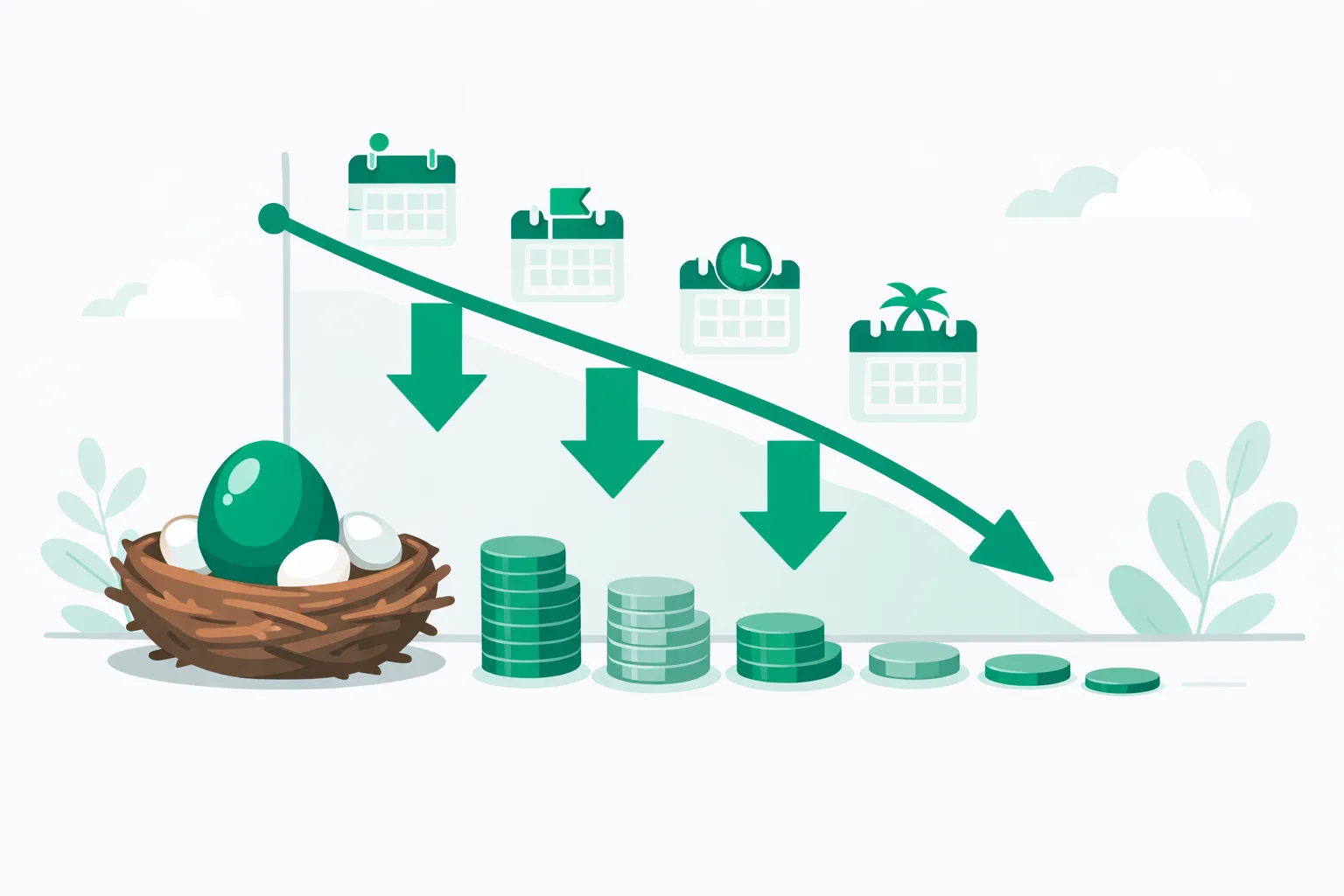
It's a tool that simulates your retirement savings declining over time as you take regular withdrawals. You plug in your nest egg, monthly spending, expected investment returns, and inflation rate — and it tells you the month and year your balance hits zero. Unlike a simple division (savings ÷ monthly spending), this calculator accounts for the fact that your remaining balance keeps earning returns while you withdraw. That investment growth can extend your money's lifespan dramatically. A $500,000 portfolio with zero returns lasts about 14 years at $3,000/month. Add 5% annual returns, and that same portfolio stretches past 22 years.
The Withdrawal Rate Formula
Your withdrawal rate is simply how much you pull out each year as a percentage of your starting balance. The formula:
Withdrawal Rate = (Annual Withdrawal ÷ Total Savings) × 100
If you have $800,000 and withdraw $32,000 per year ($2,667/month), your withdrawal rate is 4%. Here's where it gets tricky: that $32,000 buys less every year because of inflation. At 3% inflation, you'll need $32,960 in year two, $33,949 in year three, and $43,000 by year ten just to maintain the same purchasing power. So your effectivewithdrawal rate climbs over time even if you think you're sticking to 4%.
Walk through a quick example. You retire with $600,000 and need $2,500 per month ($30,000/year). That's a 5% withdrawal rate. Your portfolio earns 5% annually, and inflation runs at 3%. In year one, you withdraw $30,000 and earn $28,500 in returns (5% on the declining balance). By year five, inflation has pushed your annual withdrawal to $34,778, but your balance has already dropped to about $495,000. The returns no longer keep up with the withdrawals, and the gap accelerates from there. The compound interest calculator shows how growth works in your favor during accumulation — but during withdrawal, compounding works in reverse.
The 4% Rule — Does It Still Work?
Financial planner William Bengen introduced the 4% rule in 1994 after studying every 30-year retirement period from 1926 to 1992. His finding: a retiree who withdrew 4% in year one and adjusted for inflation each year never ran out of money in any historical period, assuming a 50/50 stock-bond portfolio.
The rule still holds up as a rough guideline, but it has blind spots. It was calibrated to U.S. market returns during a century that included massive economic expansion. Today's bond yields are lower than the historical average, and many researchers now suggest 3.3% to 3.5% is safer for a 30-year horizon. If you're retiring at 55 instead of 65, you need your money to last 35-40 years — and that pushes the safe rate closer to 3%.
| Withdrawal Rate | Annual Income ($500K) | Approximate Longevity | Risk Level |
|---|---|---|---|
| 3% | $15,000 | 40+ years | Very conservative |
| 3.5% | $17,500 | 33-38 years | Conservative |
| 4% | $20,000 | 28-33 years | Moderate |
| 4.5% | $22,500 | 23-27 years | Moderate-aggressive |
| 5% | $25,000 | 19-23 years | Aggressive |
| 6% | $30,000 | 14-17 years | High risk |
Assumes 5% annual return, 3% inflation, withdrawals adjusted annually for inflation.
How Inflation Erodes Retirement Savings
Inflation is the silent killer of retirement plans. Most people focus on investment returns and withdrawal amounts, but a retiree spending $4,000/month today will need $5,375/month in 10 years at 3% inflation — and $7,225/month in 20 years. That's an 80% increase in spending just to buy the same groceries, pay the same utilities, and cover the same healthcare.
Here's what makes it dangerous: even a small change in inflation has an outsized impact. At 2% inflation, $500,000 with $3,000/month withdrawals (adjusted annually) lasts about 25 years. Bump inflation to 4% and the same setup runs dry in roughly 19 years — six years sooner. You can use our savings calculator to model the accumulation phase, but understanding withdrawal-phase inflation is equally critical. The Bureau of Labor Statistics CPI data tracks actual inflation trends if you want to stress-test with historical numbers.
5 Factors That Determine How Long Your Money Lasts
- Starting balance. Every additional $100,000 adds roughly 3-5 years to your timeline at a 4% withdrawal rate. The difference between $400K and $600K is about 8 years of additional income.
- Withdrawal rate. Dropping from 5% to 4% adds 5-10 years of portfolio life. It's the single highest-impact lever you control.
- Investment returns. The difference between 4% and 6% annual returns adds approximately 7-10 years to your savings at a 4% withdrawal rate. But chasing higher returns means more volatility, which introduces sequence-of-returns risk.
- Inflation. At 3% inflation, your withdrawals double in purchasing power terms every 24 years. At 4%, they double every 18 years. If you don't adjust for inflation, you maintain your nominal spending but your lifestyle slowly degrades.
- Supplemental income. Social Security, pensions, rental income, or part-time work all reduce the amount you pull from savings. Even $1,500/month in Social Security with a $500,000 portfolio effectively makes it behave like a $950,000 portfolio.
Withdrawal Strategies Beyond the 4% Rule
The 4% rule is a fixed-percentage approach — simple, but rigid. Several alternatives adapt to market conditions and can extend your money further:
The guardrails method. Set a base withdrawal rate (say 4.5%) with upper and lower guardrails at 5.5% and 3.5%. If market gains push your effective rate below 3.5%, give yourself a raise. If losses push it above 5.5%, cut spending. This approach lets you spend more in good years while protecting the portfolio in bad ones.
The bucket strategy. Split your portfolio into three buckets: 1-2 years of expenses in cash or money market funds, 3-7 years in bonds, and the rest in stocks. You spend from the cash bucket, refilling it from bonds, and refilling bonds from stocks. This prevents selling equities during a downturn — the number one portfolio killer in retirement.
The percentage-of-portfolio method. Withdraw a fixed percentage (say 4%) of your currentbalance each year, not the original balance. Your income fluctuates with the market — you get more in good years and less in bad years — but you literally cannot run out of money because you're always taking a percentage of what remains.
Costly Retirement Withdrawal Mistakes
- Ignoring inflation entirely. Retirees who withdraw a flat $4,000/month for 25 years lose roughly 45% of their purchasing power. That $4,000 buys only $2,200 worth of today's goods by year 25.
- Front-loading spending. Many new retirees spend heavily in the first 3-5 years (travel, home projects, gifts). Pulling $6,000/month from a $500,000 portfolio for just 3 years burns through $216,000 — leaving only $284,000 to fund the remaining 25+ years. That often isn't recoverable.
- Not accounting for taxes. Withdrawals from traditional 401(k)s and IRAs are taxed as ordinary income. If you need $5,000/month after tax and you're in the 22% bracket, you actually need to withdraw about $6,410. That pushes a 4% rate to effectively 5.1%.
- Withdrawing during a market crash. Selling investments when the market is down 30% locks in losses permanently. Two years of withdrawals during a crash can shorten portfolio life by 5-8 years compared to holding cash reserves. The high-yield savings calculator can help you plan a cash buffer that earns competitive interest while protecting your portfolio.
Social Security Timing and Your Withdrawal Plan
When you claim Social Security directly affects how much you need from your portfolio. At 62, you get a reduced benefit — about 30% less than your full retirement age (FRA) amount. Wait until 70, and your benefit is 24% higher than FRA. For someone with an FRA benefit of $2,500/month, that's the difference between $1,750/month (claiming at 62) and $3,100/month (claiming at 70).
The tradeoff: claiming later means withdrawing more from savings during the gap years. But the math usually favors waiting. According to the Social Security Administration, each year you delay past FRA adds an 8% permanent increase to your benefit — a guaranteed return no investment can match. If you can bridge the gap by withdrawing 5-6% for a few years, the higher lifetime benefit often more than compensates.
When to Use This Calculator
- Pre-retirement planning (5-10 years out): Test whether your current savings trajectory will support your target spending. If the numbers don't work, you still have time to save more or adjust expectations.
- Deciding when to retire: Run scenarios at ages 60, 62, 65, and 67 to see how a few more years of saving (and fewer years of withdrawing) change the outcome.
- Setting a withdrawal budget: Use the comparison table to find the sweet spot between comfortable monthly income and portfolio longevity.
- Social Security claiming decision: Model the impact of claiming at 62 vs. 67 vs. 70 by adjusting the Social Security field and comparing how long your savings last in each scenario.
- Annual retirement checkup: Each year, update your current balance and spending to make sure you're still on track. If your withdrawal rate has crept above 5%, it's time to reassess.