CD Calculator Guide: How to Project Maturity Value, Compare Terms, and Avoid Penalty Costs
A CD calculator helps you estimate exactly how much your certificate of deposit will be worth at maturity, including total interest earned and the real cost of withdrawing early. Whether you're comparing a 6-month CD at 4.25% APY against a 3-year CD at 4.00%, or deciding between a single large deposit and a CD ladder, knowing the precise dollar difference turns a guessing game into a clear financial decision.
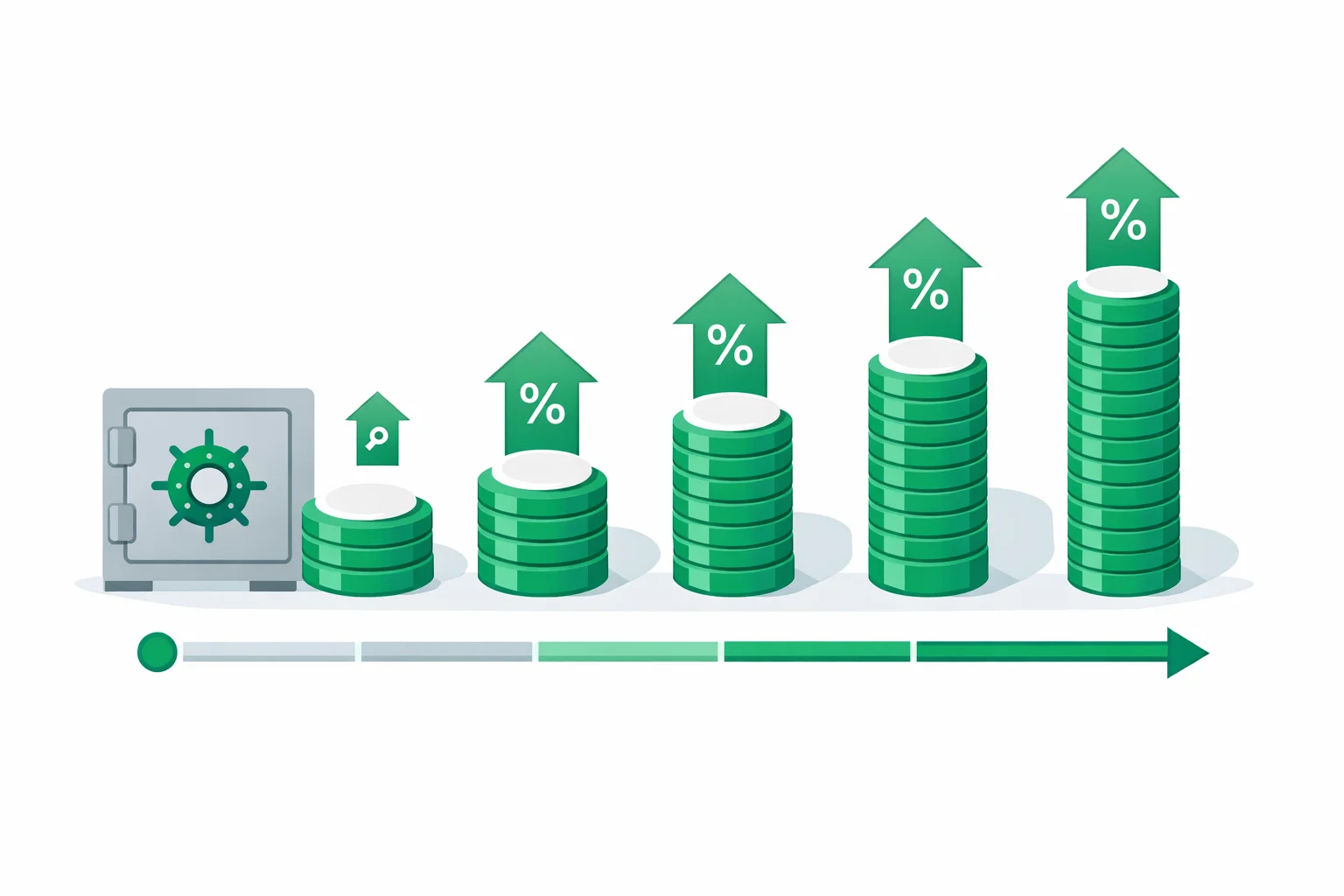
What Is a Certificate of Deposit (CD)?
A certificate of deposit is a time-bound savings product issued by banks and credit unions. You deposit a fixed amount — the principal — for a set term (3 months to 10 years), and the bank pays a guaranteed interest rate in return. Unlike a regular savings account, you agree not to touch the money until the CD matures.
CDs are FDIC-insured up to $250,000 per depositor per institution, making them one of the safest places to park cash you won't need immediately. In exchange for giving up liquidity, CD rates are typically 0.25% to 1.00% higher than even the best high-yield savings accounts. For an even longer time horizon, US savings bondsoffer government-backed returns with state tax exemption — though you'll trade liquidity for up to a 30-year maturity window.
How CD Interest Is Calculated
CD interest uses the compound interest formula: A = P(1 + r/n)nt, where A is the maturity value, P is the principal deposit, r is the annual interest rate (as a decimal), n is the number of compounding periods per year, and t is the term in years.
Worked example: You deposit $25,000 into a 2-year CD at 4.50% APY, compounded daily.
- P = $25,000
- r = 0.045
- n = 365 (daily compounding)
- t = 2 years
- A = 25,000 × (1 + 0.045/365)365×2 = $27,313
- Interest earned: $2,313
Most banks compound CD interest daily but credit it monthly. The APY already factors in compounding, so when comparing CD rates, always use APY rather than the nominal rate. Our APY calculator can help you convert between nominal rates and annual percentage yield.
Key Factors That Affect CD Rates
CD rates don't exist in a vacuum. Several factors determine what APY you'll see when you shop for a CD:
- Federal funds rate: The Fed's benchmark rate directly influences what banks offer. When the Fed raises rates, CD yields follow within weeks.
- CD term length: Longer terms usually pay more, but during inverted yield curves, short-term CDs can actually offer higher rates than 5-year terms.
- Deposit size: Jumbo CDs ($100,000+) sometimes offer 0.10% to 0.25% higher APY than standard CDs at the same bank.
- Bank type: Online banks and credit unions consistently offer 0.50% to 1.00% higher CD rates than traditional brick-and-mortar banks due to lower overhead.
- Market competition: Banks raise CD rates when they need deposits for lending, creating periodic rate spikes you can take advantage of.
Short-Term vs Long-Term CDs: A Real Comparison
Choosing the right CD term is the most important decision. Here's what a $10,000 deposit earns across common terms at current competitive rates:
| CD Term | Typical APY | Interest Earned | Maturity Value |
|---|---|---|---|
| 3 Months | 4.00% | $99 | $10,099 |
| 6 Months | 4.25% | $212 | $10,212 |
| 1 Year | 4.50% | $460 | $10,460 |
| 2 Years | 4.25% | $875 | $10,875 |
| 3 Years | 4.00% | $1,268 | $11,268 |
| 5 Years | 3.90% | $2,125 | $12,125 |
Notice that the 1-year CD currently pays the highest APY — this is an inverted yield curve. In this scenario, a CD ladder or shorter terms may outperform a single long-term CD.
CD Ladder Strategy: Balancing Rate and Flexibility
A CD ladder divides your total deposit across multiple CDs with staggered maturity dates. For example, with $25,000 you'd open five CDs of $5,000 each at 1-year, 2-year, 3-year, 4-year, and 5-year terms. Each year, the shortest CD matures and you reinvest it into a new 5-year CD.
Why it works:You earn higher long-term rates on most of your money while maintaining annual access to 20% of your total deposit. If rates rise, each reinvestment captures the new, higher rate. If rates fall, you've already locked in today's rates on 80% of your funds.
Use our compound interest calculator to model how a CD ladder compares against a single lump-sum CD over 5+ years.
Early Withdrawal Penalties: What They Really Cost
Every CD comes with an early withdrawal penalty (EWP) if you pull your money before the maturity date. The typical penalty structure:
- CDs under 1 year: 3 months of interest ($113 on a $10,000 CD at 4.50%)
- CDs of 1–3 years: 6 months of interest ($225 on the same CD)
- CDs over 3 years: 12 months of interest ($450 on the same CD)
In the worst case, the penalty can eat into your principal. If you open a 12-month CD and withdraw at month 2, you've earned roughly $75 in interest but owe $113 in penalties — a net loss of $38 from your original deposit. This is why you should only put money into a CD that you're confident you won't need before maturity.
CDs vs High-Yield Savings Accounts
The CD vs savings account decision comes down to liquidity vs rate. Here's a quick framework:
- Choose a CD when you have a specific timeline (saving for a down payment in 18 months), want to lock in today's rate before potential cuts, or don't need access to the funds.
- Choose a high-yield savings account when you need an emergency fund with instant access, expect rates to keep rising, or may need the money unexpectedly.
- Use both — keep 3–6 months of expenses in a high-yield savings account for emergencies, and put the rest into CDs or a CD ladder for the higher guaranteed return.
Tax Implications of CD Interest
CD interest is taxed as ordinary income in the year it's earned, regardless of whether you withdraw it. Your bank sends a Form 1099-INTif you earn more than $10 in interest. For a $50,000 CD at 4.50% APY, that's $2,250 in taxable interest — costing $495 to $832 in federal taxes depending on your bracket (22%–37%).
Multi-year CDs are taxed each year on the interest accrued, not just at maturity. If your 3-year CD earns $750 in year one, you owe taxes on that $750 even though you can't touch the money. Consider this cash-flow impact when choosing between short- and long-term CDs.
Tips to Maximize Your CD Returns
- Shop online banks first: Online banks consistently offer 0.50%–1.00% higher APY than traditional banks. A $25,000 CD at 4.50% vs 3.50% earns $250 more per year.
- Watch for promotional rates: Banks periodically offer above-market "CD specials" to attract deposits. These limited-time offers can be 0.25%–0.50% above standard rates.
- Consider credit unions: Credit unions often match or beat online bank CD rates. You may need to meet membership requirements, but many are open to anyone in a specific region.
- Time your CD purchases: Lock in a CD right before an expected Fed rate cut to secure the current higher rate for the full term.
- Use a CD ladder: Splitting your deposit across multiple terms protects against rate changes and gives you regular access to a portion of your funds.
- Check the penalty structure: Some banks offer "no-penalty CDs" with slightly lower rates but zero early withdrawal fees — ideal if you're unsure about your timeline.
When to Use This CD Calculator
- Before opening a CD: Calculate the exact maturity value and interest earned at your bank's offered rate to make sure the return justifies locking up your funds.
- Comparing CD offers: Enter different rates and terms from multiple banks to see which option earns the most interest on your deposit.
- Planning a CD ladder: Use the ladder visualization to see how splitting your deposit across terms affects total returns and liquidity.
- Evaluating early withdrawal: Check the penalty estimate before breaking a CD early — sometimes the penalty makes it smarter to wait.
- Tax planning: Estimate how much CD interest you'll earn in a given year to prepare for the tax impact.