Cylinder Volume Calculator: How to Calculate Capacity for Tanks, Pipes, and Containers
A cylinder volume calculatorlets you find the exact capacity of any cylindrical shape — from water tanks and storage silos to plumbing pipes and concrete columns — in seconds. Whether you're sizing a rainwater collection tank, estimating how much water a well casing holds, or ordering concrete for a round footing, knowing the precise volume saves you from costly over-ordering or frustrating shortages. This guide walks through the formula, worked examples, and practical tips for every common cylinder calculation.
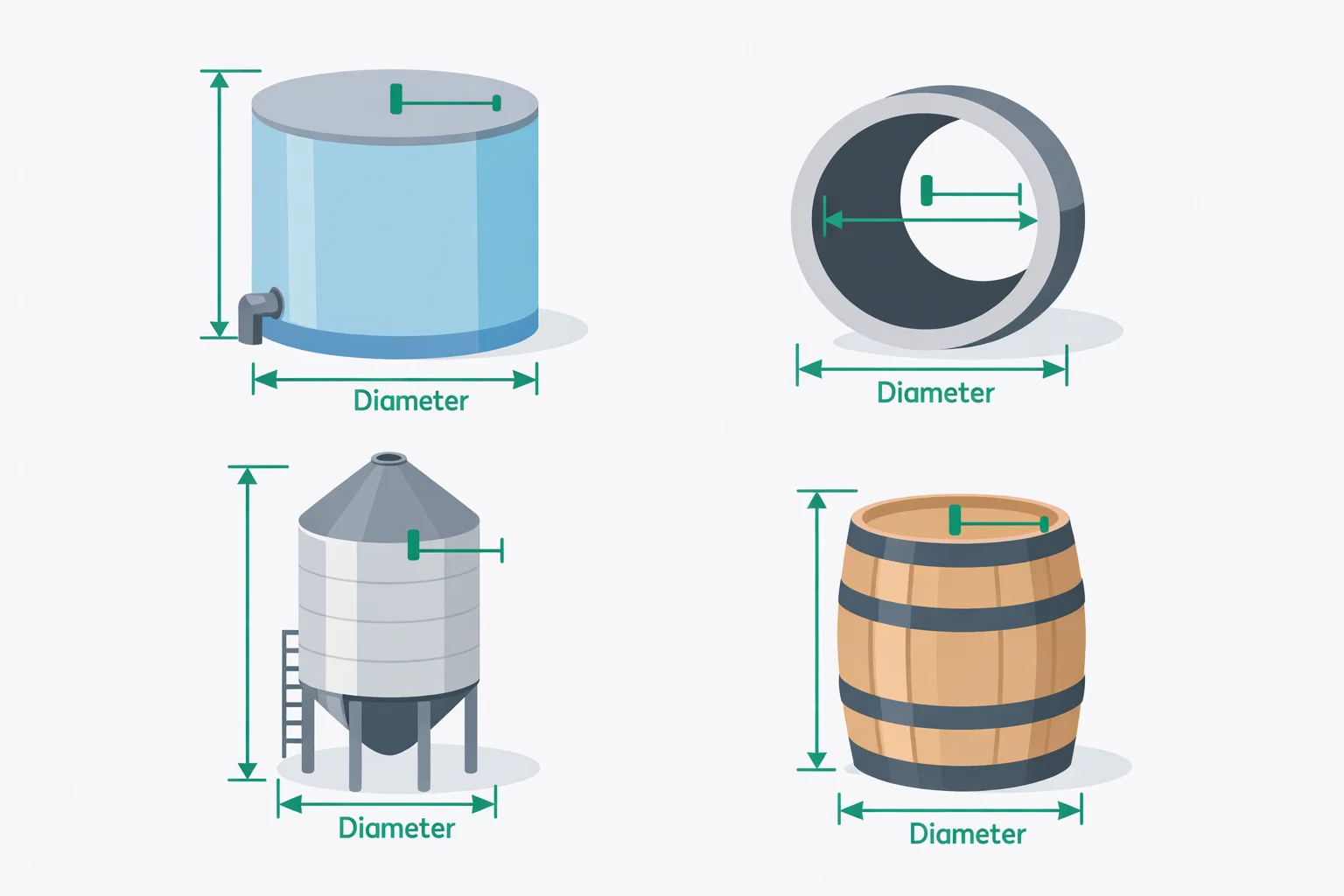
What Is Cylinder Volume?
Cylinder volume is the total three-dimensional space enclosed inside a cylinder. A cylinder is a shape with two parallel circular ends connected by a curved surface — think of a soup can, a pipe, or a water tank. The volume tells you how much material, liquid, or gas the cylinder can hold.
Volume is measured in cubic units (cubic feet, cubic inches, cubic meters). When you need to know liquid capacity, you convert cubic units to gallons or liters. One cubic foot holds 7.48 US gallons — a conversion you'll use constantly when sizing tanks and pipes.
The Cylinder Volume Formula Explained
The formula for cylinder volume is:
V = π × r² × h
Where:
- V = volume
- π (pi) = 3.14159
- r = radius (half the diameter)
- h = height (or length for horizontal cylinders)
The key insight: π × r² gives you the area of the circular base (the same formula used in our area calculator for circles). Multiply that base area by the height, and you get the total volume. If you know the diameter instead of the radius, divide the diameter by 2 first.
Worked Examples with Real Dimensions
Example 1: Water Storage Tank
A vertical water tank is 4 feet in diameter and 6 feet tall. How many gallons does it hold?
- Radius = 4 ÷ 2 = 2 feet
- Volume = 3.14159 × 2² × 6 = 3.14159 × 4 × 6 = 75.40 ft³
- Gallons = 75.40 × 7.48 = 563.99 gallons
That tank holds about 564 gallons — enough to supply a household for roughly 4-5 days of average use.
Example 2: Concrete Pier / Column
You're pouring 8 concrete piers, each 12 inches in diameter and 48 inches deep. How much concrete do you need?
- Radius = 6 inches = 0.5 feet
- Height = 48 inches = 4 feet
- Volume per pier = 3.14159 × 0.5² × 4 = 3.14 ft³
- Total for 8 piers = 3.14 × 8 = 25.13 ft³ = 0.93 cubic yards
- With 10% waste = 1.02 cubic yards
Order 1.1 cubic yards to be safe. Use our cubic yard calculator to convert between cubic feet and yards for material orders.
Example 3: Pipe Capacity
A 2-inch diameter irrigation pipe runs 200 feet. How many gallons of water does it hold?
- Radius = 1 inch = 0.0833 feet
- Volume = 3.14159 × 0.0833² × 200 = 4.36 ft³
- Gallons = 4.36 × 7.48 = 32.63 gallons
Common Cylinder Sizes Reference Table
Use this reference to quickly look up volumes for everyday cylindrical objects:
| Object | Diameter | Height | Volume (ft³) | Gallons |
|---|---|---|---|---|
| 55-Gallon Drum | 22.5" | 33.5" | 7.71 | 55 |
| 5-Gallon Bucket | 11.9" | 14.5" | 0.93 | 7.0 |
| Standard Well Casing (6") | 6" | 50 ft | 9.82 | 73.4 |
| 1,000-Gal Septic Tank | 5 ft | 6.8 ft | 133.5 | 1,000 |
| 4" PVC Pipe (per foot) | 4" | 12" | 0.087 | 0.65 |
| Round Concrete Column (12") | 12" | 4 ft | 3.14 | 23.5 |
Tank and Pipe Volume Calculations
Tanks and pipes are the two most common real-world cylinders homeowners and contractors deal with. Here are the specifics for each:
Vertical tanks (water storage, rain barrels, propane tanks) — measure the outside diameter, subtract the wall thickness × 2 to get the inside diameter, then measure the interior height. Manufacturers often list nominal capacity, but the actual usable capacity is 5-10% less due to fittings and dead space at the bottom.
Horizontal tanks— use the same V = π × r² × h formula where h is the length of the tank. The total capacity is identical to a vertical tank with the same dimensions. However, if you're checking a partially filled horizontal tank, the fill volume depends on the liquid depth — a half-full horizontal tank holds exactly 50% of total capacity.
Pipes — always use the inner diameter(ID), not the outer diameter. A "2-inch pipe" has a nominal 2-inch inner diameter. For long pipe runs, even small measurement errors multiply quickly — a 0.1-inch error in a 4-inch pipe over 500 feet changes the volume by about 10 gallons.
How to Calculate Cylinder Surface Area
Surface area matters when you need to paint a tank, wrap insulation around a pipe, or calculate heat loss. The total surface area formula is:
A = 2πr² + 2πrh
- 2πr² = area of both circular ends
- 2πrh = area of the curved side (lateral area)
For a 3-foot diameter, 5-foot tall tank: A = 2 × 3.14159 × 1.5² + 2 × 3.14159 × 1.5 × 5 = 14.14 + 47.12 = 61.26 sq ft. If you're painting, one gallon of exterior paint covers about 350 sq ft, so this tank needs less than a quart.
For open-top containers (like a rain barrel or pool), subtract one end: A = πr² + 2πrh. Use our volume calculator for other 3D shapes like cones, spheres, and pyramids.
Common Mistakes When Calculating Cylinder Volume
- Using diameter instead of radius — the most frequent error. Using a 4-foot diameter as if it were the radius gives you 4× the correct volume. Always divide the diameter by 2 before plugging it into the formula.
- Mixing units — entering the diameter in inches and the height in feet gives a wildly wrong answer. Convert all measurements to the same unit before calculating. A 24-inch diameter tank that is 5 feet tall must use either 2 feet / 5 feet or 24 inches / 60 inches.
- Using outer diameter for pipes— pipe sizes refer to nominal inner diameter. A "1-inch" Schedule 40 PVC pipe actually has an inner diameter of 1.049 inches. Using the outer diameter (1.315 inches) overstates volume by 57%.
- Forgetting wall thickness on tanks — a steel tank with ¼-inch walls has an interior diameter ½ inch smaller than the exterior. On a 24-inch tank, that reduces volume by about 4%.
Tips for Accurate Cylinder Measurements
- Measure diameter in 3 spots and average them — tanks and pipes are rarely perfectly round, especially older ones. Checking top, middle, and bottom catches any taper or warping.
- Use a tape measure across the openingfor the most accurate diameter. If you can't access the opening, wrap a flexible tape around the circumference and divide by 3.14159 to get the diameter.
- For buried tanks or wells, check the manufacturer specs or well log — the casing diameter is recorded at installation. Common residential well casings are 4-inch or 6-inch diameter.
- Add 10% for concrete orders — spillage, uneven ground, and slight overdigging always consume more than the calculated volume. Ordering exactly the calculated amount almost always leaves you short.
- For partially filled tanks, only measure the liquid depth, not the total tank height. Use that depth as your "h" value to calculate how much is currently inside.
When to Use This Calculator
- Sizing water storage — determine how many gallons a cistern, rain barrel, or tank holds before purchasing.
- Ordering concrete — calculate cubic yards needed for round footings, piers, columns, or cylindrical forms.
- Estimating pipe capacity — find out how much water sits in your plumbing, irrigation lines, or drain pipes.
- Planning paint or insulation — use the surface area results to estimate material coverage for cylindrical surfaces.
- Checking fuel tank capacity — verify propane, heating oil, or diesel tank volumes against manufacturer claims.