Cubic Feet Calculator: How to Measure Volume for Storage, Shipping, and Construction
A cubic feet calculator lets you find the volume of any space or object by entering its dimensions — length, width, and height. Whether you're sizing a storage unit, figuring out how much soil to order for a raised garden bed, or determining if a piece of furniture fits in your moving truck, knowing the cubic footage gives you a precise number to work with instead of guessing.
What Is a Cubic Foot?
A cubic foot (ft³) is a unit of volume that represents a cube measuring 1 foot on each side. Picture a box that is 12 inches long, 12 inches wide, and 12 inches tall — that's exactly one cubic foot. It contains 1,728 cubic inches, holds about 7.48 US gallons of water, and weighs roughly 62.4 pounds when filled with water.
Cubic feet are the standard volume measurement in the United States for appliances (refrigerator capacity), shipping (box dimensions), HVAC (airflow in CFM), storage units, and bulk materials like mulch and gravel. Understanding cubic footage helps you compare capacities, order the right amount of material, and avoid paying for space you don't need.
How to Calculate Cubic Feet
The basic formula for cubic feet is:
Volume (ft³) = Length (ft) × Width (ft) × Height (ft)
Measure all three dimensions in the same unit, then multiply them together. If your measurements are in inches, multiply all three and divide the result by 1,728. If in meters, multiply by 35.3147 to convert cubic meters to cubic feet.
Worked example: A moving box measures 24 inches long, 18 inches wide, and 18 inches tall. First multiply: 24 × 18 × 18 = 7,776 cubic inches. Then divide by 1,728: 7,776 ÷ 1,728 = 4.5 cubic feet. This tells you the box holds 4.5 ft³ of contents — useful when estimating how many boxes fit in a moving truck.
Second example: A room is 12 feet long, 10 feet wide, with 8-foot ceilings. Volume = 12 × 10 × 8 = 960 cubic feet. An HVAC technician uses this number to size the right air conditioner — most systems need to cycle the entire room volume about 6 times per hour.
Cubic Feet Formulas by Shape
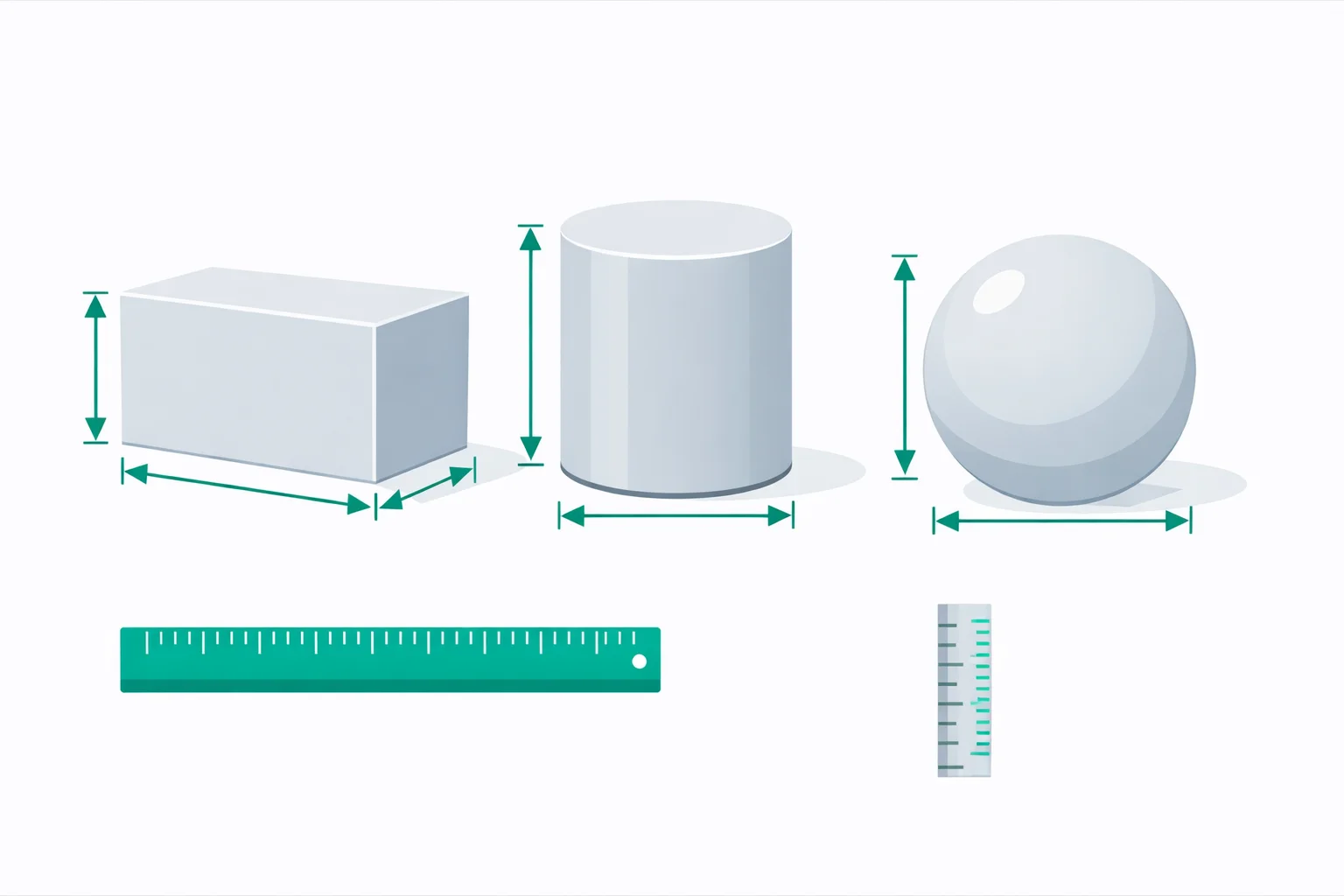
Not everything is a box. Here are the formulas for common shapes with all dimensions measured in feet:
- Box / Rectangular prism: Length × Width × Height
- Cylinder: π × (Diameter ÷ 2)² × Height — use this for round tanks, pipes, and barrels
- Sphere: (4/3) × π × (Diameter ÷ 2)³ — use this for balls, globes, and domed shapes
- Cone: (1/3) × π × (Diameter ÷ 2)² × Height — use this for tapered containers and hoppers
Cylinder example: A round water tank is 3 feet in diameter and 4 feet tall. Radius = 1.5 ft. Volume = 3.14159 × 1.5² × 4 = 28.27 cubic feet, which holds about 211 gallons of water. For other shapes and more complex solids, try our volume calculator which handles pyramids, ellipsoids, and irregular forms.
Common Cubic Footage Reference Sizes
These reference numbers help you estimate quickly without measuring:
| Item | Approximate Cubic Feet |
|---|---|
| Standard moving box (1.5 cu ft) | 1.5 |
| Large moving box (3.0 cu ft) | 3.0 |
| Extra-large wardrobe box | 6.0 |
| Mini fridge | 3.5 – 4.5 |
| Standard refrigerator | 22 – 28 |
| Front-load washing machine | 4.0 – 5.0 |
| Pickup truck bed (standard 6.5 ft) | ~62 |
| 5×5 storage unit (8 ft ceiling) | 200 |
| 10×10 storage unit (8 ft ceiling) | 800 |
| 10×20 storage unit (8 ft ceiling) | 1,600 |
| 20-foot shipping container | 1,169 |
| 40-foot shipping container | 2,385 |
Use these benchmarks to compare your calculated volume against real-world objects. If your total is 780 cubic feet, you know a 10×10 storage unit (800 ft³) will just barely fit everything — but a 10×15 unit gives breathing room.
Converting Cubic Feet to Other Units
Depending on the project, you may need your volume in a different unit. Here are the most common conversions:
- Cubic inches: Multiply cubic feet by 1,728. A 2 ft³ box = 3,456 cubic inches — useful for packaging and small parts.
- Cubic yards: Divide cubic feet by 27. A 135 ft³ garden bed needs 5 cubic yards of soil. Landscaping suppliers and cubic yard calculators price materials by the yard.
- Cubic meters: Multiply cubic feet by 0.0283. A 1,000 ft³ room = 28.3 cubic meters — common in international shipping and scientific contexts.
- US gallons: Multiply cubic feet by 7.481. A 10 ft³ fish tank holds about 74.8 gallons.
- Liters: Multiply cubic feet by 28.317. A 5 ft³ cooler holds about 141.6 liters.
Cubic Feet for Storage and Moving
Moving companies price trucks by cubic footage, not square footage. A 10-foot rental truck holds about 402 cubic feet, a 15-footer holds 764 ft³, and a 26-footer holds 1,611 ft³. To estimate your move:
- Studio apartment: 150–300 ft³ — fits a 10-foot truck
- 1-bedroom apartment: 300–600 ft³ — fits a 12-to-15-foot truck
- 2-bedroom home: 600–1,000 ft³ — fits a 15-to-17-foot truck
- 3-bedroom home: 1,000–1,500 ft³ — fits a 20-to-22-foot truck
- 4+ bedroom home: 1,500–2,200+ ft³ — may need a 26-foot truck or two trips
Pro tip: furniture takes more cubic footage than boxes because of awkward shapes and wasted airspace. Add 20% to your box total to account for couches, dressers, and mattresses.
Common Mistakes When Calculating Volume
- Mixing units: Entering 24 inches as 24 feet gives a result 1,728 times too large. Always confirm whether you are measuring in feet or inches before entering dimensions.
- Using radius instead of diameter (or vice versa): A 3-foot diameter pipe has a 1.5-foot radius. Using 3 as the radius gives 4× the correct volume. This calculator asks for diameter to avoid this error.
- Forgetting interior vs. exterior dimensions: The outside of a storage container measures 20 × 8 × 8.5 feet (1,360 ft³), but the inside usable volume is only 1,169 ft³ because of wall thickness. Always measure the inside if you need usable space.
- Ignoring irregular shapes: A room with a sloped ceiling or bay window is not a simple rectangle. Break it into simpler shapes, calculate each one, and add them together for an accurate total.
- Confusing cubic feet with square feet: Ordering 100 cubic feet of gravel for a 100-square-foot patio gives you a layer 12 inches deep — probably 4× more than you need. Multiply area by depth in feet to get the correct volume.
When to Use This Calculator
Use this cubic feet calculator when you need to figure out how much space an object takes up or how much material fills a container. Common scenarios include:
- Sizing a storage unit or shipping container for a move
- Ordering bulk materials like soil, mulch, sand, or gravel by volume
- Comparing appliance capacities (refrigerators, freezers, washers)
- Calculating water volume for fish tanks, pools, and hot tubs
- Estimating airflow requirements for HVAC and ventilation systems
- Determining shipping costs when carriers charge by cubic volume
The multi-item feature lets you add boxes, furniture, and oddly-shaped items separately, then see a combined cubic footage — perfect for planning a move or filling a storage space without surprises.